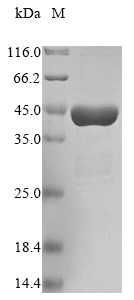
Purity
Greater than 90% as determined by SDS-PAGE.
Alternative Names
CAP1; DJ-1; DJ1; DJ1 protein ; Epididymis secretory sperm binding protein Li 67p; FLJ27376; FLJ34360; FLJ92274; HEL S 67p; Oncogene DJ1; OTTHUMP00000001348; OTTHUMP00000001349; OTTHUMP00000001350; OTTHUMP00000001351; PARK7; PARK7_HUMAN; Parkinson disease (autosomal recessive, early onset) 7; Parkinson disease protein 7; Parkinson protein 7; Protein DJ-1; SP22
Species
Homo sapiens (Human)
Expression Region
1-188aa
Target Protein Sequence
MASKRALVILAKGAEEMETVIPVDVMRRAGIKVTVAGLAGKDPVQCSRDVVICPDASLEDAKKEGPYDVVVLPGGNLGAQNLSESAAVKEILKEQENRKGLIAAICAGPTALLAHEIGFGSKVTTHPLAKDKMMNGGHYTYSENRVEKDGLILTSRGPGTSFEFALAIVEALNGKEVAAQVKAPLVLK
Note: The complete
sequence may include tag sequence, target protein sequence, linker sequence and extra sequence that is
translated with the protein sequence for the purpose(s) of secretion, stability, solubility, etc.
If the exact amino acid sequence of this recombinant protein is critical to your application,
please explicitly request the full and complete sequence of this protein before ordering.
Tag Info
Tag-Free
The tag type will be determined during production process. If you have specified tag type, please tell us and we will develop the specified tag preferentially.
Form
Liquid or Lyophilized powder
Note: We will preferentially ship the format that we have in stock, however, if you have any special requirement for the format, please remark your requirement when placing the order, we will prepare according to your demand.
Buffer
If the delivery form is liquid, the default storage buffer is Tris/PBS-based buffer, 5%-50% glycerol.If the delivery form is lyophilized powder, the buffer before lyophilization is Tris/PBS-based buffer, 6% Trehalose.
Reconstitution
We recommend that this vial be briefly centrifuged prior to opening to bring the contents to the bottom. Please reconstitute protein in deionized sterile water to a concentration of 0.1-1.0 mg/mL.We recommend to add 5-50% of glycerol (final concentration) and aliquot for long-term storage at -20°C/-80°C. Our default final concentration of glycerol is 50%. Customers could use it as reference.
Storage Condition
The shelf life is related to many factors, storage state, buffer ingredients, storage temperature and the stability of the protein itself. Generally, the shelf life of liquid form is 6 months at -20°C/-80°C. The shelf life of lyophilized form is 12 months at -20°C/-80°C.
Shelf Life
The shelf life is related to many factors, storage state, buffer ingredients, storage temperature and the stability of the protein itself.
Generally, the shelf life of liquid form is 6 months at -20°C/-80°C. The shelf life of lyophilized form is 12 months at -20°C/-80°C.
Lead Time
3-7 business days
Note: All of our proteins are default shipped with normal blue ice packs, if you request to ship with dry ice, please communicate with us in advance and extra fees will be charged.
Notes
Repeated freezing and thawing is not recommended. Store working aliquots at 4°C for up to one week.
Datasheet & COA
Please contact us to get it.
Description
Discover the potential of Recombinant Human Parkinson Disease Protein 7 (PARK7) in cancer research with our premium quality product. PARK7, also known as DJ-1, has been implicated in various cellular processes, including oxidative stress response, cell survival, and transcriptional regulation. Its multifaceted role in cancer progression and response to therapies makes it an intriguing target for researchers in the field.
Our Recombinant Human PARK7 protein is expressed in an E.coli system, ensuring a reliable and high-quality source of protein for your research needs. The partial protein sequence (1-188aa) is delivered in a tag-free format, providing an unmodified protein that closely mimics its native form. Boasting a purity greater than 90% as determined by SDS-PAGE, our PARK7 protein ensures consistent and reproducible results across various applications. Available in both liquid and lyophilized powder forms, our Recombinant Human PARK7 protein is tailored to meet the diverse requirements of your cancer research endeavors.