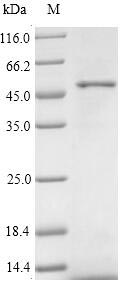
Purity
Greater than 90% as determined by SDS-PAGE.
Alternative Names
Int 1 related protein; Int-1-like protein 1; Int-1-related protein; INT1L 1; INT1L1; IRP; IRP protein; ONCOGENE INT1 LIKE 1; Protein Wnt-2; Secreted growth factor; Wingless type MMTV integration site family member 2; WNT 2; WNT2; WNT2_HUMAN
Species
Homo sapiens (Human)
Expression Region
26-360aa
Target Protein Sequence
SWWYMRATGGSSRVMCDNVPGLVSSQRQLCHRHPDVMRAISQGVAEWTAECQHQFRQHRWNCNTLDRDHSLFGRVLLRSSRESAFVYAISSAGVVFAITRACSQGEVKSCSCDPKKMGSAKDSKGIFDWGGCSDNIDYGIKFARAFVDAKERKGKDARALMNLHNNRAGRKAVKRFLKQECKCHGVSGSCTLRTCWLAMADFRKTGDYLWRKYNGAIQVVMNQDGTGFTVANERFKKPTKNDLVYFENSPDYCIRDREAGSLGTAGRVCNLTSRGMDSCEVMCCGRGYDTSHVTRMTKCGCKFHWCCAVRCQDCLEALDVHTCKAPKNADWTTAT
Note: The complete
sequence may include tag sequence, target protein sequence, linker sequence and extra sequence that is
translated with the protein sequence for the purpose(s) of secretion, stability, solubility, etc.
If the exact amino acid sequence of this recombinant protein is critical to your application,
please explicitly request the full and complete sequence of this protein before ordering.
Protein Length
Full Length of Mature Protein
Tag Info
N-terminal 6xHis-tagged
The tag type will be determined during production process. If you have specified tag type, please tell us and we will develop the specified tag preferentially.
Reconstitution
We recommend that this vial be briefly centrifuged prior to opening to bring the contents to the bottom. Please reconstitute protein in deionized sterile water to a concentration of 0.1-1.0 mg/mL.We recommend to add 5-50% of glycerol (final concentration) and aliquot for long-term storage at -20°C/-80°C. Our default final concentration of glycerol is 50%. Customers could use it as reference.
Storage Condition
The shelf life is related to many factors, storage state, buffer ingredients, storage temperature and the stability of the protein itself.
Generally, the shelf life of liquid form is 6 months at -20°C/-80°C. The shelf life of lyophilized form is 12 months at -20°C/-80°C.
Shelf Life
The shelf life is related to many factors, storage state, buffer ingredients, storage temperature and the stability of the protein itself.
Generally, the shelf life of liquid form is 6 months at -20°C/-80°C. The shelf life of lyophilized form is 12 months at -20°C/-80°C.
Lead Time
Delivery time may differ from different purchasing way or location, please kindly consult your local distributors for specific delivery time.
Note: All of our proteins are default shipped with normal blue ice packs, if you request to ship with dry ice, please communicate with us in advance and extra fees will be charged.
Notes
Repeated freezing and thawing is not recommended. Store working aliquots at 4°C for up to one week.
Datasheet & COA
Please contact us to get it.
Images
-
(Tris-Glycine gel) Discontinuous SDS-PAGE (reduced) with 5% enrichment gel and 15% separation gel.
Description
The first step of making this recombinant Human WNT2 protein is synthesizing the WNT2 gene, the synthesized gene is then cloned into an expression vector which is a cDNA plasmid that includes a promoter sequence and an antibiotic-resistant gene. It also has N-terminal 6xHis tag encoding a fusion tag for downstream protein purification or identification. The antibiotic-resistant gene enables the selection of cells carrying the plasmid in antibiotic-based media and then transfects cells with a DNA vector that contains the template and then culturing the cells so that they transcribe and translate the desired protein. The recombinant WNT2 protein is purified by ion-exchange chromatography or affinity purification. And the purity is 90%+ by SDS-PAGE.
WNT2 is an autocrine growth and differentiation factor specific for hepatic sinusoidal endothelial cells (HSECs), which act synergistically with the VEGF signaling pathway. Studies have shown that targeted disruption of the WNT2 gene causes placental defects. WNT2 has been implicated in the occurrence and progression of multiple human malignancies, including lung, breast, and colorectal cancers. WNT2 expression was found to be upregulated in human colorectal and gastric cancers, while WNT2 short interfering RNA (siRNA) or monoclonal antibodies can suppress tumor growth. WNT2 regulates beta-catenin localization in granulosa cells, and WNT2/-catenin signaling helps modulate granulosa cell proliferation.