Recombinant Human Protein AATF (AATF), partial

Code: CSB-RP052644h
Size:
20ug
20ug100ug1mg(1mg*1 or 500ug*2)
US$224
Quantity:
Express system: E.coli
Species: Homo sapiens (Human)
Tag Info: N-terminal GST-tagged
For inquiries on large quantities or another requirements
Send an Inquiry
Start an on-line Chat
Online ordering is currently available for U.S. customers only. For orders outside the U.S., please kindly submit an inquiry or start a chat with us.

Product Details

Purity
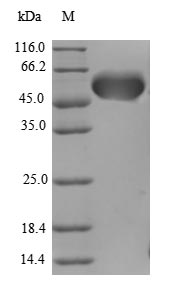
Greater than 90% as determined by SDS-PAGE.
Target Names
AATF
Uniprot NO.
Research Area
Epigenetics and Nuclear Signaling
Alternative Names
Apoptosis-antagonizing transcription factorRb-binding protein Che-1
Species
Homo sapiens (Human)
Source
E.coli
Expression Region
6-294aa
Target Protein Sequence
PLALQLEQLLNPRPSEADPEADPEEATAARVIDRFDEGEDGEGDFLVVGSIRKLASASLLDTDKRYCGKTTSRKAWNEDHWEQTLPGSSDEEISDEEGSGDEDSEGLGLEEYDEDDLGAAEEQECGDHRESKKSRSHSAKTPGFSVQSISDFEKFTKGMDDLGSSEEEEDEESGMEEGDDAEDSQGESEEDRAGDRNSEDDGVVMTFSSVKVSEEVEKGRAVKNQIALWDQLLEGRIKLQKALLTTNQLPQPDVFPLFKDKGGPEFSSALKNSHKALKALLRSLVGLQE
Note: The complete sequence may include tag sequence, target protein sequence, linker sequence and extra sequence that is translated with the protein sequence for the purpose(s) of secretion, stability, solubility, etc.
If the exact amino acid sequence of this recombinant protein is critical to your application, please explicitly request the full and complete sequence of this protein before ordering.
Mol. Weight
58.8kDa
Protein Length
Partial
Tag Info
N-terminal GST-tagged
The tag type will be determined during production process. If you have specified tag type, please tell us and we will develop the specified tag preferentially.
Reconstitution
We recommend that this vial be briefly centrifuged prior to opening to bring the contents to the bottom. Please reconstitute protein in deionized sterile water to a concentration of 0.1-1.0 mg/mL.We recommend to add 5-50% of glycerol (final concentration) and aliquot for long-term storage at -20°C/-80°C. Our default final concentration of glycerol is 50%. Customers could use it as reference.
Storage
The shelf life is related to many factors, storage state, buffer ingredients, storage temperature and the stability of the protein itself. Generally, the shelf life of liquid form is 6 months at -20°C/-80°C. The shelf life of lyophilized form is 12 months at -20°C/-80°C.
Shelf Life
The shelf life is related to many factors, storage state, buffer ingredients, storage temperature and the stability of the protein itself.
Generally, the shelf life of liquid form is 6 months at -20°C/-80°C. The shelf life of lyophilized form is 12 months at -20°C/-80°C.
Lead Time
Delivery time may differ from different purchasing way or location, please kindly consult your local distributors for specific delivery time.
Note: All of our proteins are default shipped with normal blue ice packs, if you request to ship with dry ice, please communicate with us in advance and extra fees will be charged.
Notes
Repeated freezing and thawing is not recommended. Store working aliquots at 4°C for up to one week.
Troubleshooting and FAQs
Datasheet & COA
Please contact us to get it.
Images
  • (Tris-Glycine gel) Discontinuous SDS-PAGE (reduced) with 5% enrichment gel and 15% separation gel.

Customer Reviews and Q&A

 Customer Reviews

Target Background

Function(From Uniprot)
May function as a general inhibitor of the histone deacetylase HDAC1. Binding to the pocket region of RB1 may displace HDAC1 from RB1/E2F complexes, leading to activation of E2F target genes and cell cycle progression. Conversely, displacement of HDAC1 from SP1 bound to the CDKN1A promoter leads to increased expression of this CDK inhibitor and blocks cell cycle progression. Also antagonizes PAWR mediated induction of aberrant amyloid peptide production in Alzheimer disease (presenile and senile dementia), although the molecular basis for this phenomenon has not been described to date.
Gene References into Functions
  1. Results show that Che-1 protects colon cancer cells from apoptosis induced by hypoxia through its ability to regulate HIF1-alpha stabilization in colorectal cancer cells. PMID:28214471
  2. Results show that eEF1Bgamma binds to the Che-1 promoter region and its transcript, and describe a novel mitochondrial localization for the Che-1 protein which needs mitochondrial integrity for correct localization. PMID:27639846
  3. we identified the ANN complex as a novel functional module supporting the nucleolar maturation of 40S ribosomal subunits. Our data help to explain the described role of AATF in cell proliferation during mouse development as well as its requirement for malignant tumor growth. PMID:27599843
  4. the effect of APOBEC3G over-expression upon AATF gene expression, was examined. PMID:27611213
  5. loss of Che-1 inhibits proliferation and promotes apoptosis in MG-63 cells by decreasing the level of mutant p53 PMID:27012205
  6. It was concluded that PARP-1 was involved in the DNA damage repair induced by HQ via increasing the accumulation of apoptosis antagonizing transcription factor through PARylation. PMID:26822515
  7. These results confirm Che-1 as an important regulator of p53 activity and suggest Che-1 to be a promising yet attractive drug target for cancer therapy. PMID:25996291
  8. In the face of high glucose threat, mitochondrial UCP2 gene expression is regulated by miR-2909 and AATF. PMID:25976474
  9. This mutant AATF along with its interactome consisting of SP1, DNMT3B and Par-4 ensures cancer cell DNA methylation required for down-regulation of tumor suppressor genes. PMID:25231211
  10. HIPK2 depletion strongly decreases Che-1 ubiquitylation and degradation. PMID:25210797
  11. Che-1 expression correlates with the progression of multiple myeloma and is required for cell growth and survival.Che-1 controls mTOR through the induction of Redd1 and Deptor, two important repressors of mTOR. PMID:25770584
  12. Cell proliferation decreased by 41% which was accompanied by apoptosis induction in 30% MCF-7 cells after AATF gene knockdown. PMID:23801113
  13. Che-1 depletion abolishes the ability of Chk1 to bind pericentrin and to localize at centrosomes, which, in its turn, deregulates the activation of centrosomal cyclin B-Cdk1 and advances entry into mitosis. PMID:23798705
  14. These results identify AATF as a nucleolar-confined c-Jun cofactor whose expression levels and spatial distribution determine the stress-induced activity of c-Jun and the levels of c-Jun-mediated apoptosis. PMID:22933572
  15. Nuclear AATF enrichment is selected for in p53-proficient endometrial cancers. Focal copy number AATF gains correlate with reduced overall survival in neuroblastoma. AATF is a critical repressor of p53-driven apoptosis. PMID:22909821
  16. found that Che-1 is required for sustaining mutant p53 expression in several cancer cell lines, and that Che-1 depletion by siRNA induces apoptosis both in vitro and in vivo PMID:20708154
  17. No evidence for the association of mutations with breast cancer was observed. PMID:20025740
  18. Che-1 affects cell growth by interfering with the recruitment of HDAC1 by retinoblastoma protein. Che-1 overexpression activates DNA synthesis in quiescent NIH-3T3 cells through HFDAC1 displacement. PMID:12450794
  19. Che-1 can be considered a general HDAC1 competitor and its down-regulation is involved in colon carcinoma cell proliferation PMID:12847090
  20. apoptosis-antagonizing transcription factor binds to TSG101 in a process that enhances androgen receptor-mediated transcription by promoting its monoubiquitination PMID:14761944
  21. AATF gene may be of crucial importance in maintaining the leukemic state of a cell compartment through its ability to initiate cell proliferation coupled with repression of cellular apoptosis. PMID:17006618
  22. Che-1 as a new Pin1 and HDM2 target and confirm its important role in the cellular response to DNA damage. PMID:17468107
  23. Che-1 interacts with NRAGE and NRAGE overexpression downregulates endogenous Che-1 by targeting it for proteasome-dependent degradation. PMID:17488777
  24. This review explains the novel miRNA encoded exclusively by HIV-1 genome that has the ability to specifically target cellular AATF gene known to play a crucial role in the maintenance of adaptive immunity at nucleic acid level against HIV-1 invasion. PMID:18341201

Show More

Hide All

Subcellular Location
Nucleus, nucleolus.
Protein Families
AATF family
Tissue Specificity
Ubiquitously expressed. Expressed at high levels in brain, heart, kidney, placenta and thymus.
Database Links

HGNC: 19235

UNIGENE: Hs.195740

KEGG: hsa:26574

STRING: 9606.ENSP00000225402

OMIM: 608463

icon of phone
Call us
301-363-4651 (Available 9 a.m. to 5 p.m. CST from Monday to Friday)
icon of address
Address
No. 269, Shendun 5th Road, Donghu Hi-Tech Development Area, Hubei Province, 430206, P.R.China
icon of social media
Join us with

Subscribe newsletter

Leave a message

* To protect against spam, please pass the CAPTCHA test below.
CAPTCHA verification
© 2007-2025 CUSABIO TECHNOLOGY LLC All rights reserved. 鄂ICP备15011166号-1
Select 0 Products