Recombinant Human Poly [ADP-ribose] polymerase tankyrase-2 (TNKS2), partial

Code: CSB-EP867136HUa0
Size:
20ug
20ug100ug1mg
US$306
Quantity:
Express system: E.coli
Species: Homo sapiens (Human)
Tag Info: N-terminal 6xHis-tagged
For inquiries on large quantities or another requirements
Send an Inquiry
Start an on-line Chat
Online ordering is currently available for U.S. customers only. For orders outside the U.S., please kindly submit an inquiry or start a chat with us.

Product Details

Purity
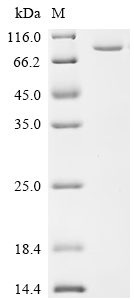
Greater than 95% as determined by SDS-PAGE.
Target Names
TNKS2
Uniprot NO.
Research Area
Epigenetics and Nuclear Signaling
Species
Homo sapiens (Human)
Source
E.coli
Expression Region
57-776aa
Target Protein Sequence
RKSTPLHFAAGFGRKDVVEYLLQNGANVQARDDGGLIPLHNACSFGHAEVVNLLLRHGADPNARDNWNYTPLHEAAIKGKIDVCIVLLQHGAEPTIRNTDGRTALDLADPSAKAVLTGEYKKDELLESARSGNEEKMMALLTPLNVNCHASDGRKSTPLHLAAGYNRVKIVQLLLQHGADVHAKDKGDLVPLHNACSYGHYEVTELLVKHGACVNAMDLWQFTPLHEAASKNRVEVCSLLLSYGADPTLLNCHNKSAIDLAPTPQLKERLAYEFKGHSLLQAAREADVTRIKKHLSLEMVNFKHPQTHETALHCAAASPYPKRKQICELLLRKGANINEKTKEFLTPLHVASEKAHNDVVEVVVKHEAKVNALDNLGQTSLHRAAYCGHLQTCRLLLSYGCDPNIISLQGFTALQMGNENVQQLLQEGISLGNSEADRQLLEAAKAGDVETVKKLCTVQSVNCRDIEGRQSTPLHFAAGYNRVSVVEYLLQHGADVHAKDKGGLVPLHNACSYGHYEVAELLVKHGAVVNVADLWKFTPLHEAAAKGKYEICKLLLQHGADPTKKNRDGNTPLDLVKDGDTDIQDLLRGDAALLDAAKKGCLARVKKLSSPDNVNCRDTQGRHSTPLHLAAGYNNLEVAEYLLQHGADVNAQDKGGLIPLHNAASYGHVDVAALLIKYNACVNATDKWAFTPLHEAAQKGRTQLCALLLAHGADPTLKNQ
Note: The complete sequence may include tag sequence, target protein sequence, linker sequence and extra sequence that is translated with the protein sequence for the purpose(s) of secretion, stability, solubility, etc.
If the exact amino acid sequence of this recombinant protein is critical to your application, please explicitly request the full and complete sequence of this protein before ordering.
Mol. Weight
82.6 kDa
Protein Length
Partial
Tag Info
N-terminal 6xHis-tagged
The tag type will be determined during production process. If you have specified tag type, please tell us and we will develop the specified tag preferentially.
Form
Liquid or Lyophilized powder
Note: We will preferentially ship the format that we have in stock, however, if you have any special requirement for the format, please remark your requirement when placing the order, we will prepare according to your demand.
Buffer
If the delivery form is liquid, the default storage buffer is Tris/PBS-based buffer, 5%-50% glycerol. If the delivery form is lyophilized powder, the buffer before lyophilization is Tris/PBS-based buffer, 6% Trehalose.
Reconstitution
We recommend that this vial be briefly centrifuged prior to opening to bring the contents to the bottom. Please reconstitute protein in deionized sterile water to a concentration of 0.1-1.0 mg/mL.We recommend to add 5-50% of glycerol (final concentration) and aliquot for long-term storage at -20℃/-80℃. Our default final concentration of glycerol is 50%. Customers could use it as reference.
Storage
The shelf life is related to many factors, storage state, buffer ingredients, storage temperature and the stability of the protein itself. Generally, the shelf life of liquid form is 6 months at -20°C/-80°C. The shelf life of lyophilized form is 12 months at -20°C/-80°C.
Shelf Life
The shelf life is related to many factors, storage state, buffer ingredients, storage temperature and the stability of the protein itself.
Generally, the shelf life of liquid form is 6 months at -20°C/-80°C. The shelf life of lyophilized form is 12 months at -20°C/-80°C.
Lead Time
Delivery time may differ from different purchasing way or location, please kindly consult your local distributors for specific delivery time.
Note: All of our proteins are default shipped with normal blue ice packs, if you request to ship with dry ice, please communicate with us in advance and extra fees will be charged.
Troubleshooting and FAQs
Datasheet & COA
Please contact us to get it.
Images
  • (Tris-Glycine gel) Discontinuous SDS-PAGE (reduced) with 5% enrichment gel and 15% separation gel.

Customer Reviews and Q&A

 Customer Reviews

Target Background

Function(From Uniprot)
Poly-ADP-ribosyltransferase involved in various processes such as Wnt signaling pathway, telomere length and vesicle trafficking. Acts as an activator of the Wnt signaling pathway by mediating poly-ADP-ribosylation of AXIN1 and AXIN2, 2 key components of the beta-catenin destruction complex: poly-ADP-ribosylated target proteins are recognized by RNF146, which mediates their ubiquitination and subsequent degradation. Also mediates poly-ADP-ribosylation of BLZF1 and CASC3, followed by recruitment of RNF146 and subsequent ubiquitination. Mediates poly-ADP-ribosylation of TERF1, thereby contributing to the regulation of telomere length. Stimulates 26S proteasome activity.
Gene References into Functions
  1. CTIF was identified as a novel PARylation target of the TNKS2 in the centrosomal region of cells, which plays a role in the distribution of the centrosomal satellites. PMID:29789535
  2. Either tankyrase 1 or 2 is sufficient to maintain telomere length, but both are required to resolve telomere cohesion and maintain mitotic spindle integrity. Tankyrases are required for Notch2 to exit the plasma membrane and enter the nucleus to activate transcription. PMID:29263426
  3. Finally, through functional validation, we uncovered a role for TNKS/2 in peroxisome homeostasis and determined that this function is independent of TNKS enzyme activities. PMID:28723574
  4. Polymerization is required for Tankyrase to drive beta-catenin-dependent transcription. The polymeric state supports PARP activity and allows Tankyrase to effectively access destruction complexes through enabling avidity-dependent AXIN binding. PMID:27494558
  5. These structural insights will be invaluable for the functional and biophysical characterization of TNKS1/2, including the role of TNKS oligomerization in protein poly(ADP-ribosyl)ation (PARylation) and PARylation-dependent ubiquitylation. PMID:27328430
  6. High TNKS2 expression is associated with breast cancer. PMID:27485113
  7. The tumor suppressive activity of miR-490-3p is largely mediated through downregulation of TNKS2 and inactivation of beta-catenin signaling. Thus, miR-490-3p may represent a potential therapeutic target for triple-negative breast cancer. PMID:27506313
  8. Data show that E7449 represents a dual Poly(ADP-ribose) Polymerase 1/2 and tankyrase 1/2 inhibitor which has the advantage of targeting Wnt/beta-catenin signaling addicted tumors. PMID:26513298
  9. rs1340420 SNP was associated with lower NSCLC risk, whereas rs1770474 SNP was associated with higher squamous-cell carcinoma risk PMID:26293798
  10. Tankyrase inhibition is a potential therapeutic approach for treating a subgroup HCC with aberrant WNT/beta-catenin signaling pathway. PMID:26246473
  11. TNKS2 is recruited to DNA lesions by MDC1 and promotes homologous recombination in response to DNA double strand breaks. PMID:26845027
  12. The variability of genes encoding for TERF1 and TNKS2 is important for keeping the integrity of the telomere structure and show a significant association with longevity. PMID:25631672
  13. Studies show a significant interaction of IWR1 with acidic and polar residues (Asp and Tyr) in the hydrophobic region at the induced pocket of TNKS1/TNKS2. These two residues are the key for the mechanism of inhibition of TNKS proteins. PMID:24291818
  14. Data indicate a basis for development of flavones as tankyrase inhibitors and suggest the development of other structurally related inhibitors. PMID:24116873
  15. Data suggest that miR-20a can promote migration and invasion of cervical cancer cells through the upregulation of TNKS2. PMID:22449978
  16. Study reports crystal structures of a representative ankyrin repeat clusters of TNKS2 bound to targeting peptides from six substrates. PMID:22153077
  17. RNF146 RING-type ubiquitin E3 ligase as a positive regulator of Wnt signaling that operates with tankyrase to maintain low steady-state levels of Axin proteins PMID:21799911
  18. TNKS2 bound to Epstein-Barr virus origin of plasmid replication in coimmunoprecipitation experiments with transfected cell lysates. PMID:15795250
  19. pathologic overexpression of tankyrase 2 in some tumors may be a result of the cancer-related adaptation of the malignant cells dependent on tankyrase activity. PMID:16151859
  20. TNKL and TNKS are aberrantly expressed in colon tumors and contain multiple epitopes that induce humoral and cellular immune responses in cancer patients PMID:18026951
  21. pH dependence and kinetic study of the enzyme activity of tankyrase 2. PMID:18393764

Show More

Hide All

Subcellular Location
Cytoplasm. Golgi apparatus membrane; Peripheral membrane protein. Nucleus. Chromosome, telomere. Note=Associated with the Golgi and with juxtanuclear SLC2A4/GLUT4-vesicles. Also found around the pericentriolar matrix of mitotic centromeres. During interphase, a small fraction of TNKS2 is found in the nucleus, associated with TRF1.
Tissue Specificity
Highly expressed in placenta, skeletal muscle, liver, brain, kidney, heart, thymus, spinal cord, lung, peripheral blood leukocytes, pancreas, lymph nodes, spleen, prostate, testis, ovary, small intestine, colon, mammary gland, breast and breast carcinoma,
Database Links

HGNC: 15677

UNIGENE: Hs.329327

KEGG: hsa:80351

STRING: 9606.ENSP00000360689

OMIM: 607128

icon of phone
Call us
301-363-4651 (Available 9 a.m. to 5 p.m. CST from Monday to Friday)
icon of address
Address
No. 269, Shendun 5th Road, Donghu Hi-Tech Development Area, Hubei Province, 430206, P.R.China
icon of social media
Join us with

Subscribe newsletter

Leave a message

* To protect against spam, please pass the CAPTCHA test below.
CAPTCHA verification
© 2007-2025 CUSABIO TECHNOLOGY LLC All rights reserved. 鄂ICP备15011166号-1
Select 0 Products