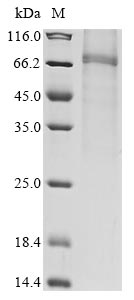
Purity
Greater than 85% as determined by SDS-PAGE.
Research Area
Signal Transduction
Species
Homo sapiens (Human)
Expression Region
23-351aa
Target Protein Sequence
SNWLYLAKLSSVGSISEEETCEKLKGLIQRQVQMCKRNLEVMDSVRRGAQLAIEECQYQFRNRRWNCSTLDSLPVFGKVVTQGTREAAFVYAISSAGVAFAVTRACSSGELEKCGCDRTVHGVSPQGFQWSGCSDNIAYGVAFSQSFVDVRERSKGASSSRALMNLHNNEAGRKAILTHMRVECKCHGVSGSCEVKTCWRAVPPFRQVGHALKEKFDGATEVEPRRVGSSRALVPRNAQFKPHTDEDLVYLEPSPDFCEQDMRSGVLGTRGRTCNKTSKAIDGCELLCCGRGFHTAQVELAERCSCKFHWCCFVKCRQCQRLVELHTCR
Note: The complete
sequence may include tag sequence, target protein sequence, linker sequence and extra sequence that is
translated with the protein sequence for the purpose(s) of secretion, stability, solubility, etc.
If the exact amino acid sequence of this recombinant protein is critical to your application,
please explicitly request the full and complete sequence of this protein before ordering.
Protein Length
Full Length of Mature Protein
Tag Info
C-terminal hFc-tagged
The tag type will be determined during production process. If you have specified tag type, please tell us and we will develop the specified tag preferentially.
Form
Liquid or Lyophilized powder
Note: We will preferentially ship the format that we have in stock, however, if you have any special requirement for the format, please remark your requirement when placing the order, we will prepare according to your demand.
Buffer
If the delivery form is liquid, the default storage buffer is Tris/PBS-based buffer, 5%-50% glycerol.If the delivery form is lyophilized powder, the buffer before lyophilization is Tris/PBS-based buffer, 6% Trehalose.
Reconstitution
We recommend that this vial be briefly centrifuged prior to opening to bring the contents to the bottom. Please reconstitute protein in deionized sterile water to a concentration of 0.1-1.0 mg/mL.We recommend to add 5-50% of glycerol (final concentration) and aliquot for long-term storage at -20°C/-80°C. Our default final concentration of glycerol is 50%. Customers could use it as reference.
Storage Condition
The shelf life is related to many factors, storage state, buffer ingredients, storage temperature and the stability of the protein itself. Generally, the shelf life of liquid form is 6 months at -20°C/-80°C. The shelf life of lyophilized form is 12 months at -20°C/-80°C.
Shelf Life
The shelf life is related to many factors, storage state, buffer ingredients, storage temperature and the stability of the protein itself.
Generally, the shelf life of liquid form is 6 months at -20°C/-80°C. The shelf life of lyophilized form is 12 months at -20°C/-80°C.
Lead Time
3-7 business days
Note: All of our proteins are default shipped with normal blue ice packs, if you request to ship with dry ice, please communicate with us in advance and extra fees will be charged.
Notes
Repeated freezing and thawing is not recommended. Store working aliquots at 4°C for up to one week.
Datasheet & COA
Please contact us to get it.
Description
To make this Recombinant Human WNT4 protein, the WNT4 gene was isolated at first and cloned into an expression vector. CUSABIO has built a mature recombinant protein platform. This Recombinant Human WNT4 protein was developed in the platform. It was expressed in Mammalian cell at the region of 23-351aa of the Human WNT4 protein. C-terminal hFc tag was fused with the expression vector for affinity and purification purposes. The purity is 85%+ determined by SDS-PAGE.
WNT4 is one of the most extensively studied prototypical ligands of the Wnt family and is known to play a key role in the developmental process, such as wound healing, acute kidney injury, and angiogenesis. Previous studies have demonstrated that angiogenesis could be enhanced by the WNT4/β-catenin pathway in Human umbilical cord mesenchymal stem cells. As a member of Wnt family, WNT4 may play a role in CRC through the β-catenindependent pathway. Therefore, it would be interesting to elucidate whether WNT4 can promote the progression of CRC via promoting epithelial-tomesenchymal transition of CRC cells, activating CAFs and enhancing angiogenesis through the β-catenin-dependent pathway. Despite these observed critical roles of WNT4 in both normal and malignant tissues, WNT4 signaling is crudely understood due to varied context-dependent functions. WNT4 has been shown to regulate either β-catenin-dependent or β-cateninindependent signaling and can either activate or suppress signaling. As such, WNT4 has been described as a “problem child” among WNT proteins. So, one of the goals of WNT4 study is to clarify the signaling pathway of WNT4. In addition, recent reports suggest that the abnormality of WNT4 signaling is involved in various cancers and ovary, kidney, bone, and metabolic disorders.