GQFRVIGPRHPIRALVGDEVELPCRISPGKNATGMEVGWYRPPFSRVVHLYRNGKDQDGDQAPEYRGRTELLKDAIGEGKVTLRIRNVRFSDEGGFTCFFRDHSYQEEAAMELKVEDPFYWVSPG
Note: The complete
sequence may include tag sequence, target protein sequence, linker sequence and extra sequence that is
translated with the protein sequence for the purpose(s) of secretion, stability, solubility, etc.
If the exact amino acid sequence of this recombinant protein is critical to your application,
please explicitly request the full and complete sequence of this protein before ordering.
Mol. Weight
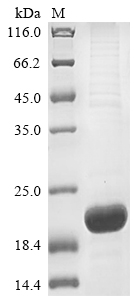
17.9 kDa
Protein Length
Partial
Tag Info
N-terminal 10xHis-tagged
The tag type will be determined during production process. If you have specified tag type, please tell us and we will develop the specified tag preferentially.
Buffer
Tris-based buffer,50% glycerol
Storage
The shelf life is related to many factors, storage state, buffer ingredients, storage temperature and the stability of the protein itself. Generally, the shelf life of liquid form is 6 months at -20°C/-80°C. The shelf life of lyophilized form is 12 months at -20°C/-80°C.
Shelf Life
The shelf life is related to many factors, storage state, buffer ingredients, storage temperature and the stability of the protein itself.
Generally, the shelf life of liquid form is 6 months at -20°C/-80°C. The shelf life of lyophilized form is 12 months at -20°C/-80°C.
Notes
Repeated freezing and thawing is not recommended. Store working aliquots at 4°C for up to one week.
Mediates homophilic cell-cell adhesion. Minor component of the myelin sheath. May be involved in completion and/or maintenance of the myelin sheath and in cell-cell communication.; (Microbial infection) Acts as a receptor for rubella virus.
Gene References into Functions
Anti-MOG positive patients may have manifestations that mimic neuromyelitis optica spectrum disorders but differ in their course and prognosis from anti-AQP4 positive NMOSD.PMID:26498263
Molecular Dynamics (MD) simulations were used to explore the interactions of MOG35-55 at the receptor level.PMID:27388119
Adoptive transfer of serum from anti-MOG Ab mice or of purified anti-MOG Ab 8.18C5 into naive 2D2 recipients triggered activation and expansion of T cells followed by severe and robust experimental autoimmune encephalomyelitis, suggesting that the mechanism of anti-MOG Ab-mediated opsonization of auto-antigen may indeed contribute to initiation and propagation of CNS demyelinating disease.PMID:27022743
Retinal nerve fiber layer may be better preserved in MOG-IgG versus AQP4-IgG optic neuritis.PMID:28125740
Data show that aquaporin-4 (AQP4) and myelin-oligodendrocyte glycoprotein (MOG) autoantibodies double positive neuromyelitis optica spectrum disorder (NMOSD) patients had a multiphase disease course with a high annual relapse rate.PMID:26920678
MOG antibody associated optic neuritis tends to involve the anterior optic pathway.PMID:26163068
This study demonstrated that increased expression of mRNA of OLIG1 in ventral prefrontal white matter in major depressive disorder.PMID:25930075
In patients with idiopathic optic neuritis, 27.6% (8/29) were positive for MOG antibodies. Three of the eight MOG-positive patients showed significantly high CSF levels of myelin basic protein. Five had optic pain and three had prodromal infection.PMID:25838512
Immune modulation by a tolerogenic myelin oligodendrocyte glycoprotein (MOG)10-60 containing fusion protein in the marmoset experimental autoimmune encephalomyelitis model.PMID:25393803
These data demonstrate a new role for myelin glycosylation in the control of immune homeostasis in the healthy human brain through the MOG-DC-SIGN homeostatic regulatory axis, which is comprised by inflammatory insults that affect glycosylation.PMID:24935259
findings suggest that immune reactions toward MOG and in particular MOG-specific antibodies may play a functional role in multiple sclerosisPMID:22494461
Patients with neuromyelitis optica spectrum disorders with MOG antibodies have distinct clinical features, fewer attacks, and better recovery than patients with AQP4 antibodies or patients seronegative for both antibodies.PMID:24415568
Bipolar I disorder and schizophrenia share a number of common genetic risk loci and susceptibility genes including the genes coding for myelin oligodendrocytes glycoprotein (MOG).PMID:23032943
We could show for the first time that a subset of aquaporin 4-IgG seronegative patients with neuromyelitis optica exhibit a MOG-IgG mediated immune responsePMID:22204662
This study provides valuable information about requirements of anti-myelin oligodendrocyte glycoprotein reactivity for being regarded as a prognostic biomarker in a subtype of MS.PMID:22093619
The authors found that the human myelin oligodendrocyte glycoprotein (MOG) specifically bound to the E1 envelope glycoprotein of rubella virus, and an antibody against MOG could block rubella virus infection.PMID:21880773
A missense mutation in myelin oligodendrocyte glycoprotein as a cause of familial narcolepsy with cataplexy.PMID:21907016
The persistence or disappearance of antibodies to MOG may have prognostic relevance for acute childhood demyelinationPMID:21795651
Conformational structure of the MOG-derived peptide 101-108 in solution.PMID:20549678
A mutated MOG peptide [MOG97-109] enables detection of MOG97-109-reactive T cells in multiple sclerosis patients bearing the HLA-DRB1*0401 allele.PMID:21653833
Report provides evidence that the humoral immune response against MOG in children is specific for demyelinating inflammatory CNS disorders.PMID:21177754
Persistence of MOG antibodies despite viral clearance in a high percentage of HIV-1 associated neurocognitive disorder (HAND) patients suggests ongoing neuroinflammation, possibly preventing recovery from HAND.PMID:21083890
cell surface-expressed native myelin oligodendrocyte glycoprotein nor linear epitopes have a predictive or discriminative role during the preclinical disease phase for developing clinically isolated syndrome or multiple sclerosis later in lifePMID:20685767
The results of this study have observed that changes in splicing, but not expression levels, are associated with common genetic variation in the MOG genePMID:20800907
Our study provides first evidence that the MOG G511C (Val142Leu) polymorphism might be associated with structural changes in the total white matter volumes of OCD patients.PMID:20452030
identification of T cell epitopes that are encephalitogenic and presented by B cellsPMID:11739534
The B cell and T cell epitopes have been identified in rat MOG-immunized marmosets, and these sequences are observed to map primarily onto accessible regions in the model, which may explain their ability to generate potent antibody responses.PMID:11895369
A T cell reactivity pattern analysis of multiple sclerosis patients at the onset of relapse or progression shows that there is a highly immunogenic epitope for CD4+ T cells within the transmembrane/intracellular part of MOG comprising amino acids 146-154.PMID:12077287
MOG-specific antibody is critical to the initiation of MOG-induced murine experimental autoimmune encephalomyelitisPMID:12115610
polymorphisms do not provide evidence to support a significant role for MOG in multiple sclerosis susceptibility.PMID:12149493
a substantial proportion of MOG-reactive T cells from some subjects have been activated in vivo without resulting in clinical diseasePMID:12482392
Human MOG is immunogenic and induces experimental autoimmune encephalomyelitis in C57BL/6 mice via an encephalitogenic B cell response to epitopes on human MOG protein that most likely cross-react with mouse determinants.PMID:12817031
Demonstration of molecular mimicry between MOG and butyrophilin suggests that exposure to this common dietary antigen may influence the composition and function of the MOG-specific autoimmune repertoire during the course of multiple sclerosis.PMID:14688379
No significant evidence for biased transmission of alleles at the (CA)n (chi2=2.430, 6 df, P=0.876) (TAAA)n (chi2=3.550, 5 df, P=0.616), C1334T (chi2=0.040, 1 df, P=0.841) and C10991T (chi2=0.154,polymorphisms in patients with schizophrenia was seen.PMID:15660663
In human brain the splice variants of MOG appear at a late stage compared to the major isoform, coincidental with myelination and myelin maturation, unlike other myelin proteins.PMID:16903876
pathogenic antibody response to native MOG in a subgroup of multiple sclerosis patientsPMID:17142321
This study represents the first evidence of alternative translation products from the MOG gene. To date, it is believed that alternative splicing of MOG is limited to primates.PMID:17402967
results indicate that variation within the MOG gene is not an important independent determinant of multiple sclerosis -inherited risk in the Sardinian populationPMID:17509152
Our findings highlight myelin oligodendrocyte glycoprotein splicing as a factor that could be critical to the phenotypic expression of multiple sclerosis.PMID:17573820
The associations observed in Japanese and French patients, the linkage studies and the present work speak in favor of the existence of a susceptibility gene for autism in the NF1 locus.PMID:17897745
A sequence variation in the MOG gene is involved in multiple sclerosis susceptibility in Italy.PMID:17928868
although individuals with anti-myelin oligodendrocyte glycoprotein (MOG) antibodies have an increased risk of developing multiple sclerosis, this association may at least in part reflect cross-reactivity between MOG and Epstein-Barr nuclear antigenPMID:18753473
genetic polymorphism is associated with autism in Sardinian childrenPMID:19167444
B cell autoimmunity to this MOG is therefore most common in patients with a very early onset of MSPMID:19687098
Show
More
Hide
All
Subcellular Location
[Isoform 1]: Cell membrane; Multi-pass membrane protein.; [Isoform 5]: Cell membrane; Multi-pass membrane protein.; [Isoform 2]: Cell membrane; Single-pass type I membrane protein.; [Isoform 3]: Cell membrane; Single-pass type I membrane protein.; [Isoform 4]: Cell membrane; Single-pass type I membrane protein.; [Isoform 6]: Cell membrane; Single-pass type I membrane protein.; [Isoform 7]: Cell membrane; Single-pass type I membrane protein.; [Isoform 8]: Cell membrane; Single-pass type I membrane protein.; [Isoform 9]: Cell membrane; Single-pass type I membrane protein.
Protein Families
Immunoglobulin superfamily, BTN/MOG family
Tissue Specificity
Found exclusively in the CNS, where it is localized on the surface of myelin and oligodendrocyte cytoplasmic membranes.