Recombinant Human L-dopachrome tautomerase (DCT),Partial

In Stock
Code: CSB-EP006562HU
Size:
20ug
20ug100ug1mg(1mg*1 or 500ug*2)
US$224
Quantity:
Express system: E.coli
Species: Homo sapiens (Human)
Tag Info: N-terminal 10xHis-SUMO-tagged and C-terminal Myc-tagged
For inquiries on large quantities or another requirements
Send an Inquiry
Start an on-line Chat
Online ordering is currently available for U.S. customers only. For orders outside the U.S., please kindly submit an inquiry or start a chat with us.

Product Details

Purity
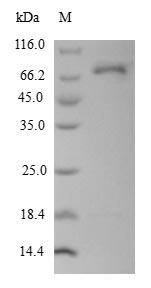
Greater than 90% as determined by SDS-PAGE.
Target Names
DCT
Uniprot NO.
Research Area
others
Species
Homo sapiens (Human)
Source
E.coli
Expression Region
24-472aa
Target Protein Sequence
QFPRVCMTVDSLVNKECCPRLGAESANVCGSQQGRGQCTEVRADTRPWSGPYILRNQDDRELWPRKFFHRTCKCTGNFAGYNCGDCKFGWTGPNCERKKPPVIRQNIHSLSPQEREQFLGALDLAKKRVHPDYVITTQHWLGLLGPNGTQPQFANCSVYDFFVWLHYYSVRDTLLGPGRPYRAIDFSHQGPAFVTWHRYHLLCLERDLQRLIGNESFALPYWNFATGRNECDVCTDQLFGAARPDDPTLISRNSRFSSWETVCDSLDDYNHLVTLCNGTYEGLLRRNQMGRNSMKLPTLKDIRDCLSLQKFDNPPFFQNSTFSFRNALEGFDKADGTLDSQVMSLHNLVHSFLNGTNALPHSAANDPIFVVLHSFTDAIFDEWMKRFNPPADAWPQELAPIGHNRMYNMVPFFPPVTNEELFLTSDQLGYSYAIDLPVSVEETPGWPTT
Note: The complete sequence may include tag sequence, target protein sequence, linker sequence and extra sequence that is translated with the protein sequence for the purpose(s) of secretion, stability, solubility, etc.
If the exact amino acid sequence of this recombinant protein is critical to your application, please explicitly request the full and complete sequence of this protein before ordering.
Mol. Weight
71.3 kDa
Protein Length
Topological Domain
Tag Info
N-terminal 10xHis-SUMO-tagged and C-terminal Myc-tagged
The tag type will be determined during production process. If you have specified tag type, please tell us and we will develop the specified tag preferentially.
Buffer
Tris-based buffer,50% glycerol
Storage
The shelf life is related to many factors, storage state, buffer ingredients, storage temperature and the stability of the protein itself. Generally, the shelf life of liquid form is 6 months at -20°C/-80°C. The shelf life of lyophilized form is 12 months at -20°C/-80°C.
Shelf Life
The shelf life is related to many factors, storage state, buffer ingredients, storage temperature and the stability of the protein itself.
Generally, the shelf life of liquid form is 6 months at -20°C/-80°C. The shelf life of lyophilized form is 12 months at -20°C/-80°C.
Lead Time
3-7 business days
Note: All of our proteins are default shipped with normal blue ice packs, if you request to ship with dry ice, please communicate with us in advance and extra fees will be charged.
Notes
Repeated freezing and thawing is not recommended. Store working aliquots at 4°C for up to one week.
Troubleshooting and FAQs
Datasheet & COA
Please contact us to get it.
Images
  • (Tris-Glycine gel) Discontinuous SDS-PAGE (reduced) with 5% enrichment gel and 15% separation gel.
Description

E.coli-expressed L-dopachrome tautomerase (DCT) CSB-EP006562HU is a recombinant fusion protein of partial DCT coupled to a 10xHis-SUMO-tag at the N-terminus and a Myc-tag at the C-terminus. This protein consists of the topological domain (23-108aa) of human DCT and has a calculated molecular weight of 71.3 kDa. The SDS-PAGE showed an about 80 kDa molecular mass of this protein and determined the purity of over 90%. In-stock DCT proteins are offered now. In addition to producing specific antibodies, this recombinant DCT protein may be used in the studies of melanogenesis.

L-DCT or TRP-2 is an important regulatory enzyme involved in melanin synthesis. It also executes proliferative, immunogenic, and anti-apoptotic roles in melanoma cells. L-DCT/TRP-2 is also a marker for amelanotic and melanotic melanoma. Studies showed that A3B5 (N-(3,5-dimethylphenyl)-3-methoxybenzamide) effectively inhibited melanin production by the degradation of TRP-2.

Customer Reviews and Q&A

 Customer Reviews
 Q&A
Q:

I was hoping you can supply more information about the expression of this protein in E.coli. Was it expressed as a soluble construct or from inclusion bodies with refolding? I am trying to express my own protein however I cannot get soluble protein and my protein does not work as well as the protein I bought from you. Are you able to help with this information? CSB-EP006562HU Recombinant Human L-dopachrome tautomerase (DCT)

A:
Very nice to receive your inquiry. This protein is expressed from inclusion bodies with refolding.
You could also try to do inclusion bodies, then purify, and finally refold. The final buffer could refer to our datasheet.

Target Background

Function(From Uniprot)
Catalyzes the conversion of L-dopachrome into 5,6-dihydroxyindole-2-carboxylic acid (DHICA).
Gene References into Functions
  1. High DCT expression is associated with progressive multiple sclerosis. PMID:28923927
  2. High DCT expression is associated with HPV16 Infection. PMID:28095444
  3. Data indicate that the caveolin-1 (CAV1) control on dopachrome tautomerase (DCT) gene expression, DCT post-translational processing, and subcellular distribution is cell phenotype-dependent. PMID:27053106
  4. The effect of DCT on UVR DNA damage responses and survival pathways in melanocytes was examined by knockdown experiments using melanoma cells, neonatal melanoblasts in monoculture and in co-culture with keratinocytes. PMID:25346513
  5. Report dopachrome tautomerase expression in mealanocytic tumors. PMID:24709887
  6. The results suggested that the miRNAs may be involved in MITF regulation of TYR, TYRP1 and TYRP2, which provides a new clue for understanding the role of miRNAs in melanocyte dysfunctional disease. PMID:22898827
  7. Data suggest that macrophage migration inhibitory factor (MIF) and d-dopachrome tautomerase (d-DT) act cooperatively to inhibit steady-state phosphorylation and activation of AMPK in LKB1 wild type and LKB1 mutant non-small cell lung carcinomas cells. PMID:22988252
  8. human TRP2 counteracts apoptotic cell death induction, possibly by means of its L-dopachrome tautomerase activity, and negatively affects the p53 pathway PMID:20520707
  9. Trp2 SNP2 allele is a risk factor for the development and severity of degenerative disc disease in a Chinese Han population. PMID:20356546
  10. Data suggest that OTX2 may regulate retinal pigment epithelium (RPE)-specific target genes, such as DOPAchrome tautomerase (DCT), thereby maintaining the homeostasis of RPE. PMID:12559959
  11. Because TRP-2(181-190) overlaps with the known HLA-A*0201-presented epitope TRP-2(180-188), an 11mer peptide encompassing both epitopes might be of specific value for vaccination of a broad population of melanoma patients. PMID:15856458
  12. Transgenic Dct regulates neural progenitor cell proliferation in a mouse model. PMID:16857183
  13. No genetic susceptibility or increased risk attributed to the tyrosinase gene family in Vogt-Koyanagi-Harada disease in Japanese. PMID:17200659
  14. Anemonin, an active compound of C. crassifolia, inhibits melanin synthesis by inhibiting the transcription of the genes encoding TYR, TRP1, and TRP2. PMID:17766092
  15. we studied a possible role of dopachrome tautomerase in the oxidative stress response in the amelanotic WM35 melanoma cell line. PMID:18206123
  16. We observe strong evidence for positive selection for DCT in Asians PMID:18312627
  17. Tyrosinase-, gp100-, or TRP-2-specific CD8(+) T cells could not be identified in the peripheral blood of individuals with vitiligo [TRP-2]. PMID:18337837
  18. TRP-2 acts on quinone metabolites other than DOPAchrome, e.g., in the catecholamine pathway, and limits their deleterious effects. PMID:18674612
  19. tyrosinase-related protein 2 (TRP-2) transcript is not detected in the peripheral blood mononuclear cells (PBMC) of vitiligo patients PMID:19284502
  20. Expression profiling demonstrated that the DCT-expressing cell population expressed adrenergic and muscarinic receptors and displayed transcriptional profiles distinct from dermal melanocytes PMID:19855129

Show More

Hide All

Subcellular Location
Melanosome membrane; Single-pass type I membrane protein. Melanosome.
Protein Families
Tyrosinase family
Database Links

HGNC: 2709

UNIGENE: Hs.301865

KEGG: hsa:1638

OMIM: 191275

icon of phone
Call us
301-363-4651 (Available 9 a.m. to 5 p.m. CST from Monday to Friday)

icon of address
Address
No. 269, Shendun 5th Road, Donghu Hi-Tech Development Area, Hubei Province, 430206, P.R.China
icon of social media
Join us with

Subscribe newsletter

Leave a message

* To protect against spam, please pass the CAPTCHA test below.
CAPTCHA verification
© 2007-2025 CUSABIO TECHNOLOGY LLC All rights reserved. 鄂ICP备15011166号-1
Select 0 Products