Recombinant Human HLA class II histocompatibility antigen, DQ alpha 2 chain (HLA-DQA2), partial

Code: CSB-RP148294h
Size:
20ug
20ug100ug1mg(1mg*1 or 500ug*2)
US$224
Quantity:
Express system: E.coli
Species: Homo sapiens (Human)
Tag Info: N-terminal 6xHis-tagged
For inquiries on large quantities or another requirements
Send an Inquiry
Start an on-line Chat
Online ordering is currently available for U.S. customers only. For orders outside the U.S., please kindly submit an inquiry or start a chat with us.

Product Details

Purity
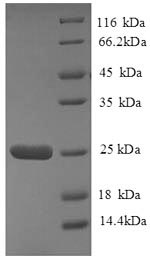
Greater than 90% as determined by SDS-PAGE.
Target Names
HLA-DQA2
Uniprot NO.
Research Area
Immunology
Species
Homo sapiens (Human)
Source
E.coli
Expression Region
24-214aa
Target Protein Sequence
EDIVADHVASYGVNFYQSHGPSGQYTHEFDGDEEFYVDLETKETVWQLPMFSKFISFDPQSALRNMAVGKHTLEFMMRQSNSTAATNEVPEVTVFSKFPVTLGQPNTLICLVDNIFPPVVNITWLSNGHSVTEGVSETSFLSKSDHSFFKISYLTFLPSADEIYDCKVEHWGLDEPLLKHWEPEIPAPMSE
Note: The complete sequence may include tag sequence, target protein sequence, linker sequence and extra sequence that is translated with the protein sequence for the purpose(s) of secretion, stability, solubility, etc.
If the exact amino acid sequence of this recombinant protein is critical to your application, please explicitly request the full and complete sequence of this protein before ordering.
Mol. Weight
25.6kDa
Protein Length
Partial
Tag Info
N-terminal 6xHis-tagged
The tag type will be determined during production process. If you have specified tag type, please tell us and we will develop the specified tag preferentially.
Buffer
Tris-based buffer,50% glycerol
Storage
The shelf life is related to many factors, storage state, buffer ingredients, storage temperature and the stability of the protein itself. Generally, the shelf life of liquid form is 6 months at -20°C/-80°C. The shelf life of lyophilized form is 12 months at -20°C/-80°C.
Shelf Life
The shelf life is related to many factors, storage state, buffer ingredients, storage temperature and the stability of the protein itself.
Generally, the shelf life of liquid form is 6 months at -20°C/-80°C. The shelf life of lyophilized form is 12 months at -20°C/-80°C.
Notes
Repeated freezing and thawing is not recommended. Store working aliquots at 4°C for up to one week.
Troubleshooting and FAQs
Datasheet & COA
Please contact us to get it.
Images
  • (Tris-Glycine gel) Discontinuous SDS-PAGE (reduced) with 5% enrichment gel and 15% separation gel.

Customer Reviews and Q&A

 Customer Reviews

Target Background

Function(From Uniprot)
Binds peptides derived from antigens that access the endocytic route of antigen presenting cells (APC) and presents them on the cell surface for recognition by the CD4 T-cells. The peptide binding cleft accommodates peptides of 10-30 residues. The peptides presented by MHC class II molecules are generated mostly by degradation of proteins that access the endocytic route, where they are processed by lysosomal proteases and other hydrolases. Exogenous antigens that have been endocytosed by the APC are thus readily available for presentation via MHC II molecules, and for this reason this antigen presentation pathway is usually referred to as exogenous. As membrane proteins on their way to degradation in lysosomes as part of their normal turn-over are also contained in the endosomal/lysosomal compartments, exogenous antigens must compete with those derived from endogenous components. Autophagy is also a source of endogenous peptides, autophagosomes constitutively fuse with MHC class II loading compartments. In addition to APCs, other cells of the gastrointestinal tract, such as epithelial cells, express MHC class II molecules and CD74 and act as APCs, which is an unusual trait of the GI tract. To produce a MHC class II molecule that presents an antigen, three MHC class II molecules (heterodimers of an alpha and a beta chain) associate with a CD74 trimer in the ER to form a heterononamer. Soon after the entry of this complex into the endosomal/lysosomal system where antigen processing occurs, CD74 undergoes a sequential degradation by various proteases, including CTSS and CTSL, leaving a small fragment termed CLIP (class-II-associated invariant chain peptide). The removal of CLIP is facilitated by HLA-DM via direct binding to the alpha-beta-CLIP complex so that CLIP is released. HLA-DM stabilizes MHC class II molecules until primary high affinity antigenic peptides are bound. The MHC II molecule bound to a peptide is then transported to the cell membrane surface. In B-cells, the interaction between HLA-DM and MHC class II molecules is regulated by HLA-DO. Primary dendritic cells (DCs) also to express HLA-DO. Lysosomal microenvironment has been implicated in the regulation of antigen loading into MHC II molecules, increased acidification produces increased proteolysis and efficient peptide loading.
Gene References into Functions
  1. HLA-DQB1/HLA-DQA2 rs9275328 may play a part in influencing the systemic lupus erythematosis susceptibility in Malays and Chinese in Malaysia. PMID:23257407
  2. HLA-DQA2 and HLA-DQB2 genes are expressed in human Langerhans cells and encode a new HLA class II molecule. PMID:22407913
  3. Parkinson's disease-associated SNP4 is correlated (r2=0.95) with variants that are associated with HLA-DQA2 expression. PMID:22096524
  4. a significant single nucleotide polymorphism , rs3998159, between HLA-DQB1 and HLA-DQA2 was identified in patients with asthma PMID:20159242

Show More

Hide All

Subcellular Location
Cell membrane; Single-pass type I membrane protein. Endoplasmic reticulum membrane; Single-pass type I membrane protein. Golgi apparatus, trans-Golgi network membrane; Single-pass type I membrane protein. Endosome membrane; Single-pass type I membrane protein. Lysosome membrane; Single-pass type I membrane protein. Note=The MHC class II complex transits through a number of intracellular compartments in the endocytic pathway until it reaches the cell membrane for antigen presentation.
Protein Families
MHC class II family
Tissue Specificity
Restricted to skin Langerhans cells, although some expression at low levels may occur at the surface of B lymphoblastoid cells.
Database Links

HGNC: 4943

UNIGENE: Hs.591798

KEGG: hsa:3118

STRING: 9606.ENSP00000364076

OMIM: 613503

icon of phone
Call us
301-363-4651 (Available 9 a.m. to 5 p.m. CST from Monday to Friday)

icon of address
Address
No. 269, Shendun 5th Road, Donghu Hi-Tech Development Area, Hubei Province, 430206, P.R.China
icon of social media
Join us with

Subscribe newsletter

Leave a message

* To protect against spam, please pass the CAPTCHA test below.
CAPTCHA verification
© 2007-2025 CUSABIO TECHNOLOGY LLC All rights reserved. 鄂ICP备15011166号-1
Select 0 Products