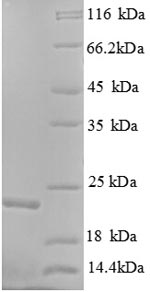
Purity
Greater than 90% as determined by SDS-PAGE.
Research Area
Epigenetics and Nuclear Signaling
Alternative Names
c Ki ras2; c Kirsten ras protein; c-K-ras; c-Ki-ras; Cellular c Ki ras2 proto oncogene; Cellular transforming proto oncogene; CFC2; cK Ras; GTPase KRas; K RAS p21 protein; K RAS2A; K RAS2B; K RAS4A; K RAS4B; K-Ras 2; KI RAS; Ki-Ras; KIRSTEN MURINE SARCOMA VIRUS 2; Kirsten rat sarcoma 2 viral (v Ki ras2) oncogene homolog; Kirsten rat sarcoma viral oncogene homolog; KRAS; KRAS proto oncogene, GTPase; KRAS1; KRAS2; N-terminally processed; NS; NS3; Oncogene KRAS2; p21ras; PR310 c K ras oncogene; PR310 cK ras oncogene; RALD; RASK_HUMAN; RASK2; Transforming protein p21; v Ki ras2 Kirsten rat sarcoma 2 viral oncogene homolog; v Ki ras2 Kirsten rat sarcoma viral oncogene homolog
Species
Homo sapiens (Human)
Expression Region
2-168aa
Target Protein Sequence
TEYKLVVVGAGGVGKSALTIQLIQNHFVDEYDPTIEDSYRKQVVIDGETCLLDILDTAGQEEYSAMRDQYMRTGEGFLCVFAINNTKSFEDIHHYREQIKRVKDSEDVPMVLVGNKCDLPSRTVDTKQAQDLARSYGIPFIETSAKTRQRVEDAFYTLVREIRQYRL
Note: The complete
sequence may include tag sequence, target protein sequence, linker sequence and extra sequence that is
translated with the protein sequence for the purpose(s) of secretion, stability, solubility, etc.
If the exact amino acid sequence of this recombinant protein is critical to your application,
please explicitly request the full and complete sequence of this protein before ordering.
Tag Info
N-terminal 6xHis-tagged
The tag type will be determined during production process. If you have specified tag type, please tell us and we will develop the specified tag preferentially.
Storage Condition
The shelf life is related to many factors, storage state, buffer ingredients, storage temperature and the stability of the protein itself. Generally, the shelf life of liquid form is 6 months at -20°C/-80°C. The shelf life of lyophilized form is 12 months at -20°C/-80°C.
Shelf Life
The shelf life is related to many factors, storage state, buffer ingredients, storage temperature and the stability of the protein itself.
Generally, the shelf life of liquid form is 6 months at -20°C/-80°C. The shelf life of lyophilized form is 12 months at -20°C/-80°C.
Lead Time
3-7 business days
Note: All of our proteins are default shipped with normal blue ice packs, if you request to ship with dry ice, please communicate with us in advance and extra fees will be charged.
Notes
Repeated freezing and thawing is not recommended. Store working aliquots at 4°C for up to one week.
Datasheet & COA
Please contact us to get it.
Description
The Human KRAS recombinant protein is conventionally generated by transfecting the recombinant DNA into a host cell, and then the host cells are cultured and the transfected DNA transcribed and translated. Different host cells can be chosen for recombinant protein production, the choice of which depends on the type of protein that needs to be generated, its functional activity and requisite yield. We choose E.coli as the expression system for this KRAS protein expression because bacteria cells are easy to culture, grow fast and produce high yields of recombinant protein.
KRAS is a protein coding gene that encodes GTPase KRas. According to some research, KRAS may have the following features.
KRAS mutation status predicts colorectal cancer response to cetuximab therapy. KRAS proteins play an important role in human cancers but have not yet succumbed to therapeutic attack. By determining the mutational status of EGFR and KRAS, treatment decisions regarding the use of these kinase inhibitors may be improved. GTPase KRAS inhibits the p53 tumor suppressor by activating the NRF2-regulated antioxidant defense system in cancer cells. The quantitative biophysical analysis identified key components that regulate the recruitment of the GTPase KRAS to the plasma membrane.