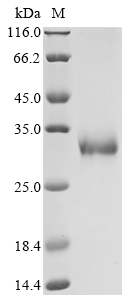
If the delivery form is liquid, the default storage buffer is Tris/PBS-based buffer, 5%-50% glycerol.
If the delivery form is lyophilized powder, the buffer before lyophilization is Tris/PBS-based buffer, 6% Trehalose.
Reconstitution
We recommend that this vial be briefly centrifuged prior to opening to bring the contents to the bottom. Please reconstitute protein in deionized sterile water to a concentration of 0.1-1.0 mg/mL.We recommend to add 5-50% of glycerol (final concentration) and aliquot for long-term storage at -20℃/-80℃. Our default final concentration of glycerol is 50%. Customers could use it as reference.
Storage
The shelf life is related to many factors, storage state, buffer ingredients, storage temperature and the stability of the protein itself.
Generally, the shelf life of liquid form is 6 months at -20°C/-80°C. The shelf life of lyophilized form is 12 months at -20°C/-80°C.
Shelf Life
The shelf life is related to many factors, storage state, buffer ingredients, storage temperature and the stability of the protein itself.
Generally, the shelf life of liquid form is 6 months at -20°C/-80°C. The shelf life of lyophilized form is 12 months at -20°C/-80°C.
Lead Time
3-7 business days
Notes
Repeated freezing and thawing is not recommended. Store working aliquots at 4°C for up to one week.
Receptor for erythropoietin. Mediates erythropoietin-induced erythroblast proliferation and differentiation. Upon EPO stimulation, EPOR dimerizes triggering the JAK2/STAT5 signaling cascade. In some cell types, can also activate STAT1 and STAT3. May also activate the LYN tyrosine kinase.; Isoform EPOR-T acts as a dominant-negative receptor of EPOR-mediated signaling.
Gene References into Functions
Here, we present two crystal structures of the human JAK2 FERM and SH2 domains bound to Leptin receptor (LEPR) and Erythropoietin receptor (EPOR), which identify a novel dimeric conformation for JAK2.PMID:30044226
EpoR role in the proliferation and survival of non-small cell lung cancer cellsPMID:29345289
These results highlight the high intrinsic specificity of transmembrane domain interactions, demonstrate that a single methyl group can dictate specificity, and define the minimal chemical difference that can modulate the specificity of transmembrane domain interactions and the activity of transmembrane proteins.PMID:28869036
Study reports for the first evidence that EPOR modulates breast cancer cell morphology changes upon tamoxifen treatment, which result in increased formation of cell protrusions and subsequent cell death and, proposes sustained AKT phosphorylation in EPOR-overexpressing cells as a mechanism that can lead to EPOR-induced tamoxifen resistance.PMID:28714517
Authors retrospectively investigated whether TFR2 isoforms and EPOR are differentially expressed in MDS patients and whether the expression is associated with patients' clinical outcomes.PMID:26914246
High EPOR expression is associated with monoclonal gammopathy of undetermined significance and multiple myeloma.PMID:26919105
EPO-mediated EPOR signaling reduced the viability of myeloma cell lines and of malignant primary plasma cells in vitroPMID:27581518
this study shows that EPO could directly promote tumor progression via EPO receptor-expressing macrophagesPMID:27262376
No evidence of in vivo activation of the Epo-R in WAT could be documented despite detectable levels of Epo-R mRNA. CONCLUSION: Thus, in contradiction to animal studies, Epo treatment within a physiological relevant range in humans does not exert direct effects in a subcutaneous WAT.PMID:27640183
Overexpression of EPOR is associated with clear cell renal cell carcinoma.PMID:27468719
HIF-1alpha and EPO-R may be an indicator of the aggressiveness of invasive breast cancersPMID:27629849
These results identify EPOR as the secondbona fidehydroxylation-dependent substrate of VHL that potentially influences oxygen homeostasis and contributes to the complex genotype-phenotype correlation in VHL disease.PMID:26846855
We report for a first time that functional EpoR is expressed in human rhabdomyosarcoma cell lines as well as by primary tumors from RMS patients.PMID:26412593
erythrocyte lineage enforces exclusivity through upregulation of EKLF and its lineage-specific cytokine receptor (EpoR) while inhibiting both FLI-1 and the receptor TpoR (also known as MPL) for the opposing megakaryocyte lineagePMID:26159733
A new point mutation in EPOR induces a short deletion in congenital erythrocytosis.PMID:26010769
Data show that erythropoietin receptor antagonist EMP9 suppressed hemoglobin synthesis in xenografts of HeLa cells.PMID:25874769
Data suggest that erythropoietin receptor (EPOR) could be a target to overcome therapeutic resistance toward ionizing radiation or temozolomide.PMID:25544764
transmembrane domain and the juxtamembrane region of the erythropoietin receptor in micellesPMID:25418301
while EPO can stimulate NO production, NO in turn can regulate EPOR expression in endothelial cells during hypoxiaPMID:24518819
In HBV-related HCC, the levels of EpoR mRNA and protein in non-tumour cirrhotic livers were positively correlated with tumour cell differentiation, which is a favourable predictor of disease-specific survival.PMID:23496059
This study reveals high EPOR level as a potential novel positive prognostic marker in human lung lung adenocarcinoma.PMID:24155958
3 novel EPOR mutations in primary familial and congenital polycythemia--Del1377-1411, a C1370A and G1445--were chimerized with EGFR to study signalling and metabolism of the chimeric receptors.PMID:24533580
Data show that erythropoietin receptor (EPOR) protein is expressed in breast cancer cells, where it appears to promote proliferation by an EPO-independent mechanism in estrogen receptor alpha (ERalpha) expressing breast cancer cells.PMID:24502950
Epo-R is expressed in bone marrow-derived macrophages from multiple myeloma and monoclonal gammopathy of undetermined significance patients. The Epo/Epo-R pathway may be involved in the regulation of angiogenic response occurring in MM.PMID:23881169
Data suggest that adipose tissue-specific disruption of EPO receptor does not alter adipose tissue expansion, adipocyte morphology, insulin resistance, inflammation, or angiogenesis.PMID:23885016
Sp1 may significantly affect the number of EPO-R molecules present on the surface of activated CD4(+) lymphocytesPMID:23577103
EPOR expression may be involved in tumor progression and proliferation in HER2-positive breast cancer.EPOR contributes to the mechanism of trastuzumab resistance in breast cancer.PMID:23117856
TAL1 binds to the EPO-R promoter to activate EPO-R expressionPMID:22982397
High EPOR expression in OSCC is associated with an aggressive tumor behavior and poorer prognosis in the univariate analysis among patients with OSCC.PMID:22639817
Erythropoietin is capable of downregulating erythropoietin receptor when it acts early within HepG2 cells.PMID:22227182
the biology of the EpoR in ovarian cancer cellsPMID:22552716
The absence of functional Epo receptor activity in human skeletal muscle indicates that the long-term effects are indirect and probably related to an increased oxidative capacity in this tissuePMID:22384088
a critical role for membrane raft in recruitment and assembly of Epo-R and signal intermediates into discrete membrane signaling unitsPMID:22509308
New knowledge concerning regulated EPOR expression and trafficking therefore is provided, together with new insight into mechanisms via which mutated EPOR-T polycythemia alleles dysregulate the erythron.PMID:22253704
These data support that EpoR is functional in melanoma and EpoR activation may promote melanoma progression, and suggest that Epo may stimulate angiogenesis and increase survival of melanoma cells under hypoxic condition in vivo.PMID:21860424
The expression of EPOR and TPOR on CD34+ CD59+ bone marrow cells are significantly higher than those on CD34+ CD59- cells of paroxysmal nocturnal hemoglobinuria patients.PMID:22338178
STAT5 phosphorylation levels of EPO and TPO receptors are elevated in bone marrow cells of patients with paroxysmal nocturnal hemoglobinuria.PMID:22093990
ETV6-RUNX1 directly activates ectopic expression of a functional EPOR and provides cell survival signals that may contribute critically to persistence of covert premalignant clones in children.PMID:21900195
EPOR signalling in tumour cells is involved in the control of glioma growth.PMID:21749867
EPO-R cytosolic lysine residues enhance receptor function, most probably through ubiquitination and/or other post-translational modifications.PMID:21291419
The Epo/EpoR complex plays a critical role in the adhesion and migration of rat fibroblasts, and its functional inactivation is associated with PLC-gammal-dependent reduction of cell-matrix adhesion and this also affects cell migration.PMID:21360263
Detected is a novel heterozygous frameshift mutation in exon 8 of the EPOR resulting in primary familial and congenital polycythaemia.PMID:21437635
EPOR is expressed in cells of acute leukemia, but the expression level in low. The EPOR expression rate shows no significant difference between AML and ALL.PMID:19099624
High EpoR is associated with angiogenesis in glioma.PMID:20614229
Tumor vessels exhibited EpoR, pJAK-2, and pSTAT-5 immunoreactivityPMID:20336349
results suggest that spermatozoa express EPO receptor on plasma membrane, which might act to protect these cells from damage after ejaculation.PMID:20884294
EpoR signaling is absolutely required for Parvovirus B19 replication in ex vivo-expanded erythroid progenitor cells after initial virus entry and at least partly accounts for the remarkable tropism of B19V infection for human erythroid progenitors.PMID:20861249
a regulatory role of EPO/EPOR pathway in human circulating endothelial precursors homeostasisPMID:20700488
Data show that sEpoR is detectable as a 27kDa protein in the serum of dialysis patients, and that higher serum sEpoR levels correlate with increased erythropoietin requirements.PMID:20169072
EpoR mRNA was detected in essentially all cell types examined, including primary endothelial, renal, cardiac, and neuronal cells but 10- to 100-fold lower than Epo-responsive cellsPMID:20124513
Show
More
Hide
All
Subcellular Location
Cell membrane; Single-pass type I membrane protein.; [Isoform EPOR-S]: Secreted. Note=Secreted and located to the cell surface.
Protein Families
Type I cytokine receptor family, Type 1 subfamily
Tissue Specificity
Erythroid cells and erythroid progenitor cells. Isoform EPOR-F is the most abundant form in EPO-dependent erythroleukemia cells and in late-stage erythroid progenitors. Isoform EPOR-S and isoform EPOR-T are the predominant forms in bone marrow. Isoform EP