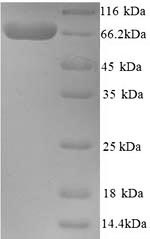
Purity
Greater than 90% as determined by SDS-PAGE.
Research Area
Neuroscience
Alternative Names
Acylcholine acylhydrolase; BCHE; Butyrylcholine esterase; CHE1; CHE2; CHLE_HUMAN; Choline esterase II; Cholinesterase (serum) 2; Cholinesterase 1; Cholinesterase; E1; Pseudocholinesterase; Pseudocholinesterase E1
Species
Homo sapiens (Human)
Expression Region
29-602aa
Target Protein Sequence
EDDIIIATKNGKVRGMNLTVFGGTVTAFLGIPYAQPPLGRLRFKKPQSLTKWSDIWNATKYANSCCQNIDQSFPGFHGSEMWNPNTDLSEDCLYLNVWIPAPKPKNATVLIWIYGGGFQTGTSSLHVYDGKFLARVERVIVVSMNYRVGALGFLALPGNPEAPGNMGLFDQQLALQWVQKNIAAFGGNPKSVTLFGESAGAASVSLHLLSPGSHSLFTRAILQSGSFNAPWAVTSLYEARNRTLNLAKLTGCSRENETEIIKCLRNKDPQEILLNEAFVVPYGTPLSVNFGPTVDGDFLTDMPDILLELGQFKKTQILVGVNKDEGTAFLVYGAPGFSKDNNSIITRKEFQEGLKIFFPGVSEFGKESILFHYTDWVDDQRPENYREALGDVVGDYNFICPALEFTKKFSEWGNNAFFYYFEHRSSKLPWPEWMGVMHGYEIEFVFGLPLERRDNYTKAEEILSRSIVKRWANFAKYGNPNETQNNSTSWPVFKSTEQKYLTLNTESTRIMTKLRAQQCRFWTSFFPKVLEMTGNIDEAEWEWKAGFHRWNNYMMDWKNQFNDYTSKKESCVGL
Note: The complete
sequence may include tag sequence, target protein sequence, linker sequence and extra sequence that is
translated with the protein sequence for the purpose(s) of secretion, stability, solubility, etc.
If the exact amino acid sequence of this recombinant protein is critical to your application,
please explicitly request the full and complete sequence of this protein before ordering.
Protein Length
Full Length of Mature Protein
Tag Info
N-terminal 6xHis-tagged
The tag type will be determined during production process. If you have specified tag type, please tell us and we will develop the specified tag preferentially.
Reconstitution
We recommend that this vial be briefly centrifuged prior to opening to bring the contents to the bottom. Please reconstitute protein in deionized sterile water to a concentration of 0.1-1.0 mg/mL.We recommend to add 5-50% of glycerol (final concentration) and aliquot for long-term storage at -20°C/-80°C. Our default final concentration of glycerol is 50%. Customers could use it as reference.
Storage Condition
The shelf life is related to many factors, storage state, buffer ingredients, storage temperature and the stability of the protein itself.
Generally, the shelf life of liquid form is 6 months at -20°C/-80°C. The shelf life of lyophilized form is 12 months at -20°C/-80°C.
Shelf Life
The shelf life is related to many factors, storage state, buffer ingredients, storage temperature and the stability of the protein itself.
Generally, the shelf life of liquid form is 6 months at -20°C/-80°C. The shelf life of lyophilized form is 12 months at -20°C/-80°C.
Lead Time
Delivery time may differ from different purchasing way or location, please kindly consult your local distributors for specific delivery time.
Note: All of our proteins are default shipped with normal blue ice packs, if you request to ship with dry ice, please communicate with us in advance and extra fees will be charged.
Notes
Repeated freezing and thawing is not recommended. Store working aliquots at 4°C for up to one week.
Datasheet & COA
Please contact us to get it.
Description
To produce recombinant Human BCHE protein, a well-established recombinant DNA technology is the key. A DNA template of BCHE was constructed with N-terminal 6xHis tag using the technique. Once the template was made, the recombinant Human BCHE protein could be produced with it efficiently. CUSABIO has built a strict QC system to ensure quality. The expression region is 29-602aa of the Human BCHE. The purity of this recombinant is 90% determined by SDS-PAGE.
BCHE is a protein coding gene that encodes Cholinesterase (Butyrylcholine esterase). According to some studies, BCHE may have the following features.
The cloned BCHE gene maps to a single chromosome site, 3q26. GWAS of butyrylcholinesterase activity identified four novel loci, independent effects within BCHE and secondary associations with metabolic risk factors. Potent AChE and BChE inhibitors were isolated from seeds of Peganum harmala Linn by bioassay-guided fractionation. Neuroprotective tricyclic and tetracyclic BChE inhibitors release reversible inhibitors after carbamate transfer. Variation at locus 116 of the BCHE gene associating with enzyme activity and body mass index. BCHE, through its K variant, but not a nearby marker, is a susceptibility factor for AD and enhances AD risk defined only by APOE蓻4 in an age-dependent manner.