Purity
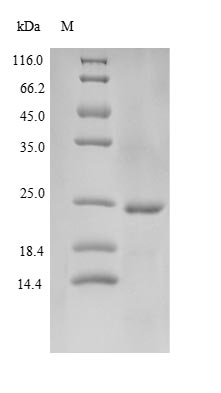
Greater than 90% as determined by SDS-PAGE.
Alternative Names
18 kDa cationic antimicrobial protein; Antibacterial peptide LL-37; Antibacterial protein FALL-39; CAMP; CAMP_HUMAN; CAP 18; CAP-18; CAP18; Cathelicidin antimicrobial peptide; Cathelin-like protein; Cathelin-related antimicrobial peptide; CATHL3; Cationic antimicrobial protein; 18-KD; CLP; Cnlp; Cramp; CRAMP; mouse; homolog of; FALL 39 ; FALL-39 peptide antibiotic; FALL39 ; hCAP 18; hCAP-18; hCAP18; HSD26 ; LL37; MCLP; Peptide antibiotic; PR-39; porcine; homolog of
Species
Homo sapiens (Human)
Expression Region
132-170aa
Target Protein Sequence
FALLGDFFRKSKEKIGKEFKRIVQRIKDFLRNLVPRTES
Note: The complete
sequence may include tag sequence, target protein sequence, linker sequence and extra sequence that is
translated with the protein sequence for the purpose(s) of secretion, stability, solubility, etc.
If the exact amino acid sequence of this recombinant protein is critical to your application,
please explicitly request the full and complete sequence of this protein before ordering.
Protein Length
Full Length of Mature Protein
Tag Info
N-terminal 10xHis-SUMO-tagged and C-terminal Myc-tagged
The tag type will be determined during production process. If you have specified tag type, please tell us and we will develop the specified tag preferentially.
Reconstitution
We recommend that this vial be briefly centrifuged prior to opening to bring the contents to the bottom. Please reconstitute protein in deionized sterile water to a concentration of 0.1-1.0 mg/mL.We recommend to add 5-50% of glycerol (final concentration) and aliquot for long-term storage at -20°C/-80°C. Our default final concentration of glycerol is 50%. Customers could use it as reference.
Storage Condition
The shelf life is related to many factors, storage state, buffer ingredients, storage temperature and the stability of the protein itself.
Generally, the shelf life of liquid form is 6 months at -20°C/-80°C. The shelf life of lyophilized form is 12 months at -20°C/-80°C.
Shelf Life
The shelf life is related to many factors, storage state, buffer ingredients, storage temperature and the stability of the protein itself.
Generally, the shelf life of liquid form is 6 months at -20°C/-80°C. The shelf life of lyophilized form is 12 months at -20°C/-80°C.
Lead Time
3-7 business days
Note: All of our proteins are default shipped with normal blue ice packs, if you request to ship with dry ice, please communicate with us in advance and extra fees will be charged.
Notes
Repeated freezing and thawing is not recommended. Store working aliquots at 4°C for up to one week.
Datasheet & COA
Please contact us to get it.
Images
-
(Tris-Glycine gel) Discontinuous SDS-PAGE (reduced) with 5% enrichment gel and 15% separation gel.
Description
Amino acids 132-170 form the expressed segment for recombinant Human CAMP. The theoretical molecular weight of the CAMP protein is 24.7 kDa. The CAMP protein was expressed in e.coli. The N-terminal 10xHis-SUMO tag and C-terminal Myc tag was fused into the coding gene segment of CAMP, making it easier to detect and purify the CAMP recombinant protein in the later stages of expression and purification.
Cathelicidin antimicrobial peptide (CAMP) is a protein primarily studied in the fields of immunology and infectious diseases. Its pivotal role lies in the innate immune system, where it acts as a natural antibiotic, defending against microbial invaders. Researchers focus extensively on CAMP's involvement in combating bacterial, viral, and fungal infections, making it a key player in understanding host defense mechanisms. The most significant and widely explored area is its impact on antimicrobial activity, unveiling insights into potential therapeutic strategies against infectious diseases. Additionally, studies touch upon CAMP's contribution to inflammatory responses and its implications in various dermatological conditions, shedding light on skin immunity. While CAMP's main spotlight is on infection defense, its diverse roles across different immune processes hint at broader applications in medicine and immunotherapy.