Recombinant Human Calcium/calmodulin-dependent protein kinase type II subunit delta (CAMK2D)

Code: CSB-EP613410HU
Size:
20ug
20ug100ug1mg(1mg*1 or 500ug*2)
US$306
Quantity:
Express system: E.coli
Species: Homo sapiens (Human)
Tag Info: N-terminal 10xHis-tagged and C-terminal Myc-tagged
For inquiries on large quantities or another requirements
Send an Inquiry
Start an on-line Chat
Online ordering is currently available for U.S. customers only. For orders outside the U.S., please kindly submit an inquiry or start a chat with us.

Product Details

Purity
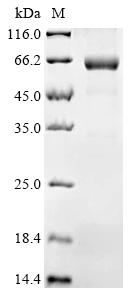
Greater than 90% as determined by SDS-PAGE.
Target Names
CAMK2D
Uniprot NO.
Research Area
Cancer
Alternative Names
(CaM kinase II subunit delta)(CaMK-II subunit delta)
Species
Homo sapiens (Human)
Source
E.coli
Expression Region
2-499aa
Target Protein Sequence
ASTTTCTRFTDEYQLFEELGKGAFSVVRRCMKIPTGQEYAAKIINTKKLSARDHQKLEREARICRLLKHPNIVRLHDSISEEGFHYLVFDLVTGGELFEDIVAREYYSEADASHCIQQILESVNHCHLNGIVHRDLKPENLLLASKSKGAAVKLADFGLAIEVQGDQQAWFGFAGTPGYLSPEVLRKDPYGKPVDMWACGVILYILLVGYPPFWDEDQHRLYQQIKAGAYDFPSPEWDTVTPEAKDLINKMLTINPAKRITASEALKHPWICQRSTVASMMHRQETVDCLKKFNARRKLKGAILTTMLATRNFSAAKSLLKKPDGVKESTESSNTTIEDEDVKARKQEIIKVTEQLIEAINNGDFEAYTKICDPGLTAFEPEALGNLVEGMDFHRFYFENALSKSNKPIHTIILNPHVHLVGDDAACIAYIRLTQYMDGSGMPKTMQSEETRVWHRRDGKWQNVHFHRSGSPTVPIKPPCIPNGKENFSGGTSLWQNI
Note: The complete sequence may include tag sequence, target protein sequence, linker sequence and extra sequence that is translated with the protein sequence for the purpose(s) of secretion, stability, solubility, etc.
If the exact amino acid sequence of this recombinant protein is critical to your application, please explicitly request the full and complete sequence of this protein before ordering.
Mol. Weight
63.7 kDa
Protein Length
Full Length of Mature Protein
Tag Info
N-terminal 10xHis-tagged and C-terminal Myc-tagged
The tag type will be determined during production process. If you have specified tag type, please tell us and we will develop the specified tag preferentially.
Form
Liquid or Lyophilized powder
Note: We will preferentially ship the format that we have in stock, however, if you have any special requirement for the format, please remark your requirement when placing the order, we will prepare according to your demand.
Buffer
If the delivery form is liquid, the default storage buffer is Tris/PBS-based buffer, 5%-50% glycerol. If the delivery form is lyophilized powder, the buffer before lyophilization is Tris/PBS-based buffer, 6% Trehalose.
Reconstitution
We recommend that this vial be briefly centrifuged prior to opening to bring the contents to the bottom. Please reconstitute protein in deionized sterile water to a concentration of 0.1-1.0 mg/mL.We recommend to add 5-50% of glycerol (final concentration) and aliquot for long-term storage at -20℃/-80℃. Our default final concentration of glycerol is 50%. Customers could use it as reference.
Storage Condition
The shelf life is related to many factors, storage state, buffer ingredients, storage temperature and the stability of the protein itself. Generally, the shelf life of liquid form is 6 months at -20°C/-80°C. The shelf life of lyophilized form is 12 months at -20°C/-80°C.
Shelf Life
The shelf life is related to many factors, storage state, buffer ingredients, storage temperature and the stability of the protein itself.
Generally, the shelf life of liquid form is 6 months at -20°C/-80°C. The shelf life of lyophilized form is 12 months at -20°C/-80°C.
Lead Time
Delivery time may differ from different purchasing way or location, please kindly consult your local distributors for specific delivery time.
Note: All of our proteins are default shipped with normal blue ice packs, if you request to ship with dry ice, please communicate with us in advance and extra fees will be charged.
Notes
Repeated freezing and thawing is not recommended. Store working aliquots at 4°C for up to one week.
Troubleshooting and FAQs
Datasheet & COA
Please contact us to get it.
Images
  • (Tris-Glycine gel) Discontinuous SDS-PAGE (reduced) with 5% enrichment gel and 15% separation gel.

Customer Reviews and Q&A

 Customer Reviews

Target Background

Function(From Uniprot)
Calcium/calmodulin-dependent protein kinase involved in the regulation of Ca(2+) homeostatis and excitation-contraction coupling (ECC) in heart by targeting ion channels, transporters and accessory proteins involved in Ca(2+) influx into the myocyte, Ca(2+) release from the sarcoplasmic reticulum (SR), SR Ca(2+) uptake and Na(+) and K(+) channel transport. Targets also transcription factors and signaling molecules to regulate heart function. In its activated form, is involved in the pathogenesis of dilated cardiomyopathy and heart failure. Contributes to cardiac decompensation and heart failure by regulating SR Ca(2+) release via direct phosphorylation of RYR2 Ca(2+) channel on 'Ser-2808'. In the nucleus, phosphorylates the MEF2 repressor HDAC4, promoting its nuclear export and binding to 14-3-3 protein, and expression of MEF2 and genes involved in the hypertrophic program. Is essential for left ventricular remodeling responses to myocardial infarction. In pathological myocardial remodeling acts downstream of the beta adrenergic receptor signaling cascade to regulate key proteins involved in ECC. Regulates Ca(2+) influx to myocytes by binding and phosphorylating the L-type Ca(2+) channel subunit beta-2 CACNB2. In addition to Ca(2+) channels, can target and regulate the cardiac sarcolemmal Na(+) channel Nav1.5/SCN5A and the K+ channel Kv4.3/KCND3, which contribute to arrhythmogenesis in heart failure. Phosphorylates phospholamban (PLN/PLB), an endogenous inhibitor of SERCA2A/ATP2A2, contributing to the enhancement of SR Ca(2+) uptake that may be important in frequency-dependent acceleration of relaxation (FDAR) and maintenance of contractile function during acidosis. May participate in the modulation of skeletal muscle function in response to exercise, by regulating SR Ca(2+) transport through phosphorylation of PLN/PLB and triadin, a ryanodine receptor-coupling factor.
Gene References into Functions
  1. CKIalpha-mediated NS5A S235 phosphorylation is critical for HCV replication. CaMKII gamma and delta may have negative roles in the HCV life cycle. PMID:27875595
  2. CEACAM1 is able to maintain the active transcription of ID4 by an epigenetic mechanism involving HDAC4 and CaMK2D, and the same kinase enables lumen formation by CEACAM1 PMID:27302061
  3. CaMKIId activity is up-regulated in the myocardium of diabetic patients and mouse models of diabetes, where it promotes pathological signaling that includes hypertrophy, fibrosis and apoptosis. PMID:26198034
  4. Study found a significant association with disordered gambling and rs167771 (DRD3) and with rs381572 (CAMK2D) in humans PMID:25266122
  5. This study showed that AKAP12,CAMK2D and a molecular pathway(cyclic amp)association to outcome of depressive during citalopram treatment. PMID:24986638
  6. Reveal a novel in vivo function of CaMKIIdelta in regulating H3 phosphorylation and suggest a novel epigenetic mechanism by which CaMKIIdelta controls cardiac hypertrophy. PMID:25421395
  7. CAMKIIdelta is required for PP1gamma-exacerbated apoptosis of cardiomyocytes. PMID:24196533
  8. Our studies suggest that CaMKII is a molecular signal that couples increased reactive oxygen species with atrial fibrillation and that therapeutic strategies to decrease oxidized CaMKII may prevent or reduce it. PMID:24030498
  9. End-stage failing human hearts had more phosphorylation at CaMKII-dependent titin sites, contributing to their mechanical dysfunction & establishing a new role for CaMKIIdelta in regulating diastolic passive properties of healthy & diseased hearts. PMID:23283722
  10. suggest that CaMKII and calcineurin provide a switch-like mechanism that controls Ca-dependent LIMK1, SSH1L and cofilin activation, and subsequently actin cytoskeletal reorganization PMID:22270398
  11. Data show that Pcp4 overexpression induces precocious neuronal differentiation, and is associated with an increase in CaMKIIdelta activation. PMID:21491429
  12. Single nucleotide polymorphism in CAMK2D gene is associated with epithelial ovarian cancer. PMID:21447778
  13. This study shows for the first time that CAMKII inhibition acutely improves contractility in human heart failure where CAMKIIdelta expression is increased. PMID:20814023
  14. The crystal structure of the human CaMKIIdelta/Ca2+/CaM complex, is described. PMID:20668654
  15. Calcium/Calmodulin-dependent protein kinase II delta 6 (CaMKIIdelta6) and RhoA is involved in thrombin-induced endothelial barrier dysfunction PMID:20442409
  16. HDAC4 as a specific downstream substrate of CaMKIIdeltaB in cardiac cells and have broad applications for the signaling pathways leading to cardiac hypertrophy and heart failure. PMID:17179159
  17. Chronic upregulation/activation of CaMKIID, and PKD in heart failure shifts HDAC5 out of the nucleus, derepressing transcription of hypertrophic genes. PMID:18218981
  18. The cloned, expressed CAMK2delta6 protein comigrated with D52 kinase and colocalized with D52 protein in T84 and HEK293 cells. These findings support a role for CAMK2delta6 in the mediation of D52 phosphorylation. PMID:18832449

Show More

Hide All

Subcellular Location
Cell membrane, sarcolemma; Peripheral membrane protein; Cytoplasmic side. Sarcoplasmic reticulum membrane; Peripheral membrane protein; Cytoplasmic side.
Protein Families
Protein kinase superfamily, CAMK Ser/Thr protein kinase family, CaMK subfamily
Tissue Specificity
Expressed in cardiac muscle and skeletal muscle. Isoform Delta 3, isoform Delta 2, isoform Delta 8 and isoform Delta 9 are expressed in cardiac muscle. Isoform Delta 11 is expressed in skeletal muscle.
Database Links

HGNC: 1462

UNIGENE: Hs.144114

KEGG: hsa:817

STRING: 9606.ENSP00000339740

OMIM: 607708

icon of phone
Call us
301-363-4651 (Available 9 a.m. to 5 p.m. CST from Monday to Friday)
icon of address
Address
No. 269, Shendun 5th Road, Donghu Hi-Tech Development Area, Hubei Province, 430206, P.R.China
icon of social media
Join us with

Subscribe newsletter

Leave a message

* To protect against spam, please pass the CAPTCHA test below.
CAPTCHA verification
© 2007-2025 CUSABIO TECHNOLOGY LLC All rights reserved. 鄂ICP备15011166号-1
Select 0 Products