Recombinant Human Aspartoacylase (ASPA)

In Stock
Code: CSB-YP002223HU
Size:
20ug
20ug100ug1mg(1mg*1 or 500ug*2)
US$368
Quantity:
Express system: Yeast
Species: Homo sapiens (Human)
Tag Info: N-terminal 10xHis-tagged and C-terminal Myc-tagged
For inquiries on large quantities or another requirements
Send an Inquiry
Start an on-line Chat
Online ordering is currently available for U.S. customers only. For orders outside the U.S., please kindly submit an inquiry or start a chat with us.

Product Details

Purity
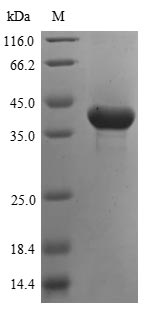
Greater than 85% as determined by SDS-PAGE.
Target Names
ASPA
Uniprot NO.
Research Area
Signal Transduction
Species
Homo sapiens (Human)
Source
Yeast
Expression Region
1-313aa
Target Protein Sequence
MTSCHIAEEHIQKVAIFGGTHGNELTGVFLVKHWLENGAEIQRTGLEVKPFITNPRAVKKCTRYIDCDLNRIFDLENLGKKMSEDLPYEVRRAQEINHLFGPKDSEDSYDIIFDLHNTTSNMGCTLILEDSRNNFLIQMFHYIKTSLAPLPCYVYLIEHPSLKYATTRSIAKYPVGIEVGPQPQGVLRADILDQMRKMIKHALDFIHHFNEGKEFPPCAIEVYKIIEKVDYPRDENGEIAAIIHPNLQDQDWKPLHPGDPMFLTLDGKTIPLGGDCTVYPVFVNEAAYYEKKEAFAKTTKLTLNAKSIRCCLH
Note: The complete sequence may include tag sequence, target protein sequence, linker sequence and extra sequence that is translated with the protein sequence for the purpose(s) of secretion, stability, solubility, etc.
If the exact amino acid sequence of this recombinant protein is critical to your application, please explicitly request the full and complete sequence of this protein before ordering.
Mol. Weight
39.7 kDa
Protein Length
Full Length
Tag Info
N-terminal 10xHis-tagged and C-terminal Myc-tagged
The tag type will be determined during production process. If you have specified tag type, please tell us and we will develop the specified tag preferentially.
Reconstitution
We recommend that this vial be briefly centrifuged prior to opening to bring the contents to the bottom. Please reconstitute protein in deionized sterile water to a concentration of 0.1-1.0 mg/mL.We recommend to add 5-50% of glycerol (final concentration) and aliquot for long-term storage at -20°C/-80°C. Our default final concentration of glycerol is 50%. Customers could use it as reference.
Storage
The shelf life is related to many factors, storage state, buffer ingredients, storage temperature and the stability of the protein itself. Generally, the shelf life of liquid form is 6 months at -20°C/-80°C. The shelf life of lyophilized form is 12 months at -20°C/-80°C.
Shelf Life
The shelf life is related to many factors, storage state, buffer ingredients, storage temperature and the stability of the protein itself.
Generally, the shelf life of liquid form is 6 months at -20°C/-80°C. The shelf life of lyophilized form is 12 months at -20°C/-80°C.
Lead Time
3-7 business days
Note: All of our proteins are default shipped with normal blue ice packs, if you request to ship with dry ice, please communicate with us in advance and extra fees will be charged.
Notes
Repeated freezing and thawing is not recommended. Store working aliquots at 4°C for up to one week.
Troubleshooting and FAQs
Datasheet & COA
Please contact us to get it.
Images
  • (Tris-Glycine gel) Discontinuous SDS-PAGE (reduced) with 5% enrichment gel and 15% separation gel.

Description

Enhance your signal transduction research with our high-quality Recombinant Human ASPA protein. Aspartoacylase, also known as Aminoacylase-2 or ACY-2, is a crucial enzyme responsible for the hydrolysis of N-acetyl-L-aspartic acid (NAA) into aspartate and acetate within the central nervous system. This enzyme has significant implications in neural development, myelin maintenance, and various neurodegenerative disorders.

Derived from yeast expression systems, our recombinant ASPA protein is a full-length construct spanning the 1-313aa region, specifically designed to facilitate your scientific investigations. The N-terminal 10xHis-tag and C-terminal Myc-tag enable seamless protein purification and detection. With a purity greater than 85% as determined by SDS-PAGE, our Recombinant Human ASPA protein is provided in a lyophilized powder format, ensuring optimal results in your signal transduction studies.

Customer Reviews and Q&A

 Customer Reviews
 Q&A
Q:

Would you happen to know if this recombinant ASPA protein is bioactive? Have you tested it for enzymatic activity?

A:

We haven't tested the activity of ASPA protein, its activity is not guaranteed. Generally, the protein expressed in eukaryotic cells has a high possibility of activity.

Target Background

Function(From Uniprot)
Catalyzes the deacetylation of N-acetylaspartic acid (NAA) to produce acetate and L-aspartate. NAA occurs in high concentration in brain and its hydrolysis NAA plays a significant part in the maintenance of intact white matter. In other tissues it act as a scavenger of NAA from body fluids.
Gene References into Functions
  1. report of 2 Egyptian sibling patients suspected of Canavan disease (CD); study revealed homozygosity for substitution T530C (Ile177Thr) in exon 4 of the ASPA gene in both sibs; substitution T530C (Ile177Thr) results in a novel missense mutation causing a CD phenotype with severe clinical characteristics PMID:24036223
  2. Four ASPA missense mutations associated with Canavan disease are structurally characterized. PMID:25003821
  3. Definitive evidence is presented to show that the recombinantly-expressed human aspartoacylase is not a glycoprotein. PMID:24632142
  4. This is the first case report of ASPA mutation studies in Canavan disease from Indian subcontinent. PMID:22878930
  5. a novel mutation Y88X within the aspartoacylase gene in a consanguineous family with an affected child diagnosed as Canavan disease. PMID:22468686
  6. Human aspartoacylase gene expression was high not only in brain and kidney, but also in lung and liver. PMID:22750302
  7. Gene ASPA (NM_000049) was undertaken to sequence for mutation analysis. PMID:22219087
  8. We report on an Italian female patient with Canavan disease due to a missense mutation of the aspartoacylase gene and a 17p13.3 chromosomal microdeletion PMID:22019069
  9. the ASPA gene was analysed in 22 unrelated non-Jewish patients with Canavan disease, and 24 different mutations were found PMID:12638939
  10. Mild-onset presentation of Canavan's disease associated with novel G212A point mutation in aspartoacylase gene PMID:16437572
  11. molecular weight of the purified enzyme is higher than predicted, suggesting the presence of post-translational modifications. Deglycosylation of aspartoacylase or mutation at glycosylation site causes decreased enzyme stability and catalytic activity PMID:16669630
  12. a green fluorescent protein-human ASPA fusion protein larger than the permissible size for the nuclear pore complex was enzymatically active and showed mixed nuclear-cytoplasmic distribution. PMID:16935940
  13. The finding that wild-type and Glu178Asp have the same K(m) but different k(cat) values confirms the idea that the carboxylate group contributes importantly to the enzymatic activity of aspartoacylase. PMID:17027983
  14. the N-terminal domain of aspartoacylase adopts a protein fold similar to that of zinc-dependent hydrolases related to carboxypeptidases A PMID:17194761
  15. These results show that aspartoacylase is a member of the caboxypeptidase A family and offer novel explanations for most loss-of-function aspartoacylase mutations associated with Canavan Disease. PMID:17391648
  16. New structure of human aspartoacylase complexed with a catalytic intermediate analogue, N-phosphonomethyl- l-aspartate, supports a carboxypeptidase-type mechanism for hydrolysis of the amide bond of the substrate, N-acetyl- l-aspartate. PMID:18293939

Show More

Hide All

Subcellular Location
Cytoplasm. Nucleus.
Protein Families
AspA/AstE family, Aspartoacylase subfamily
Tissue Specificity
Brain white matter, skeletal muscle, kidney, adrenal glands, lung and liver.
Database Links

HGNC: 756

UNIGENE: Hs.171142

KEGG: hsa:443

STRING: 9606.ENSP00000263080

OMIM: 271900

icon of phone
Call us
301-363-4651 (Available 9 a.m. to 5 p.m. CST from Monday to Friday)

icon of address
Address
No. 269, Shendun 5th Road, Donghu Hi-Tech Development Area, Hubei Province, 430206, P.R.China
icon of social media
Join us with

Subscribe newsletter

Leave a message

* To protect against spam, please pass the CAPTCHA test below.
CAPTCHA verification
© 2007-2025 CUSABIO TECHNOLOGY LLC All rights reserved. 鄂ICP备15011166号-1
Select 0 Products