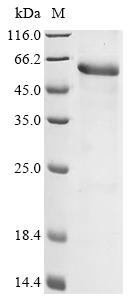
N-terminal 10xHis-tagged and C-terminal Myc-tagged
Form
Liquid or Lyophilized powder
Buffer
If the delivery form is liquid, the default storage buffer is Tris/PBS-based buffer, 5%-50% glycerol.
If the delivery form is lyophilized powder, the buffer before lyophilization is Tris/PBS-based buffer, 6% Trehalose.
Reconstitution
We recommend that this vial be briefly centrifuged prior to opening to bring the contents to the bottom. Please reconstitute protein in deionized sterile water to a concentration of 0.1-1.0 mg/mL.We recommend to add 5-50% of glycerol (final concentration) and aliquot for long-term storage at -20℃/-80℃. Our default final concentration of glycerol is 50%. Customers could use it as reference.
Storage
The shelf life is related to many factors, storage state, buffer ingredients, storage temperature and the stability of the protein itself.
Generally, the shelf life of liquid form is 6 months at -20°C/-80°C. The shelf life of lyophilized form is 12 months at -20°C/-80°C.
Shelf Life
The shelf life is related to many factors, storage state, buffer ingredients, storage temperature and the stability of the protein itself.
Generally, the shelf life of liquid form is 6 months at -20°C/-80°C. The shelf life of lyophilized form is 12 months at -20°C/-80°C.
Lead Time
Delivery time may differ from different purchasing way or location, please kindly consult your local distributors for specific delivery time.
Notes
Repeated freezing and thawing is not recommended. Store working aliquots at 4°C for up to one week.
Tumor suppressor. Promotes rapid degradation of CTNNB1 and participates in Wnt signaling as a negative regulator. APC activity is correlated with its phosphorylation state. Activates the GEF activity of SPATA13 and ARHGEF4. Plays a role in hepatocyte growth factor (HGF)-induced cell migration. Required for MMP9 up-regulation via the JNK signaling pathway in colorectal tumor cells. Acts as a mediator of ERBB2-dependent stabilization of microtubules at the cell cortex. It is required for the localization of MACF1 to the cell membrane and this localization of MACF1 is critical for its function in microtubule stabilization.
Gene References into Functions
elevated expression of miR-494 promotes cell proliferation and tumorigenesis in CRC by suppressing the expression of APC, an inhibitor of beta-catenin signaling. These findings uncover a novel molecular mechanism for the hyperactivation of the Wnt/beta-catenin signaling pathway in CRC.PMID:29304823
Study reveal an unexpected role of APC in the directional spread of HIV-1 by promoting the directional assembly of viral components at virological synapses, thereby facilitating cell-to-cell viral transmission.PMID:28134256
Because of low sensitivity, APC gene promoter methylation in serum was not suitable for breast cancer (BC) screening. However, as specificity was very high, detection of serum APC gene promoter methylation could be used as tool to confirm BC.PMID:29297603
Multivariate analyses revealed that the PIK3CA mutation and clinical T stage were independent favorable prognostic factors (hazard ratio 0.34, 95% confidence interval: 0.12-0.96, p = 0.042). PIK3CA mutations were significantly associated with APC alterations (p = 0.0007) and BRAF mutations (p = 0.0090).PMID:30115035
A novel APC frameshift mutation has been identified in a large Chinese family with familial adenomatous polyposis.PMID:29901124
In the two wild type (WT) cases, two novel alterations were detected: a complex deletion of APC and a pathogenic mutation of LAMTOR2. Focusing on WT DT subtype, deep sequencing of CTNNB1, APC and LAMTOR2 was conducted on a retrospective series of 11 WT DT using a targeted approachPMID:29901254
This study demonstrates a prognostic role for APC.PMID:27302369
There is a certain correlation between the APC gene and ovarian tumors, and the APC gene mediates the apoptosis of tumor cells through the MDR-1/CLCX-1 signaling pathway.PMID:29921377
Its mutation is identified in duodenal adenoma and it involves in development of duodenal cancers.PMID:29525853
We have investigated if the initial source of intratumoral heterogeneity is consequent to multiple independent lineages derived from different crypts harboring distinct truncal APC and driver KRAS mutations, thus challenging the prevailing monoclonal monocryptal model.PMID:28645942
methylation-dependent silencing of the APC gene promoter 1A is a mechanism that contributes to the activation of Wnt signaling pathway in cervical cancer cells infected by high risk HPV16.PMID:29115417
miR-3607 contributes to lung cancer cell proliferation by inhibiting APC.PMID:28866416
USP7 depletion in APC-mutated colorectal cancer inhibits Wnt activation by restoring beta-catenin ubiquitination, drives differentiation, and suppresses xenograft tumor growth.PMID:29045831
Data suggest that the concurrent mutations of the adenomatous polyposis coli protein (APC) and mutL protein homolog 1 (MLH1) genes probably underline the familial adenomatous polyposis (FAP) in the pedigree.PMID:29419868
The expression of APC-DeltaC in colon cells reduces the accumulation of mitotic cells upon PLK1 inhibition, accelerates mitotic exit and increases the survival of cells with enhanced chromosomal abnormalities.PMID:29549256
our results suggest that the amount of APC expression is the rate-limiting factor for the constitution of beta-catenin destruction complexes.PMID:28810742
APC defines Treg differentiation and anti-inflammatory function through microtubule-mediated NFAT localization.PMID:28978472
Data show that tumor suppressor adenomatous polyposis coli (APC) loss results in up-regulation of IL-6 signal transducer (IL-6ST/gp130), thereby activating YAP (YY1-associated) protein (YAP) which are simultaneously up-regulated in the majority of colorectal cancer (CRC).PMID:28130546
The results indicate that APC promoter hypermethylation is an early event in carcinogenesis of CRC, could be a valuable diagnostic marker for early-stage CRC. APC methylation is not significantly associated with overall survival in patients with CRC.PMID:28515349
the promoters of WIF1, NLK, and APC are highly methylated in the nasopharyngeal cancers (NPC) and gastric carcinoma (GC) cell lines, and the 3 genes are also regulated by miR-BART19-3p expressed by Epstein-Barr virus (EBV); expression of the WIF1, APC, and NLK genes is strongly affected by hypermethylation, and in EBV-associated tumors, the 3 genes are also affected by miR-BART19-3pPMID:28543390
The model we propose is a variation of the currently existing model and hypothesizes that, in a subgroup of colorectal carcinomas, K-ras mutation may precede APC inactivation, representing the earliest driving force and, probably, an early biomarker of colorectal carcinogenesis.PMID:28652417
We conclude that among multiple genomic alterations in CRC, strongest associations with clinical outcome were observed for common mutations in APC.PMID:27729614
Studies reveal that the proportion of APC promoter 1A methylation in non-small cell lung cancer (NSCLC) tissues was higher than in autologous controls, indicating that promoter 1A methylation of the APC gene may play an important role in NSCLC carcinogenesis. [meta-analysis]PMID:28497891
E-cadherin inhibits beta-catenin in the context of disruption of the APC-destruction complex, and that this function is also EC1 domain dependent. Both binding functions of E-cadherin may be required for its tumour suppressor activity.PMID:27566565
analysis of the largest deletion of the APC gene in the Chinese population associated with familial adenomatous polyposis in a five generation familyPMID:27391059
APC promoter methylation was associated with breast cancer risk, and it could be a valuable biomarker for diagnosis, treatment and prognosis of breast cancer (Meta-Analysis)PMID:27191268
A novel APC promoter 1B deletion is associated with familial adenomatous polyposis in generations of a large Italian family.PMID:28791770
Study is the first to demonstrate that EphB6 overexpression together with Apc gene mutations may enhance proliferation, invasion and metastasis by colorectal epithelial cells.PMID:27145271
Promoter methylation was detected in 30.67% breast cancer tissues and was associated with low histological grade.PMID:28164568
Utilizing zebrafish to examine the genetic relationship between MPC1 and Adenomatous polyposis coli (APC), a key tumor suppressor in colorectal cancer, the authors found that apc controls the levels of mpc1 and that knock down of mpc1 recapitulates phenotypes of impaired apc function including failed intestinal differentiation.PMID:28397687
Multiple pilomatrixomas in a survivor of WNT-activated medulloblastoma leading to the discovery of a germline APC mutation and the diagnosis of familial adenomatous polyposisPMID:28792655
FZR1 inhibits BRAF oncogenic functions via both APC-dependent proteolysis and APC-independent disruption of BRAF dimers, whereas hyperactivated ERK and CDK4 reciprocally suppress APC(FZR1) E3 ligase activityPMID:28174173
we present a clinical molecular study of a four generation Chinese family with a novel splice-acceptor site mutation causing Familial adenomatous polyposisPMID:28423518
Establish a role for APC in coordinating microtubules and actin cytoskeleton at focal adhesions to direct cell migration.PMID:28663347
Germline mutation in the APC gene is associated with familial adenomatous polyposis.PMID:28010732
beta-catenin reactivity was noted in all familial adenomatous polyposis-associated Gardner fibromas and in 1/4 APC wild-type casesPMID:26840078
The rs75612255 C allele and rs113017087 C allele in promoter 1A of APC as well as the rs138386816 T allele and rs115658307 T allele in promoter 1B of APC significantly increased luciferase activity in the human erythromyeloblastoid leukaemia cell line K562.PMID:28105931
Functional redundancy between Apc and Apc2 regulates tissue homeostasis and prevents tumorigenesis in murine mammary epitheliumPMID:27694902
Finally, we observed that expression of miR-19a significantly correlates with beta-catenin levels in colorectal cancer specimens, and it is associated to the aggressive stage of tumor progression. Thus, our study reveals that miR-17-92 cluster is directly regulated by APC/b-catenin pathway and could be a potential therapeutic target in colon cancers with aberrant APC/b-catenin signaling.PMID:26804172
Findings show that colorectal Cancer patients-derived cells with short APC mutants were either sensitive or responsive to tankyrase inhibitors corroborating the idea that APC with complete deletion of seven 20-AA repeats could be a predictive biomarker for the sensitivity to tankyrase inhibitors.PMID:28179481
Our study showed that mutations in the APC gene alter the protein expression and cell cycle regulation in diffuse type gastric adenocarcinoma.PMID:28576136
Gasdermin C is upregulated by inactivation of Tgfbr2 in the presence of mutated Apc, promoting colorectal cancer cell proliferation.PMID:27835699
Nine patients with 21- approximately 100 colorectal adenomas (50%) and the two positive controls, showed somatic mosaicism, with identical APC variants in adenomas tested.PMID:27816598
These result suggested that miR-590-3p can promote osteogenic differentiation via suppressing APC expression and stabilizing beta-catenin.PMID:27586273
The present findings indicate epigenetic silencing of APC in advanced gallbladder cancer (GBC). The methylation pattern, followed by expression analysis of APC may be suggested for diagnostic, prognostic and therapeutic purposes in GBC in futurePMID:27748282
miR-106a-5p is involved in the invasive behavior of glioblastoma cells and by targeting APC and activating Wnt/beta-catenin pathway.PMID:27815074
Point Mutations in Exon 1B of APC Reveal Similar mutations in APC promoter 1B occur in rare families with familial adenomatous polyposisPMID:27087319
Studies suggest that both loss of tumor suppressive function and gain of function of APC mutants play critical roles in colorectal cancers (CRC) tumorigenesis.PMID:28423402
Loss of heterozygosity of TP53, P16, SMAD4 and APC genes was observed in esophageal adenocarcinoma.PMID:28376920
miR-582-5P was upregulated in the colorectal cancer specimens and cell lines and targeted the 3' untranslated region of APC directly.PMID:27595705
Expressed in a variety of tissues: brain, small intestine, colon, thymus, skeletal muscle, heart, prostate, lung, spleen, ovary, testis kidney, placenta, blood and liver. Isoform 1A: Very strongly expressed in brain but has relatively low expression level