Recombinant Human AP-2 complex subunit sigma (AP2S1)

In Stock
Code: CSB-EP001873HU
Size:
20ug
20ug100ug1mg(1mg*1 or 500ug*2)
US$306
Quantity:
Express system: E.coli
Species: Homo sapiens (Human)
Tag Info: C-terminal 6xHis-tagged
For inquiries on large quantities or another requirements
Send an Inquiry
Start an on-line Chat
Online ordering is currently available for U.S. customers only. For orders outside the U.S., please kindly submit an inquiry or start a chat with us.

Product Details

Purity
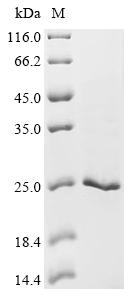
Greater than 90% as determined by SDS-PAGE.
Activity
Not Test
Target Names
AP2S1
Uniprot NO.
Research Area
Signal Transduction
Alternative Names
Adaptor protein complex AP-2 subunit sigma;Adaptor-related protein complex 2 subunit sigma;Clathrin assembly protein 2 sigma small chain;Clathrin coat assembly protein AP17;Clathrin coat-associated protein AP17;HA2 17 kDa subunit;Plasma membrane adaptor AP-2 17 kDa protein;Sigma2-adaptin
Species
Homo sapiens (Human)
Source
E.coli
Expression Region
1-142aa
Target Protein Sequence
MIRFILIQNRAGKTRLAKWYMQFDDDEKQKLIEEVHAVVTVRDAKHTNFVEFRNFKIIYRRYAGLYFCICVDVNDNNLAYLEAIHNFVEVLNEYFHNVCELDLVFNFYKVYTVVDEMFLAGEIRETSQTKVLKQLLMLQSLE
Note: The complete sequence may include tag sequence, target protein sequence, linker sequence and extra sequence that is translated with the protein sequence for the purpose(s) of secretion, stability, solubility, etc.
If the exact amino acid sequence of this recombinant protein is critical to your application, please explicitly request the full and complete sequence of this protein before ordering.
Mol. Weight
23.9 kDa
Protein Length
Full Length
Tag Info
C-terminal 6xHis-tagged
The tag type will be determined during production process. If you have specified tag type, please tell us and we will develop the specified tag preferentially.
Form
Liquid or Lyophilized powder
Note: We will preferentially ship the format that we have in stock, however, if you have any special requirement for the format, please remark your requirement when placing the order, we will prepare according to your demand.
Buffer
If the delivery form is liquid, the default storage buffer is Tris/PBS-based buffer, 5%-50% glycerol. If the delivery form is lyophilized powder, the buffer before lyophilization is Tris/PBS-based buffer, 6% Trehalose.
Reconstitution
We recommend that this vial be briefly centrifuged prior to opening to bring the contents to the bottom. Please reconstitute protein in deionized sterile water to a concentration of 0.1-1.0 mg/mL.We recommend to add 5-50% of glycerol (final concentration) and aliquot for long-term storage at -20℃/-80℃. Our default final concentration of glycerol is 50%. Customers could use it as reference.
Storage Condition
The shelf life is related to many factors, storage state, buffer ingredients, storage temperature and the stability of the protein itself. Generally, the shelf life of liquid form is 6 months at -20°C/-80°C. The shelf life of lyophilized form is 12 months at -20°C/-80°C.
Shelf Life
The shelf life is related to many factors, storage state, buffer ingredients, storage temperature and the stability of the protein itself.
Generally, the shelf life of liquid form is 6 months at -20°C/-80°C. The shelf life of lyophilized form is 12 months at -20°C/-80°C.
Lead Time
3-7 business days
Note: All of our proteins are default shipped with normal blue ice packs, if you request to ship with dry ice, please communicate with us in advance and extra fees will be charged.
Notes
Repeated freezing and thawing is not recommended. Store working aliquots at 4℃ for up to one week.
Troubleshooting and FAQs
Datasheet & COA
Please contact us to get it.
Images
  • (Tris-Glycine gel) Discontinuous SDS-PAGE (reduced) with 5% enrichment gel and 15% separation gel.

Customer Reviews and Q&A

 Customer Reviews

Target Background

Function(From Uniprot)
Component of the adaptor protein complex 2 (AP-2). Adaptor protein complexes function in protein Transport via Transport vesicles in different membrane traffic pathways. Adaptor protein complexes are vesicle coat components and appear to be involved in cargo selection and vesicle formation. AP-2 is involved in clathrin-dependent endocytosis in which cargo proteins are incorporated into vesicles surrounded by clathrin (clathrin-coated vesicles, CCVs) which are destined for fusion with the early endosome. The clathrin lattice serves as a mechanical scaffold but is itself unable to bind directly to membrane components. Clathrin-associated adaptor protein (AP) complexes which can bind directly to both the clathrin lattice and to the lipid and protein components of membranes are considered to be the major clathrin adaptors contributing the CCV formation. AP-2 also serves as a cargo receptor to selectively sort the membrane proteins involved in receptor-mediated endocytosis. AP-2 seems to play a role in the recycling of synaptic vesicle membranes from the presynaptic surface. AP-2 recognizes Y-X-X-[FILMV] (Y-X-X-Phi) and [ED]-X-X-X-L-[LI] endocytosis signal motifs within the cytosolic tails of transmembrane cargo molecules. AP-2 may also play a role in maintaining normal post-endocytic trafficking through the ARF6-regulated, non-clathrin pathway. The AP-2 alpha and AP-2 sigma subunits are thought to contribute to the recognition of the [ED]-X-X-X-L-[LI] motif. May also play a role in extracellular calcium homeostasis.
Gene References into Functions
  1. In 33 CASR-negative patients with suspected FHH, Data found two (~6%) with a mutation in AP2S1 (p.Arg15Leu and p.Arg15His). Family screening confirmed the genotype-phenotype correlations. Data did not identify any pathogenic mutations in GNA11. PMID:27913609
  2. our studies demonstrate AP2sigma2 mutations to result in a more severe FHH phenotype with genotype-phenotype correlations, and a dominant-negative mechanism of action with mutational bias at the Arg15 residue. PMID:26082470
  3. The results affirm that a significant number of patients suspected of having Familial hypocalciuric hypercalcemia but proven negative for CASR mutation have AP2S1 p.R15 mutations. PMID:24731014
  4. The absence of AP2S1 abnormalities in hypocalcemic patients, suggests that autosomal dominant hypocalcemia 3 (ADH3) may not occur or otherwise represents a rare hypocalcemic disorder. PMID:24708097
  5. None of the 60 patients presented with nucleotidic changes or copy number variation in the AP2S1 gene, thereby excluding AP2S1 defects as a frequent cause of isolated hypoparathyroidism. PMID:24423332
  6. Mutations in AP2S1 cause familial hypocalciuric hypercalcemia type 3. PMID:23222959

Show More

Hide All

Subcellular Location
Cell membrane. Membrane, coated pit; Peripheral membrane protein; Cytoplasmic side.
Protein Families
Adaptor complexes small subunit family
Database Links

HGNC: 565

UNIGENE: Hs.119591

KEGG: hsa:1175

STRING: 9606.ENSP00000263270

OMIM: 600740

icon of phone
Call us
301-363-4651 (Available 9 a.m. to 5 p.m. CST from Monday to Friday)
icon of address
Address
No. 269, Shendun 5th Road, Donghu Hi-Tech Development Area, Hubei Province, 430206, P.R.China
icon of social media
Join us with

Subscribe newsletter

Leave a message

* To protect against spam, please pass the CAPTCHA test below.
CAPTCHA verification
© 2007-2025 CUSABIO TECHNOLOGY LLC All rights reserved. 鄂ICP备15011166号-1
Select 0 Products