Recombinant Horse Growth/differentiation factor 8 (MSTN)

Code: CSB-EP861952HO
Size:
20ug
20ug100ug1mg(1mg*1 or 500ug*2)
US$388
Quantity:
Express system: E.coli
Species: Equus caballus (Horse)
Tag Info: N-terminal 6xHis-tagged
For inquiries on large quantities or another requirements
Send an Inquiry
Start an on-line Chat
Online ordering is currently available for U.S. customers only. For orders outside the U.S., please kindly submit an inquiry or start a chat with us.

Product Details

Purity
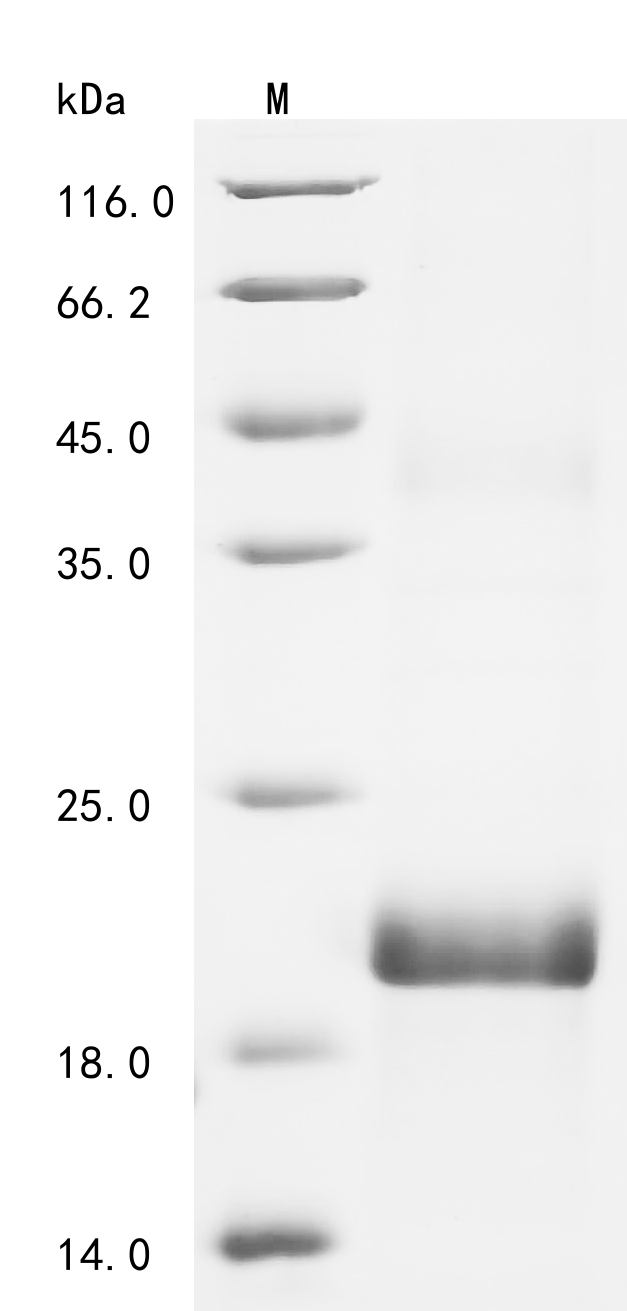
Greater than 90% as determined by SDS-PAGE.
Target Names
MSTN
Uniprot NO.
Research Area
Cancer
Species
Equus caballus (Horse)
Source
E.coli
Expression Region
267-375aa
Target Protein Sequence
DFGLDCDEHSTESRCCRYPLTVDFEAFGWDWIIAPKRYKANYCSGECEFVFLQKYPHTHLVHQANPRGSAGPCCTPTKMSPINMLYFNGKEQIIYGKIPAMVVDRCGCS
Note: The complete sequence may include tag sequence, target protein sequence, linker sequence and extra sequence that is translated with the protein sequence for the purpose(s) of secretion, stability, solubility, etc.
If the exact amino acid sequence of this recombinant protein is critical to your application, please explicitly request the full and complete sequence of this protein before ordering.
Mol. Weight
18.4 kDa
Protein Length
Full Length of Mature Protein
Tag Info
N-terminal 6xHis-tagged
The tag type will be determined during production process. If you have specified tag type, please tell us and we will develop the specified tag preferentially.
Form
Liquid or Lyophilized powder
Note: We will preferentially ship the format that we have in stock, however, if you have any special requirement for the format, please remark your requirement when placing the order, we will prepare according to your demand.
Buffer
If the delivery form is liquid, the default storage buffer is Tris/PBS-based buffer, 5%-50% glycerol. If the delivery form is lyophilized powder, the buffer before lyophilization is Tris/PBS-based buffer, 6% Trehalose.
Reconstitution
We recommend that this vial be briefly centrifuged prior to opening to bring the contents to the bottom. Please reconstitute protein in deionized sterile water to a concentration of 0.1-1.0 mg/mL.We recommend to add 5-50% of glycerol (final concentration) and aliquot for long-term storage at -20℃/-80℃. Our default final concentration of glycerol is 50%. Customers could use it as reference.
Storage Condition
The shelf life is related to many factors, storage state, buffer ingredients, storage temperature and the stability of the protein itself. Generally, the shelf life of liquid form is 6 months at -20°C/-80°C. The shelf life of lyophilized form is 12 months at -20°C/-80°C.
Shelf Life
The shelf life is related to many factors, storage state, buffer ingredients, storage temperature and the stability of the protein itself.
Generally, the shelf life of liquid form is 6 months at -20°C/-80°C. The shelf life of lyophilized form is 12 months at -20°C/-80°C.
Lead Time
Delivery time may differ from different purchasing way or location, please kindly consult your local distributors for specific delivery time.
Note: All of our proteins are default shipped with normal blue ice packs, if you request to ship with dry ice, please communicate with us in advance and extra fees will be charged.
Notes
Repeated freezing and thawing is not recommended. Store working aliquots at 4°C for up to one week.
Troubleshooting and FAQs
Datasheet & COA
Please contact us to get it.
Images
  • (Tris-Glycine gel) Discontinuous SDS-PAGE (reduced) with 5% enrichment gel and 15% separation gel.

Customer Reviews and Q&A

 Customer Reviews

Target Background

Function(From Uniprot)
Acts specifically as a negative regulator of skeletal muscle growth.
Gene References into Functions
  1. The association between a single nucleotide polymorphism and hypertrophy of muscle fiber in racehorses was studied. PMID:29058242
  2. identified several mitochondrial phenotypes associated with MSTN genotype in untrained Thoroughbred horses and in addition, our findings suggest that nutritional supplementation with CoQ may aid to restore coenzyme Q activity in TT/NN horses PMID:29190290
  3. The effect of an Equine Repetitive Element 1 insertion in the promoter of the myostatin gene, which is involved in muscle development, was also investigated. PMID:26503543
  4. Myostatin mRNA but not protein was increased in skeletal muscle of obese compared with lean animals. Myostatin mRNA was increased in crest fat of obese animals and protein was undetectable. Serum myostatin was higher in obese than lean animals. PMID:25390640
  5. All three target polymorphisms (Ins227bp, g.66493737 T succeeds C, BIEC2-417495) are suitable markers to assess the ability of non-elite Thoroughbreds to race at short or longer distances. PMID:26100061
  6. Genotype frequencies in Icelandic horses vary depending on whether the horses were used for meat or riding PMID:26095686
  7. The tissue-specific presence of myostatin, the moystatin receptor (activin receptor IIB, ActRIIB), follistatin and perilipin, genes and proteins across a range of equine tissues, were examined. PMID:24956155
  8. The SINE insertion was genotyped in 227 horses from 10 breeds belonging to different morphological types (brachimorphic, mesomorphic, meso-dolichomorphic and dolichomorphic). PMID:25273961
  9. The candidate for racing performance genomic region contained eight genes annotated by ENSEMBL, including the myostatin gene (MSTN). PMID:21070273
  10. Polymorphisms of the MSTN promoter region in 5 horse breeds in Poland are reported. PMID:25403076
  11. significant association observed between genotype and mRNA abundance for untrained horses with the C/C cohort having highest MSTN mRNA levels,T/T group lowest levels and C/T group intermediate levels; following training there was significant decrease in MSTN mRNA which was most apparent for the C/C cohort PMID:22497477
  12. Exon 2 of the MSTN gene, which encodes part of the TGF-beta pro-peptide, was sequenced in 332 horses of 20 different breeds and compared with the horse MSTN gene sequence deposited in GenBank. The sequences obtained revealed the presence of 11 haplotypes represented by 10 variable nucleotide mutations, eight of them corresponding to amino acid sequence changes. PMID:22404361
  13. Variation at the MSTN gene influences speed in Thoroughbred horses. PMID:22016373
  14. This study demonstrates that the g.66493737C>T single nucleotide polymorphism in MSTN provides the most powerful genetic marker for prediction of race distance aptitude in Thoroughbreds. PMID:20932346
  15. Characterized the horse (Equus caballus) MSTN gene and identified and analysed single nucleotide polymorphisms (SNPs) in breeds of different morphological types. PMID:20706663

Show More

Hide All

Subcellular Location
Secreted.
Protein Families
TGF-beta family
Database Links
icon of phone
Call us
301-363-4651 (Available 9 a.m. to 5 p.m. CST from Monday to Friday)
icon of address
Address
No. 269, Shendun 5th Road, Donghu Hi-Tech Development Area, Hubei Province, 430206, P.R.China
icon of social media
Join us with

Subscribe newsletter

Leave a message

* To protect against spam, please pass the CAPTCHA test below.
CAPTCHA verification
© 2007-2025 CUSABIO TECHNOLOGY LLC All rights reserved. 鄂ICP备15011166号-1
Select 0 Products