Recombinant Clostridium perfringens Phospholipase C (plc)

In Stock
Code: CSB-EP314672CMB
Size:
20ug
20ug100ug1mg(1mg*1 or 500ug*2)
US$388
Quantity:
Express system: E.coli
Species: Clostridium perfringens (strain 13 / Type A)
Tag Info: N-terminal 6xHis-tagged
For inquiries on large quantities or another requirements
Send an Inquiry
Start an on-line Chat
Online ordering is currently available for U.S. customers only. For orders outside the U.S., please kindly submit an inquiry or start a chat with us.

Product Details

Purity
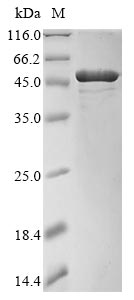
Greater than 85% as determined by SDS-PAGE.
Target Names
plc
Uniprot NO.
Research Area
Signal Transduction
Alternative Names
Alpha-toxin (Hemolysin) (Lecithinase) (Phosphatidylcholine cholinephosphohydrolase)
Species
Clostridium perfringens (strain 13 / Type A)
Source
E.coli
Expression Region
29-398aa
Target Protein Sequence
WDGKIDGTGTHAMIVTQGVSILENDLSKNEPESVRKNLEILKENMHELQLGSTYPDYDKNAYDLYQDHFWDPDTDNNFSKDNSWYLAYSIPDTGESQIRKFSALARYEWQRGNYKQATFYLGEAMHYFGDIDTPYHPANVTAVDSAGHVKFETFAEERKEQYKINTAGCKTNEDFYADILKNKDFNAWSKEYARGFAKTGKSIYYSHASMSHSWDDWDYAAKVTLANSQKGTAGYIYRFLHDVSEGNDPSVGKNVKELVAYISTSGEKDAGTDDYMYFGIKTKDGKTQEWEMDNPGNDFMTGSKDTYTFKLKDENLKIDDIQNMWIRKRKYTAFPDAYKPENIKIIANGKVVVDKDINEWISGNSTYNIK
Note: The complete sequence may include tag sequence, target protein sequence, linker sequence and extra sequence that is translated with the protein sequence for the purpose(s) of secretion, stability, solubility, etc.
If the exact amino acid sequence of this recombinant protein is critical to your application, please explicitly request the full and complete sequence of this protein before ordering.
Mol. Weight
48.5 kDa
Protein Length
Full Length of Mature Protein
Tag Info
N-terminal 6xHis-tagged
The tag type will be determined during production process. If you have specified tag type, please tell us and we will develop the specified tag preferentially.
Form
Liquid or Lyophilized powder
Note: We will preferentially ship the format that we have in stock, however, if you have any special requirement for the format, please remark your requirement when placing the order, we will prepare according to your demand.
Buffer
If the delivery form is liquid, the default storage buffer is Tris/PBS-based buffer, 5%-50% glycerol. If the delivery form is lyophilized powder, the buffer before lyophilization is Tris/PBS-based buffer, 6% Trehalose.
Reconstitution
We recommend that this vial be briefly centrifuged prior to opening to bring the contents to the bottom. Please reconstitute protein in deionized sterile water to a concentration of 0.1-1.0 mg/mL.We recommend to add 5-50% of glycerol (final concentration) and aliquot for long-term storage at -20°C/-80°C. Our default final concentration of glycerol is 50%. Customers could use it as reference.
Storage Condition
The shelf life is related to many factors, storage state, buffer ingredients, storage temperature and the stability of the protein itself. Generally, the shelf life of liquid form is 6 months at -20°C/-80°C. The shelf life of lyophilized form is 12 months at -20°C/-80°C.
Shelf Life
The shelf life is related to many factors, storage state, buffer ingredients, storage temperature and the stability of the protein itself.
Generally, the shelf life of liquid form is 6 months at -20°C/-80°C. The shelf life of lyophilized form is 12 months at -20°C/-80°C.
Lead Time
3-7 business days
Note: All of our proteins are default shipped with normal blue ice packs, if you request to ship with dry ice, please communicate with us in advance and extra fees will be charged.
Notes
Repeated freezing and thawing is not recommended. Store working aliquots at 4°C for up to one week.
Troubleshooting and FAQs
Datasheet & COA
Please contact us to get it.
Images
  • (Tris-Glycine gel) Discontinuous SDS-PAGE (reduced) with 5% enrichment gel and 15% separation gel.
Description

Constructing a plasmid encoding the Clostridium perfringens perfringens Phospholipase C (PLC) protein (29-398aa) and the N-terminal 6xHis-tag is the initial step in the general approach to express the recombinant Clostridium perfringens PLC protein. The plasmid is then transformed into E.coli cells. Positive E.coli cells are selected and cultured, protein expression is induced, and cells are lysed. The resulting recombinant Clostridium perfringens PLC protein is then purified through affinity purification, and SDS-PAGE analysis is carried out to verify the presence and assess the purity of the protein. Its purity exceeds 85%.

PLC is a crucial enzyme that helps cells communicate, especially when they're responding to hormones, neurotransmitters, or chemical signals. When activated by these signals, PLC breaks down a molecule called phosphatidylinositol 4,5-bisphosphate (PIP2) into two important substances: inositol 1,4,5-trisphosphate (InsP3) and diacylglycerol (DAG) [1]. These substances are like messengers inside cells and help control things like calcium levels, secretion, cell growth, and changes in cell function [1]. PLC gets switched on by special proteins called G protein-coupled receptors (GPCRs), which also control other parts of the cell [2]. Besides its role in cell signaling, PLC is involved in various other cell activities, like turning on enzymes and affecting how certain substances interact with cell membranes [3][4][5].

Scientists have found PLC in different tiny organisms, like certain bacteria and yeast, suggesting it might help these organisms cause diseases [6][7]. The activity of PLC is influenced by other cell components, such as Na+/H+ exchanger regulatory factor 2 and protein kinase C, showing how complex the control of PLC can be [8][5]. Also, researchers have figured out the detailed structure of PLC from a bacteria called Listeria monocytogenes, which gives us more insights into how this enzyme works in disease-causing bacteria [9].

References:
[1] C. Bizzarri, M. Girolamo, M. D’Orazio, & D. Corda, Evidence that a guanine nucleotide-binding protein linked to a muscarinic receptor inhibits directly phospholipase c., Proceedings of the National Academy of Sciences, vol. 87, no. 12, p. 4889-4893, 1990. https://doi.org/10.1073/pnas.87.12.4889
[2] A. Barr, H. Ali, B. Haribabu, R. Snyderman, & A. Smrcka, Identification of a region at the n-terminus of phospholipase c-β3 that interacts with g protein βγ subunits, Biochemistry, vol. 39, no. 7, p. 1800-1806, 2000. https://doi.org/10.1021/bi992021f
[3] J. Parrish and D. Nichols, Serotonin 5‐ht2a receptor activation induces 2‐arachidonoylglycerol release through a phospholipase c‐dependent mechanism, Journal of Neurochemistry, vol. 99, no. 4, p. 1164-1175, 2006. https://doi.org/10.1111/j.1471-4159.2006.04173.x
[4] V. Mellay, B. Grosse, & M. Lieberherr, Phospholipase c β and membrane action of calcitriol and estradiol, Journal of Biological Chemistry, vol. 272, no. 18, p. 11902-11907, 1997. https://doi.org/10.1074/jbc.272.18.11902
[5] S. Chakraborti, J. Michael, & T. Sanyal, Defining the role of protein kinase c in calcium‐ionophore‐(a23187)‐mediated activation of phospholipase a2 in pulmonary endothelium, European Journal of Biochemistry, vol. 206, no. 3, p. 965-972, 1992. https://doi.org/10.1111/j.1432-1033.1992.tb17007.x
[6] A. Gómez, A. Mve-Obiang, B. Vray, W. Rudnicka, I. Shamputa, F. Portaelset al., Detection of phospholipase c in nontuberculous mycobacteria and its possible role in hemolytic activity, Journal of Clinical Microbiology, vol. 39, no. 4, p. 1396-1401, 2001. https://doi.org/10.1128/jcm.39.4.1396-1401.2001
[7] M. Niewerth and H. Korting, Phospholipases of candida albicans, Mycoses, vol. 44, no. 9-10, p. 361-367, 2001. https://doi.org/10.1046/j.1439-0507.2001.00685.x
[8] J. Hwang, K. Heo, K. Shin, E. Kim, C. Yun, S. Ryuet al., Regulation of phospholipase c-β3 activity by na+/h+ exchanger regulatory factor 2, Journal of Biological Chemistry, vol. 275, no. 22, p. 16632-16637, 2000. https://doi.org/10.1074/jbc.m001410200
[9] J. Moser, B. Gerstel, J. Meyer, T. Chakraborty, J. Wehland, & D. Heinz, Crystal structure of the phosphatidylinositol-specific phospholipase c from the human pathogen listeria monocytogenes, Journal of Molecular Biology, vol. 273, no. 1, p. 269-282, 1997. https://doi.org/10.1006/jmbi.1997.1290

Customer Reviews and Q&A

 Customer Reviews

Target Background

Function(From Uniprot)
Bacterial hemolysins are exotoxins that attack blood cell membranes and cause cell rupture. Constitutes an essential virulence factor in gas gangrene. Binds to eukaryotic membranes where it hydrolyzes both phosphatidylcholine and sphingomyelin. The diacylglycerol produced can activate both the arachidonic acid pathway, leading to modulation of the inflammatory response cascade and thrombosis, and protein kinase C, leading to activation of eukaryotic phospholipases and further membrane damage. Acts on human and mouse erythrocytes, but not on rabbit or horse erythrocytes.
Subcellular Location
Secreted.
Protein Families
Bacterial zinc-metallophospholipase C family
Database Links

KEGG: cpe:CPE0036

icon of phone
Call us
301-363-4651 (Available 9 a.m. to 5 p.m. CST from Monday to Friday)

icon of address
Address
No. 269, Shendun 5th Road, Donghu Hi-Tech Development Area, Hubei Province, 430206, P.R.China
icon of social media
Join us with

Subscribe newsletter

Leave a message

* To protect against spam, please pass the CAPTCHA test below.
CAPTCHA verification
© 2007-2025 CUSABIO TECHNOLOGY LLC All rights reserved. 鄂ICP备15011166号-1
Select 0 Products