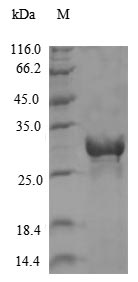
Purity
Greater than 90% as determined by SDS-PAGE.
Alternative Names
Polyprotein P1234; P1234; Non-structural polyprotein) [Cleaved into: Polyprotein P123; P123); mRNA-capping enzyme nsP1; EC 2.1.1.-; EC 2.7.7.-; Non-structural protein 1); Protease nsP2; EC 3.1.3.33; EC 3.4.22.-; EC 3.6.1.15; EC 3.6.4.13; Non-structural protein 2; nsP2); Non-structural protein 3; nsP3; EC 3.1.3.84); RNA-directed RNA polymerase nsP4; EC 2.7.7.19; EC 2.7.7.48; Non-structural protein 4; nsP4)]
Species
Chikungunya virus (strain S27-African prototype) (CHIKV)
Expression Region
2228-2474aa
Target Protein Sequence
DTVLETDIASFDKSQDDSLALTALMLLEDLGVDHSLLDLIEAAFGEISSCHLPTGTRFKFGAMMKSGMFLTLFVNTLLNITIASRVLEDRLTKSACAAFIGDDNIIHGVVSDELMAARCATWMNMEVKIIDAVVSQKAPYFCGGFILHDIVTGTACRVADPLKRLFKLGKPLAAGDEQDEDRRRALADEVVRWQRTGLIDELEKAVYSRYEVQGISVVVMSMATFASSRSNFEKLRGPVVTLYGGPK
Note: The complete
sequence may include tag sequence, target protein sequence, linker sequence and extra sequence that is
translated with the protein sequence for the purpose(s) of secretion, stability, solubility, etc.
If the exact amino acid sequence of this recombinant protein is critical to your application,
please explicitly request the full and complete sequence of this protein before ordering.
Tag Info
N-terminal 6xHis-tagged
The tag type will be determined during production process. If you have specified tag type, please tell us and we will develop the specified tag preferentially.
Reconstitution
We recommend that this vial be briefly centrifuged prior to opening to bring the contents to the bottom. Please reconstitute protein in deionized sterile water to a concentration of 0.1-1.0 mg/mL.We recommend to add 5-50% of glycerol (final concentration) and aliquot for long-term storage at -20°C/-80°C. Our default final concentration of glycerol is 50%. Customers could use it as reference.
Storage Condition
The shelf life is related to many factors, storage state, buffer ingredients, storage temperature and the stability of the protein itself.
Generally, the shelf life of liquid form is 6 months at -20°C/-80°C. The shelf life of lyophilized form is 12 months at -20°C/-80°C.
Shelf Life
The shelf life is related to many factors, storage state, buffer ingredients, storage temperature and the stability of the protein itself.
Generally, the shelf life of liquid form is 6 months at -20°C/-80°C. The shelf life of lyophilized form is 12 months at -20°C/-80°C.
Lead Time
3-7 business days
Note: All of our proteins are default shipped with normal blue ice packs, if you request to ship with dry ice, please communicate with us in advance and extra fees will be charged.
Notes
Repeated freezing and thawing is not recommended. Store working aliquots at 4°C for up to one week.
Datasheet & COA
Please contact us to get it.
Description
Amino acids 2228-2474 form the expressed segment for recombinant Chikungunya virus nsp4. This nsp4 protein is theoretically predicted to have a molecular weight of 31.1 kDa. This nsp4 protein is produced using e.coli expression system. Fusion of the N-terminal 6xHis tag into the nsp4 encoding gene fragment was conducted, allowing for easier detection and purification of the nsp4 protein in subsequent stages.
The Chikungunya virus non-structural polyprotein plays a central role in viral replication and host interaction. Its primary function involves processing into individual non-structural proteins that contribute to viral RNA synthesis. In virology, understanding this polyprotein is crucial for elucidating the Chikungunya virus life cycle and developing antiviral strategies. In immunology, studying the polyprotein aids in unraveling host-virus interactions, informing vaccine design. The polyprotein's role in pathogenesis makes it a target in infectious disease research. Investigating the Chikungunya non-structural polyprotein provides insights into viral replication mechanisms, host immune responses, and antiviral approaches, offering potential applications in virology, immunology, and vaccine development.