Recombinant Chicken Focal adhesion kinase 1 (PTK2), partial

Code: CSB-RP144494CH
Size:
20μg
20μg100μg1mg(1mg*1 or 500ug*2)
US$388
Quantity:
Express system: E.coli
Species: Gallus gallus (Chicken)
Tag Info: N-terminal GST-tagged
For inquiries on large quantities or another requirements
Send an Inquiry
Start an on-line Chat
Online ordering is currently available for U.S. customers only. For orders outside the U.S., please kindly submit an inquiry or start a chat with us.

Product Details

Purity
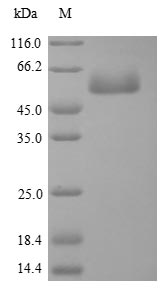
Greater than 90% as determined by SDS-PAGE.
Target Names
PTK2
Uniprot NO.
Research Area
Cancer
Alternative Names
Focal adhesion kinase-related nonkinase ;FRNK ;p41/p43FRNKProtein-tyrosine kinase 2p125FAKpp125FAK
Species
Gallus gallus (Chicken)
Source
E.coli
Expression Region
376-683aa
Target Protein Sequence
LANNEKQGVRSHTVSVSETDDYAEIIDEEDTYTMPSTRDYEIQRERIELGRCIGEGQFGDVHQGIYMSPENPAMAVAIKTCKNCTSDSVREKFLQEALTMRQFDHPHIVKLIGVITENPVWIIMELCTLGELRSFLQVRKFSLDLASLILYAYQLSTALAYLESKRFVHRDIAARNVLVSATDCVKLGDFGLSRYMEDSTYYKASKGKLPIKWMAPESINFRRFTSASDVWMFGVCMWEILMHGVKPFQGVKNNDVIGRIENGERLPMPPNCPPTLYSLMTKCWAYDPSRRPRFTELKAQLSTILEEE
Note: The complete sequence may include tag sequence, target protein sequence, linker sequence and extra sequence that is translated with the protein sequence for the purpose(s) of secretion, stability, solubility, etc.
If the exact amino acid sequence of this recombinant protein is critical to your application, please explicitly request the full and complete sequence of this protein before ordering.
Mol. Weight
62.3kDa
Protein Length
Partial
Tag Info
N-terminal GST-tagged
The tag type will be determined during production process. If you have specified tag type, please tell us and we will develop the specified tag preferentially.
Reconstitution
We recommend that this vial be briefly centrifuged prior to opening to bring the contents to the bottom. Please reconstitute protein in deionized sterile water to a concentration of 0.1-1.0 mg/mL.We recommend to add 5-50% of glycerol (final concentration) and aliquot for long-term storage at -20°C/-80°C. Our default final concentration of glycerol is 50%. Customers could use it as reference.
Storage
The shelf life is related to many factors, storage state, buffer ingredients, storage temperature and the stability of the protein itself. Generally, the shelf life of liquid form is 6 months at -20°C/-80°C. The shelf life of lyophilized form is 12 months at -20°C/-80°C.
Shelf Life
The shelf life is related to many factors, storage state, buffer ingredients, storage temperature and the stability of the protein itself.
Generally, the shelf life of liquid form is 6 months at -20°C/-80°C. The shelf life of lyophilized form is 12 months at -20°C/-80°C.
Lead Time
Delivery time may differ from different purchasing way or location, please kindly consult your local distributors for specific delivery time.
Note: All of our proteins are default shipped with normal blue ice packs, if you request to ship with dry ice, please communicate with us in advance and extra fees will be charged.
Notes
Repeated freezing and thawing is not recommended. Store working aliquots at 4°C for up to one week.
Troubleshooting and FAQs
Datasheet & COA
Please contact us to get it.
Images
  • (Tris-Glycine gel) Discontinuous SDS-PAGE (reduced) with 5% enrichment gel and 15% separation gel.


Customer Reviews and Q&A

 Customer Reviews

Target Background

Function(From Uniprot)
Non-receptor protein-tyrosine kinase that plays an essential role in regulating cell migration, adhesion, spreading, reorganization of the actin cytoskeleton, formation and disassembly of focal adhesions and cell protrusions, cell cycle progression, cell proliferation and apoptosis. Required for early embryonic development, embryonic angiogenesis, normal cardiomyocyte migration and proliferation, and normal heart development. Regulates axon growth and neuronal cell migration, axon branching and synapse formation; required for normal development of the nervous system. Plays a role in osteogenesis and differentiation of osteoblasts. Functions in integrin signal transduction, but also in signaling downstream of numerous growth factor receptors, G-protein coupled receptors (GPCR), ephrin receptors, netrin receptors and LDL receptors. Forms multisubunit signaling complexes with SRC and SRC family members upon activation; this leads to the phosphorylation of additional tyrosine residues, creating binding sites for scaffold proteins, effectors and substrates. Regulates numerous signaling pathways. Promotes activation of phosphatidylinositol 3-kinase and the AKT1 signaling cascade. Promotes activation of MAPK1/ERK2, MAPK3/ERK1 and the MAP kinase signaling cascade. Promotes localized and transient activation of guanine nucleotide exchange factors (GEFs) and GTPase-activating proteins (GAPs), and thereby modulates the activity of Rho family GTPases. Signaling via CAS family members mediates activation of RAC1. Regulates P53/TP53 activity and stability. Phosphorylates SRC; this increases SRC kinase activity. Isoform 2 (FRNK) does not contain a kinase domain and inhibits PTK2/FAK1 phosphorylation and signaling.
Gene References into Functions
  1. FAK-derived peptide binds the SH3 domain in two orientations. PMID:26645346
  2. findings uncover an inhibitory interaction between the FAK FERM domain and sarcomeric myosin that presents potential opportunities to modulate the cardiac hypertrophic response through changes in FAK activity PMID:22101605
  3. Src-dependent FAK phosphorylation is required for focal adhesion turnover and cell migration PMID:15340073
  4. structural features suggest the possibility that protein interactions of the FAK FERM domain can be regulated by binding of Src kinases to the linker segment PMID:16221668
  5. inactivation of p38MAPK down-regulated the level of MMP-2 mRNA and activity, and increased mesenchymal cell condensation in parallel with enhanced phosphorylation of FAK PMID:17604018
  6. These data suggested that the apoptotic effect of transforming growth factor-beta1 on satellite cells is likely associated with a beta1 integrin-mediated focal adhesion kinase signaling pathway. PMID:19590089

Show More

Hide All

Subcellular Location
Cell junction, focal adhesion. Cell membrane; Peripheral membrane protein; Cytoplasmic side. Cytoplasm, perinuclear region. Cytoplasm, cytoskeleton. Cytoplasm, cytoskeleton, microtubule organizing center, centrosome. Nucleus. Cytoplasm, cytoskeleton, cilium basal body.
Protein Families
Protein kinase superfamily, Tyr protein kinase family, FAK subfamily
Database Links
icon of phone
Call us
301-363-4651 (Available 9 a.m. to 5 p.m. CST from Monday to Friday)
icon of address
Address
No. 269, Shendun 5th Road, Donghu Hi-Tech Development Area, Hubei Province, 430206, P.R.China
icon of social media
Join us with

Subscribe newsletter

Leave a message

* To protect against spam, please pass the CAPTCHA test below.
CAPTCHA verification
© 2007-2025 CUSABIO TECHNOLOGY LLC All rights reserved. 鄂ICP备15011166号-1
Select 0 Products