Recombinant Bovine Interferon gamma (IFNG)

Code: CSB-EP011050BO
Size:
20ug
20ug100ug1mg(1mg*1 or 500ug*2)
US$388
Quantity:
Express system: E.coli
Species: Bos taurus (Bovine)
Tag Info: N-terminal 6xHis-tagged
For inquiries on large quantities or another requirements
Send an Inquiry
Start an on-line Chat
Online ordering is currently available for U.S. customers only. For orders outside the U.S., please kindly submit an inquiry or start a chat with us.

Product Details

Purity
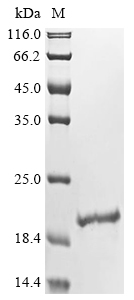
Greater than 90% as determined by SDS-PAGE.
Target Names
IFNG
Uniprot NO.
Research Area
Cancer
Species
Bos taurus (Bovine)
Source
E.coli
Expression Region
24-166aa
Target Protein Sequence
QGQFFREIENLKEYFNASSPDVAKGGPLFSEILKNWKDESDKKIIQSQIVSFYFKLFENLKDNQVIQRSMDIIKQDMFQKFLNGSSEKLEDFKKLIQIPVDDLQIQRKAINELIKVMNDLSPKSNLRKRKRSQNLFRGRRASM
Note: The complete sequence may include tag sequence, target protein sequence, linker sequence and extra sequence that is translated with the protein sequence for the purpose(s) of secretion, stability, solubility, etc.
If the exact amino acid sequence of this recombinant protein is critical to your application, please explicitly request the full and complete sequence of this protein before ordering.
Mol. Weight
21.0 kDa
Protein Length
Full Length of Mature Protein
Tag Info
N-terminal 6xHis-tagged
The tag type will be determined during production process. If you have specified tag type, please tell us and we will develop the specified tag preferentially.
Form
Liquid or Lyophilized powder
Note: We will preferentially ship the format that we have in stock, however, if you have any special requirement for the format, please remark your requirement when placing the order, we will prepare according to your demand.
Buffer
If the delivery form is liquid, the default storage buffer is Tris/PBS-based buffer, 5%-50% glycerol. If the delivery form is lyophilized powder, the buffer before lyophilization is Tris/PBS-based buffer, 6% Trehalose.
Reconstitution
We recommend that this vial be briefly centrifuged prior to opening to bring the contents to the bottom. Please reconstitute protein in deionized sterile water to a concentration of 0.1-1.0 mg/mL.We recommend to add 5-50% of glycerol (final concentration) and aliquot for long-term storage at -20℃/-80℃. Our default final concentration of glycerol is 50%. Customers could use it as reference.
Storage Condition
The shelf life is related to many factors, storage state, buffer ingredients, storage temperature and the stability of the protein itself. Generally, the shelf life of liquid form is 6 months at -20°C/-80°C. The shelf life of lyophilized form is 12 months at -20°C/-80°C.
Shelf Life
The shelf life is related to many factors, storage state, buffer ingredients, storage temperature and the stability of the protein itself.
Generally, the shelf life of liquid form is 6 months at -20°C/-80°C. The shelf life of lyophilized form is 12 months at -20°C/-80°C.
Lead Time
Delivery time may differ from different purchasing way or location, please kindly consult your local distributors for specific delivery time.
Note: All of our proteins are default shipped with normal blue ice packs, if you request to ship with dry ice, please communicate with us in advance and extra fees will be charged.
Notes
Repeated freezing and thawing is not recommended. Store working aliquots at 4°C for up to one week.
Troubleshooting and FAQs
Datasheet & COA
Please contact us to get it.
Images
  • (Tris-Glycine gel) Discontinuous SDS-PAGE (reduced) with 5% enrichment gel and 15% separation gel.

Customer Reviews and Q&A

 Customer Reviews

Target Background

Function(From Uniprot)
Type II interferon produced by immune cells such as T-cells and NK cells that plays crucial roles in antimicrobial, antiviral, and antitumor responses by activating effector immune cells and enhancing antigen presentation. Primarily signals through the JAK-STAT pathway after interaction with its receptor IFNGR1 to affect gene regulation. Upon IFNG binding, IFNGR1 intracellular domain opens out to allow association of downstream signaling components JAK2, JAK1 and STAT1, leading to STAT1 activation, nuclear translocation and transcription of IFNG-regulated genes. Many of the induced genes are transcription factors such as IRF1 that are able to further drive regulation of a next wave of transcription. Plays a role in class I antigen presentation pathway by inducing a replacement of catalytic proteasome subunits with immunoproteasome subunits. In turn, increases the quantity, quality, and repertoire of peptides for class I MHC loading. Increases the efficiency of peptide generation also by inducing the expression of activator PA28 that associates with the proteasome and alters its proteolytic cleavage preference. Up-regulates as well MHC II complexes on the cell surface by promoting expression of several key molecules such as cathepsins B/CTSB, H/CTSH, and L/CTSL. Participates in the regulation of hematopoietic stem cells during development and under homeostatic conditions by affecting their development, quiescence, and differentiation.
Gene References into Functions
  1. Increase of cells expressing PD-1 and PD-L1 and enhancement of IFN-gamma production via PD-1/PD-L1 blockade in bovine mycoplasmosis. PMID:28544524
  2. The expression of multiple toll-like receptors, interferon-gamma, and interleukin-12 (IL-12) in cattle with low and high proviral loads of bovine leukemia virus are reported. PMID:27473994
  3. Diet-driven interferon-gamma enhances malignant transformation of primary bovine mammary epithelial cells through nutrient sensor GCN2-activated autophagy. PMID:26962688
  4. Data suggest that luteolytic factors (such as IFNG, tumor necrosis factor alpha, and PGF2a) control expression of MMP1, other matrix metalloproteinases, and tissue inhibitors of metalloproteinase in cultured luteal cells. PMID:25924700
  5. These findings indicate that IFN-gamma production correlates negatively and the production of antibodies against N. caninum is uncorrelated with plasma pregnancy-associated glycoproteins levels. PMID:24456132
  6. These results support pregnancy as type 2 immune response biased, with increases of IFN-gamma occurring after parturition and an increase in IL-4 production before calving. PMID:23814356
  7. Genetic characterization of IFNG gene was done in resistant and susceptible animals of Sahiwal cattle (n = 95) and Friesian (n = 92). PMID:21960011
  8. Data suggest that activation of gammadelta T cells to IFN-gamma production, NK cell-like killing plays a pivotal role in controlling virus infection. PMID:21383249
  9. The differential expression levels of IFN-gamma mRNA between cattle and buffalo could be due to a conserved 4 base (GTCT) deletion in the promoter region of buffalo. PMID:20541234
  10. SNPs in IFNG, IFNGR1 and R2, IL22, and IL22RA1 were analyzed for an association to Estimated breeding values for somatic cell score in Canadian Holstein bulls; no significant associations were found. PMID:21328101
  11. Nuclear localization sequence of bovine gamma-interferon provides translocation of recombinant protein to yeast Pichia pastoris cell nucleus PMID:21268843
  12. The upregulation of TNFRI mRNA expression by IFNG suggests that TNF and IFNG synergistically affect the death of luteal endothelial cells resulting in acute luteolysis PMID:20562522
  13. Data demonstrated that the monoclonal antibodies secreted by the four hybridoma cell lines could react specifically to the recombinant BovIFN-gamma. PMID:17366886
  14. The entire bovine IFN-gamma gene (BoIFNG) and 2605 bp of its promoter DNA were sequenced. A comprehensive survey for polymorphisms in the bovine IFN-gamma gene reveals a highly polymorphic intronic DNA sequence allowing improved genotyping of Bovinae. PMID:12396714
  15. Bovine interferon gamma demonstrates no effect on P-glycoprotein transport activity in human Caco-2 intestinal epithelial cells with rhodamine 123 as susbstrate. PMID:15124210
  16. In giant cell arteritis, IFN-gamma functional polymorphisms are associated with clinical manifestations of severity rather than susceptibility to this vasculitis. PMID:15675129
  17. The majority of patients with gad-enhancing lesions showed PLP/IFN gamma and MBP/IFN gamma recurrent burst responses PMID:15957503
  18. A polymorphism within the interferon gamma gene is a risk factor in severe acute respiratory syndrome susceptibility. PMID:16672072
  19. Intradermal sensitization of cows in the subclinical stage of M. paratuberculosis infection will upregulate expression of interferon gamma, enhancing the sensitivity of this assay. PMID:17459831
  20. This study compared the protective immune responses to bovine tuberculosis induced in cattle vaccinated with BCG Danish with those induced by BCG Pasteur. PMID:17524495
  21. Lipopolysaccharide stimulation up-regulates the secretion of cytokines by bovine polymorphonuclear neutrophil leukocytes. PMID:17727806
  22. Taken together, these results support the hypothesis of an inactivating phosphorylation of nNOS by IFNgamma, via JAK/STAT, in bovine chromaffin cells. PMID:19141072
  23. A tendency toward statistical significance for the effect of polymorphisms in the odds of infection in cattle was not found for alleles IFNG. PMID:19525022

Show More

Hide All

Subcellular Location
Secreted.
Protein Families
Type II (or gamma) interferon family
Tissue Specificity
Released primarily from activated T lymphocytes.
Database Links

UNIGENE: Bt.188

KEGG: bta:281237

STRING: 9913.ENSBTAP00000016634

icon of phone
Call us
301-363-4651 (Available 9 a.m. to 5 p.m. CST from Monday to Friday)
icon of address
Address
No. 269, Shendun 5th Road, Donghu Hi-Tech Development Area, Hubei Province, 430206, P.R.China
icon of social media
Join us with

Subscribe newsletter

Leave a message

* To protect against spam, please pass the CAPTCHA test below.
CAPTCHA verification
© 2007-2025 CUSABIO TECHNOLOGY LLC All rights reserved. 鄂ICP备15011166号-1
Select 0 Products