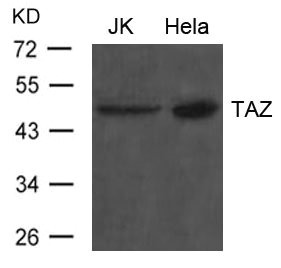
Peptide sequence around aa.386~390 (V-E-S-A-L) derived from Human TAZ.
Immunogen Species
Homo sapiens (Human)
Clonality
Polyclonal
Purification Method
Antibodies were produced by immunizing rabbits with synthetic peptide and KLH conjugates. Antibodies were purified by affinity-chromatography using epitope-specific peptide.
Concentration
It differs from different batches. Please contact us to confirm it.
Form
Supplied at 1.0mg/mL in phosphate buffered saline (without Mg2+ and Ca2+), pH 7.4, 150mM NaCl, 0.02% sodium azide and 50% glycerol.
Note: We will preferentially ship the format that we have in stock, however, if you have any special requirement for the format, please remark your requirement when placing the order, we will prepare according to your demand.
Upon receipt, store at -20°C or -80°C. Avoid repeated freeze.
Lead Time
Basically, we can dispatch the products out in 1-3 working days after receiving your orders. Delivery time maybe differs from different purchasing way or location, please kindly consult your local distributors for specific delivery time.
Note: All of our proteins are default shipped with normal blue ice packs, if you request to ship with dry ice, please communicate with us in advance and extra fees will be charged.
Usage
For Research Use Only. Not for use in diagnostic or therapeutic procedures.
Transcriptional coactivator which acts as a downstream regulatory target in the Hippo signaling pathway that plays a pivotal role in organ size control and tumor suppression by restricting proliferation and promoting apoptosis. The core of this pathway is composed of a kinase cascade wherein STK3/MST2 and STK4/MST1, in complex with its regulatory protein SAV1, phosphorylates and activates LATS1/2 in complex with its regulatory protein MOB1, which in turn phosphorylates and inactivates YAP1 oncoprotein and WWTR1/TAZ. WWTR1 enhances PAX8 and NKX2-1/TTF1-dependent gene activation. In conjunction with YAP1, involved in the regulation of TGFB1-dependent SMAD2 and SMAD3 nuclear accumulation. Plays a key role in coupling SMADs to the transcriptional machinery such as the mediator complex. Regulates embryonic stem-cell self-renewal, promotes cell proliferation and epithelial-mesenchymal transition.
Gene References into Functions
The TAZ WW domain exhibits a binding preference for the second of the two PPxY motifs of LATS1 in vitro. We modelled the structure of the domain in complex with LATS1 PPxY2 peptide and, through molecular dynamics simulations, show that WW domain-PPxY2 complex is stable with some flexibility in the peptide region.PMID:29787761
WWTR1 promotes cell proliferation and inhibits apoptosis of GC cells by regulating cell cycle/apoptosisassociated factors, and effectors in the TGFbeta pathway.PMID:29207147
High TAZ expression is associated with breast cancer.PMID:26885614
Nuclear localization of YAP and TAZ was reduced in DMOG-treated primary tubular epithelial cells.PMID:27155083
SnoN interacts with multiple components of the Hippo pathway to inhibit the binding of Lats2 to TAZ and the subsequent phosphorylation of TAZ, leading to TAZ stabilization.PMID:27237790
Besides its role in normal tissue development, TAZ plays critical roles in cell proliferation, differentiation, apoptosis, migration, invasion, epithelial-mesenchymal transition (EMT), and stemness in multiple human cancers.PMID:27412635
results highlight both CYR61 and TAZ genes as potential predictive biomarkers for stratification of the risk for development of adenocarcinoma and suggest a potential mechanistic route for Barrett's esophagus neoplastic progressionPMID:27583562
Collectively, our study identified an unexpected transcriptional repression function of the BET bromodomain and a novel mechanism for TAZ upregulation.PMID:27717711
These findings demonstrate sufficiency of TAZ activation for driving fibroblast proliferation, contraction, and soluble profibrotic factor expression, and mechanical context-dependent crosstalk of TAZ with other pathways in regulating Col1a1 expression.PMID:27881410
mechanistic study revealed that miR-224 functions by inhibiting the tumor suppressor, SMAD4, to support the proliferation and migration of osteosarcoma (OS) cells. Our findings indicate that targeting TAZ and miR-224 could be a promising approach for the treatment of OS.PMID:28055015
the prostate cancer-related oncogenic E26 transformation-specific (ETS) transcription factors, ETV1, ETV4, and ETV5, were required for TAZ gene transcription in PC3 prostate cancer cellsPMID:28408625
Data suggest that 14-3-3 sigma protein exhibits two individual secondary binding sites for peptide fragments of TAZ protein; these two pockets appear to be part of at least three physiologically relevant and structurally characterized 14-3-3 protein-protein interaction interfaces.PMID:28681606
TAZ was positively correlated with EGFR signaling, and coexpression of TAZ/EGFR conferred a poorer prognosis in lung cancer patients. Our findings identify that targeting TAZ-mediated compensatory mechanism is a novel therapeutic approach to overcome gefitinib resistance in KRAS-mutant/EGFR-wild-type non-small-cell lung cancer .PMID:28710768
TAZ may be a potent therapeutic target for NSCLC in combination with conventional chemotherapy.PMID:28737828
expression of PODXL associates with TAZ downstream gene expression. Suppression of PODXL induces phosphorylation of LATS1 and TAZ, and is accompanied with a decrease in TAZ protein expression. We speculate that changes in actin cytoskeleton may participate in PODXL-mediated TAZ signaling.PMID:28946619
Author found a significant direct correlation between TAZ expression and VIII CN schwannoma volumes on latest preoperative ceMRI (p<0.0003). Mean TAZ expression was also significantly higher in VIII CN schwannomas with a volume >/=2.1 cm3 than in those with a volume <2.1 cm3.PMID:28430338
Data indicate the role of tyrosine kinase c-Src (Src) in rescuing Taz (transcriptional coactivator with PDZ-binding motif) from E3 ligase SCF(beta-TrCP)-mediated degradation.PMID:28154141
Mechanistically, YOD1 deubiquitinates ITCH, an E3 ligase of LATS, and enhances the stability of ITCH, which leads to reduced levels of LATS and a subsequent increase in the YAP/TAZ level.PMID:28416659
this study identified TAZ as a novel inducer of lung cancer stem cells and the first transcriptional activator of the stem cell marker ALDH1A1PMID:28415606
Rottlerin exerted its tumor suppressive function via inactivation of TAZ in non-small cell lung carcinoma cells.PMID:27999199
These results indicate that TAZ is an independent prognostic factor and plays an important role in Non-Small Cell lung cancer (NSCLC)progression and may serve as a novel therapeutic target of NSCLC.PMID:28128737
TAZ is overexpressed in glioma and translocated more into nucleus in high grade glioma. TAZ is involved in gliomagenesis by promoting glioma growth and may benefit to epithelial mesenchymal transformation.PMID:27764783
TAZ may be implicated in the proliferation and migration of hDPSCs.PMID:28487958
FZD7 may promote glioma cell proliferation via upregulation of TAZ.PMID:27852064
this study indicates that TAZ proteins are linked to prognosis and therefore could be therapeutic targets in conventional osteosarcomasPMID:27608849
Data show that TAZ, a WW-domain-containing transcriptional co-activator, could promote the acceleration of cell cycle and cell proliferation through EGFR pathway.PMID:27167112
TAZ is a critical factor for SRC kinase-mediated intestinal tumor formation and regeneration.PMID:28939028
YAP/TAZ plays multifaceted roles for endothelial cell behaviors, proliferation, junction assembly, and metabolism in sprouting angiogenesis and barrier formationPMID:28805663
Activation of GPR81 decreases intracellular cAMP levels and inhibits PKA activity, leading to activation of TAZ and upregulation of PD-L1. This study reveals a critical role for lactate in the immune checkpoint pathway and an unexpected function of TAZ in tumor evasion of the T-cell-mediated immune response.PMID:28604752
results provide evidence that TAZ and miR-135b engage in a positive feedback loop to regulate epithelial-mesenchymal transition and metastasis in osteosarcoma, and suggest that both factors can be therapeutic targets for osteosarcoma treatment.PMID:28823959
extracellular matrix stiffening sustains vascular cell growth and migration through YAP/TAZ-dependent glutaminolysis and anaplerosisPMID:27548520
Various studies show that in human cancers, the Hippo pathway is frequently deregulated allowing YAP1 and TAZ to escape the inhibition by the Hippo pathway. The upregulation of YAP1 and TAZ induces epithelial-mesenchymal transition and increases drug resistance in cancer cells. TAZ is implicated in cancer stemness.[review]PMID:26758663
Results demonstrate a pivotal role for TAZ in regulating the differentiation of Treg cells and TH17 cells.PMID:28504697
These results suggest that vinculin promotes the nuclear localization of transcription factor TAZ to inhibit the adipocyte differentiation on rigid extracellular matrix.PMID:28115535
TAZ regulates cell proliferation and sensitivity to vitamin D3 in intrahepatic cholangiocarcinoma by regulating tp53/CYP24A1 pathway.PMID:27554639
PDE/cGMP/PKG signaling targets Hippo/TAZ pathway to maintain stemness of prostate cancer stem cells.PMID:27179930
TAZ represents a previously unrecognized factor that contributes to the critical process of steatosis-to-Nonalcoholic Steatohepatitis progression.PMID:28068223
Thus, it could be concluded that EPO and IGF1 possessed a potent synergism in promoting osteogenic differentiation, and the synergism was mainly attributed to co-regulation of different osteogenic regulators PPARgamma and TAZ, which were targeted genes of EPO and IGF1 respectively.PMID:27422606
eIF5A-PEAK1 signaling controls YAP1/TAZ expression, which is associated with increased pancreatic ductal adenocarcinoma tumorigenicityPMID:28381547
Our goal is to describe the physiological roles of Hippo signaling in several normal organ systems, as well as to emphasize how disruption of the Hippo pathway, and particularly hyperactivation of YAP1/TAZ, can be oncogenic (review)PMID:28078823
miR-125a-5p functions as an important tumor suppressor that suppresses the EGFR pathway by targeting TAZ to inhibit tumor progression in retinoblastoma.PMID:27094723
results demonstrate that skeletal stem/stromal cell mobilize Snail/Slug-YAP/TAZ complexes to control stem cell functionPMID:27479603
TAZ is significantly associated with poor survival in embryonal rhabdomyosarcoma. Constitutively active TAZ S89A significantly increased proliferation of C2C12 myoblasts and, importantly, colony formation on soft agar, suggesting transformation. However, TAZ then switches to enhance myogenic differentiation in C2C12 myoblasts.PMID:27184927
Over expression of TAZ was associated with abnormal expression of beta-catenin, which is correlated with poor prognosis of patients with adenocarcinoma of the esophagogastric junctionPMID:25029906
Our findings emphasize the tumorigenic role of TAZ and may serve as the basis for new treatment strategies.PMID:24951773
Results revealed that TAZ is a differentially expressed molecule in human hepatocellular carcinoma (HCC) suggesting it as an important regulator, TAZ might be as a new diagnostic biomarker in HCC.PMID:25650113
Results show TAZ functioned as an oncogene and promoted pancreatic cancer epithelial-mesenchymal transition and progression.PMID:26416426
this article summarizes the current understanding of the biological functions of YAP and TAZ, and how the regulation of these two proteins can be disrupted in cancer.[Review][PMID:25592648
TAZ inhibits temozolomide induced apoptosis via upregulation of MCL-1 (myeloid cell leukemia 1) and high expression of TAZ predicts a poor prognosis for GBM patientsPMID:26043698
Overexpression of TAZ in neuroblastoma BE(2)-C cells increases cell proliferation, self renewal and colony formation. TAZ knockdown reverses this. TAZ promotes cell proliferation and tumorigenicity by up-regulating CTGF and PDGF-beta genes.PMID:25940705
Show
More
Hide
All
Subcellular Location
Nucleus. Cytoplasm. Cell membrane.
Tissue Specificity
Highly expressed in kidney, heart, placenta and lung. Expressed in the thyroid tissue.