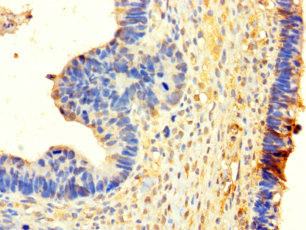
Upon receipt, store at -20°C or -80°C. Avoid repeated freeze.
Lead Time
Basically, we can dispatch the products out in 1-3 working days after receiving your orders. Delivery time maybe differs from different purchasing way or location, please kindly consult your local distributors for specific delivery time.
Note: All of our proteins are default shipped with normal blue ice packs, if you request to ship with dry ice, please communicate with us in advance and extra fees will be charged.
Usage
For Research Use Only. Not for use in diagnostic or therapeutic procedures.
Histone methyltransferase. Preferentially dimethylates 'Lys-4' and 'Lys-27' of histone H3 forming H3K2me2 and H3K27me2. H3 'Lys-4' methylation represents a specific tag for epigenetic transcriptional activation, while 'Lys-27' is a mark for transcriptional repression.
Gene References into Functions
Studies showed that depletion of NSD3 in osteosarcoma cell lines inhibited cell proliferation and survival, and induced cell apoptosis. RNA sequence analysis of tumor cell lines with NSD3 deletion revealed that NSD3 functions as either a transcriptional activator or a repressor. These results suggest that NSD3 may function as an oncogenic driver in osteosarcoma.PMID:28901481
Results extend the in vitro results and show that targeted expression of NSD3 to the mammary gland of FVB mice is oncogenic, consistent with the hypothesis that NSD3 is an important driver oncogene in human breast cancer.PMID:28484924
WHSC1L1 and H3K36me2 are enriched in the gene bodies of the cell cycle-related genes CDC6 and CDK2, implying that WHSC1L1 directly regulates the transcription of these genePMID:27285764
This study demonstrates that over-expression of WHSC1L1 is linked to over-expression of ER-alpha in SUM-44 breast cancer cells and in primary human breast cancers.PMID:27005559
Studies indicate that the NSD methyltransferases NSD1, NSD2/WHSC1/MMSET and NSD3/WHSC1L1 were overexpressed, amplified or somatically mutated in multiple types of cancer, suggesting their critical role in cancer.PMID:25942451
Results demonstrate that the AML maintenance function of BRD4 requires its interaction with the short isoform of NSD3 lacking the methyltransferase domain. This protein is an adaptor that sustains leukemia by linking BRD4 to the CHD8 chromatin remodeler.PMID:26626481
The results describe the binding of NSD1, 2 and 3 catalytic domains (CD) on histone tails through recognition of histone-lysine and methylation properties.PMID:25494638
The involvement of the NSD3 methyltransferase as a component of the NUT fusion protein oncogenic complex identifies a new potential therapeutic target.PMID:24875858
PPAPDC1B and WHSC1L1 played a major role in regulating the survival of breast cancer, pancreatic adenocarcinoma and small-cell lung cancer-derived cell lines.PMID:24051013
Data indicate that siRNA attenuated the expression levels of CCNG1 and NEK7, implying that WHSC1L1 appears to activate the expression of CCNG1 and NEK7 in cancer cells.PMID:23011637
methyltransferase NSD3 has chromatin-binding motifs, PHD5-C5HCH, that are distinct from other NSD (nuclear receptor SET domain) family members in their histone H3 recognitionPMID:23269674
Functional studies with Brd4 indicate that the ET domain mediates pTEFb-independent transcriptional activation through a subset of these associated factors, including NSD3.PMID:21555454
Overexpression of WHSC1L1 gene is associated with breast cancer.PMID:20940404
NSD3L depletion increased the invasiveness of MDA-MB-231 breast cancer cells indicating that NSD3L normally restrain cellular metastatic potential. Together the presented data indicates that NSD3L is a candidate tumor suppressor.PMID:20599755
Show
More
Hide
All
Subcellular Location
Nucleus. Chromosome.
Protein Families
Class V-like SAM-binding methyltransferase superfamily, Histone-lysine methyltransferase family, SET2 subfamily
Tissue Specificity
Highly expressed in brain, heart and skeletal muscle. Expressed at lower level in liver and lung.