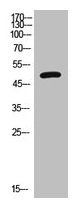
VIPR1; Vasoactive intestinal polypeptide receptor 1; VIP-R-1; Pituitary adenylate cyclase-activating polypeptide type II receptor; PACAP type II receptor; PACAP-R-2; PACAP-R2; VPAC1
Raised in
Rabbit
Species Reactivity
Human
Immunogen
Synthesized peptide derived from the Internal region of Human VPAC1.
Immunogen Species
Homo sapiens (Human)
Conjugate
Non-conjugated
Isotype
IgG
Purification Method
The antibody was affinity-purified from rabbit antiserum by affinity-chromatography using epitope-specific immunogen.
Concentration
It differs from different batches. Please contact us to confirm it.
Buffer
Liquid in PBS containing 50% glycerol, 0.5% BSA and 0.02% sodium azide.
Tested Applications
WB, ELISA
Storage
Upon receipt, store at -20°C or -80°C. Avoid repeated freeze.
Lead Time
Basically, we can dispatch the products out in 1-3 working days after receiving your orders. Delivery time maybe differs from different purchasing way or location, please kindly consult your local distributors for specific delivery time.
Usage
For Research Use Only. Not for use in diagnostic or therapeutic procedures.
This is a receptor for VIP. The activity of this receptor is mediated by G proteins which activate adenylyl cyclase. The affinity is VIP = PACAP-27 > PACAP-38.
Gene References into Functions
In vitro-polarized macrophages by GM-CSF (GM-MO), with a proinflammatory profile, expressed higher levels of VIP receptors, vasoactive intestinal polypeptide receptors 1 and 2 (VPAC1 and VPAC2, respectively), than macrophages polarized by M-CSF (M-MO) with anti-inflammatory activities. RA synovial macrophages, according to their GM-CSF-like polarization state, expressed both VPAC1 and VPAC2.PMID:27381006
VPAC1 rs9677 CC genotype could be correlated with a reduced response to statin therapy and seems to be involved in diabetes cardiomyopathy in female patients with type 2 diabetes.PMID:26712708
The results reveal that more severe inflammation, based on high levels of IL-6, is associated with lower expression of VPAC1 and, conversely, with increased expression of VPAC2.PMID:26881970
variations at the 3'UTR of the VPAC-1 gene act synergistically to affect the expression of the luciferase as well as of the GFP reporter genes expressed in HEK293T cells.PMID:25390694
These data suggest that VPAC1 overexpression is associated with poorer differentiation of colon cancer, which is likely caused by subsequent EGFR activation in cancer cells.PMID:24671823
VPAC1 receptor has a role in endotoxemia in peripheral blood mononuclear cellsPMID:23651810
The overexpression of VPAC1 and VPAC2 receptors and COX-2 in cancer tissue gives them a potential role as targets for diagnosis of prostate cancer.PMID:22763881
hree residues play an important role in VPAC1 interaction with the first histidine residue of VIP. These data demonstrate that VIP and PG97-269 bind to distinct domains of VPAC1PMID:22291440
The genetic association reported here indicates that VIP/VPAC1 signaling can be a relevant pathway in the pathogenesis of type 2 diabetes in femalesPMID:22166542
silencing of VPAC1 receptor inhibits vasoactive intestinal peptide effects on both EGF receptor and HER2 transactivation and vascular endothelial growth factor secretion in human breast cancer cellsPMID:21896307
mRNA expression of the VPAC1 receptor was detected in 51% of the tumor specimens, while the incidence of mRNA expression for VPAC2 was 46%.PMID:21769421
increased expression in patients with allergic rhinitisPMID:21711977
The VIPR1 polymorphism, previously linked to gastrointestinal dysmotility disorders, does not represent a common risk factor for gallstones in the general or in an elderly population.PMID:20922191
Moreover, we report the markedly nuclear localization of VPAC(1) receptors in estrogen-dependent (T47D) and independent (MDA-MB-468) human breast cancer cell linesPMID:20691743
role of in MicroRNA 525-5p down-modulating VPAC1 expressioPMID:20706588
Results indicate that VPAC1, but not VPAC2 or PAC1, up-regulation in macrophages is a common mechanism in response to acute and chronic pro-inflammatory stimuli.PMID:20026142
We describe significant upregulation of the SPP1 gene, downregulation of VIPR1, and losses of the VIPR1 gene.PMID:20014941
Vasoactive intestinal peptide receptor-1 (VPAC-1) is a novel gene target of the hemolymphopoietic transcription factor Ikaros.PMID:11812772
VPAC1 is a cellular neuroendocrine receptor expressed on T cells that actively facilitates productive HIV-1 infection.PMID:11834941
Thus, the highly diverged chemical properties of the hydrophobic "YL" motif and charged "DR(Y)" motif could be a crucial difference between the Secretin Receptor Family and the Rhodopsin Family with respect to receptor activation and G-protein coupling.PMID:11859928
VPAC1 receptor mRNA is expressed in the trigeminal, otic and superior cervical ganglia (prejunctional) and cerebral arteries (postjunctional).PMID:11930171
a small sequence in the third intracellular loop of the VPAC(1) receptor is responsible for the efficient agonist-stimulated intracellular calcium concentration increasePMID:11981043
Genetic complexity of HVR1 quasispecies of hepatitis C virus in patients with cirrhosis.PMID:12094871
a selective filter; Identification of a critical domain for restricting secretin bindingPMID:12133828
the role of charged residues in the intracellular loop 3 and the proximal C-terminal tail of hVPAC1 receptor for agonist-induced adenylyl cyclase activationPMID:12690118
cloning and sequencing of 5' flanking region; VPAC1 may play a functional role in development of both cerebellum and adrenal medullaPMID:14599709
Data suggest that vasoactive intestinal peptide directly stimulates cortisol secretion from H295 cells via activation of the VPAC1 receptor subtype.PMID:15171718
the hVPAC1 receptor binds to vasoactive intestinal peptide at its N-terminal ectodomainPMID:15247290
Interaction of different G proteins with the recombinant VPAC1 receptor involves different receptor sub-domains.PMID:15451021
the VPAC1 receptor carboxyl terminus has a role in agonist-induced receptor phosphorylation, internalization, and recyclingPMID:15932876
Farnesoid X receptor agonists may increase gallbladder fluid secretion through transcriptional activation of VPAC1.PMID:16037943
analysis of the two-step activation mechanism of VPAC receptor and of class II G protein-coupled receptorsPMID:16520374
Thr429 phosphorylation has a role in activation of human VPAC1PMID:16554109
125I-[Bpa28-vasoactive intestinal peptide] was covalently bonded to the 121-133 fragment within the N-terminal ectodomain of the receptorPMID:16888162
Photoaffinity experiments clearly indicated that the 6-28 part of VIP physically interacts with the N-terminal ectodomain of VPAC1 receptorPMID:16888167
MCF-7 cells have VPAC1 receptors that bound the VIP chemotherapeutic conjugatePMID:16888206
observations provide additional evidence for a role of proapoptotic caspase adaptor protein and PAC1 R in the events determining the outcome of prostate cancerPMID:16888207
identification and characterization of novel five-transmembrane(5TM) isoforms of VPAC1PMID:16934434
expression of VIP receptor-1 (VPAC1) and VPAC2 in CD4+ T cells changed reciprocally in the context of the activation statePMID:17077178
The differential expression of VIPR1 in ulcerative colitis and Crohn's disease mucosa suggests that the VIP system plays different roles in the pathogenesis of inflammatory bowel disease.PMID:17611633
Both intra- and extracellular Ca2+ play a role in controlling pro-inflammatory functions stimulated by PACAP which acts through a VPAC-1, FPRL1/Galphai/PI3K/ERK pathway and a VPAC-1/Galphas/PKA/p38 pathway to fully activate monocytesPMID:17651798
analysis of VIP 16gamma-glutamyl diamino derivative positive charges on hVPAC1 and hVPAC2 receptor functionPMID:17883247
VPAC1 signaling tempers normal megakaryopoiesis, and inhibition of this pathway stimulates megakaryocyte differentiation.PMID:18000164
Proinflammatory effect of VIP is mediated via the specific G protein-coupled receptor VIP/pituitary adenylate cyclase-activating protein (VPAC1) receptor as well as via FPRL1.PMID:18174366
deficient expression of VPAC1 (vasoactive intestinal peptide receptor 1) in immune cells of Rheumatoid Arthritis was associated with the predominant proinflammatory Th1 mileu; reduced VPAC1 expression in RA is associated with genetic polymorphismPMID:18383379
Results indicate that the N-terminal part of VIP physically interacts with the N-ted in the continuity of 6-28 VIP sequence; and the N-terminal part of VIP and its antagonist (PG97-269) have different sites of interaction with the VPAC1 receptor N-ted.PMID:18597186
HLA-B (*)2705 and a functional polymorphism in VIPR1 gene, might be due to a founder effect or might be the result of a selective pressure. Consequent downregulation of this receptor in presence of a 'danger' signal might influence susceptibility to AS.PMID:18668120
Patients with idiopathic achalasia show a significant difference in allele, genotype and phenotype of VIPR1 distribution of snpsPMID:19309439
Show
More
Hide
All
Subcellular Location
Cell membrane; Multi-pass membrane protein.
Protein Families
G-protein coupled receptor 2 family
Tissue Specificity
In lung, HT-29 colonic epithelial cells, Raji B-lymphoblasts. Lesser extent in brain, heart, kidney, liver and placenta. Not expressed in CD4+ or CD8+ T-cells. Expressed in the T-cell lines HARRIS, HuT 78, Jurkat and SUP-T1, but not in the T-cell lines Pe