Upon receipt, store at -20°C or -80°C. Avoid repeated freeze.
Lead Time
Basically, we can dispatch the products out in 1-3 working days after receiving your orders. Delivery time maybe differs from different purchasing way or location, please kindly consult your local distributors for specific delivery time.
Note: All of our proteins are default shipped with normal blue ice packs, if you request to ship with dry ice, please communicate with us in advance and extra fees will be charged.
Usage
For Research Use Only. Not for use in diagnostic or therapeutic procedures.
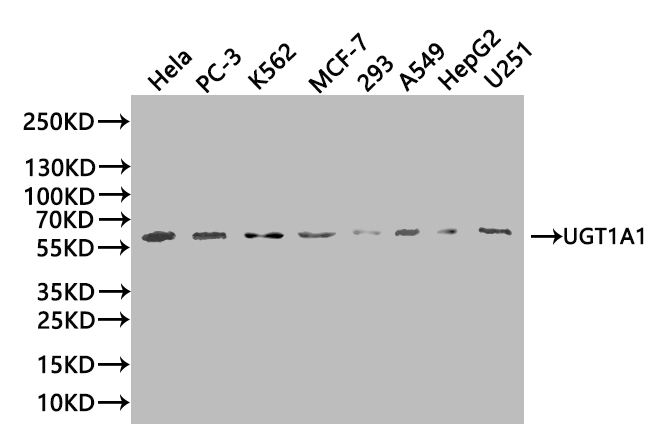
Western Blot Positive WB detected in: Hela whole cell lysate(20µg), PC-3 whole cell lysate(20µg), K562 whole cell lysate(20µg), MCF-7 whole cell lysate(20µg), 293 whole cell lysate(20µg), A549 whole cell lysate(20µg), HepG2 whole cell lysate(20µg), U251 whole cell lysate(20µg) All lanes: UGT1A1 antibody at 1:1000 Secondary Goat polyclonal to rabbit IgG at 1/50000 dilution Predicted band size: 60, 50 kDa Observed band size: 60 kDa Exposure time:120s
Description
UGT1A1 polyclonal antibody CSB- PA025570LA01HU was produced in the rabbits immunized by using the Recombinant Human UDP-glucuronosyltransferase 1-1 protein (395-482AA). The target protein UGT1A1, a UDP-glucuronosyltransferase, an enzyme of the glucuronidation pathway that transforms small lipophilic molecules (steroids, bilirubin, hormones, and drugs) into water-soluble, excretable metabolites. Mutations in this gene result in Crigler-Najjar syndromes types I and II and in Gilbert syndrome.
This Rabbit anti-Homo sapiens (Human) UGT1A1 Polyclonal antibody was tested in the ELISA, WB, IHC and IF applications. The non-conjugated IgG got purified by protein G and reached up to 95% in purity. It reacts with the UGT1A1 proteins of human or mouse or rat origin and may be used to detect the endogenous levels of UGT1A1 protein.
UDP-glucuronosyltransferase (UGT) that catalyzes phase II biotransformation reactions in which lipophilic substrates are conjugated with glucuronic acid to increase the metabolite's water solubility, thereby facilitating excretion into either the urine or bile. Essential for the elimination and detoxification of drugs, xenobiotics and endogenous compounds. Catalyzes the glucuronidation of endogenous estrogen hormones such as estradiol, estrone and estriol. Involved in the glucuronidation of bilirubin, a degradation product occurring in the normal catabolic pathway that breaks down heme in vertebrates. Also catalyzes the glucuronidation the isoflavones genistein, daidzein, glycitein, formononetin, biochanin A and prunetin, which are phytoestrogens with anticancer and cardiovascular properties. Involved in the glucuronidation of the AGTR1 angiotensin receptor antagonist losartan, a drug which can inhibit the effect of angiotensin II. Involved in the biotransformation of 7-ethyl-10-hydroxycamptothecin (SN-38), the pharmacologically active metabolite of the anticancer drug irinotecan.; Lacks UGT glucuronidation activity but acts as a negative regulator of isoform 1.
Gene References into Functions
The UGT1A1 modified HeLa cells were a simple and practical tool to study UGT1A1-mediated glucuronidation and to characterize BCRP and MRPs-mediated glucuronide transport at a cellular level.PMID:30237061
we observed that protein expression of UGT1A1 was significantly more frequent in samples from endometriotic lesions in comparison with endometria. In addition, expression of UGT1A1 protein was greater in deep-infiltrating than in non-deep-infiltrating endometriotic lesions.PMID:29540112
The suggesting that regulation by other factors could hide the contribution of miR-141-3p to the regulation of UGT1A constitutive expression in the human liver.PMID:30001838
The UGT1A1*28 gene variant is associated with lower mortality rates. The protective effect of the UGT1A1*28 variant likely includes mechanism other than bilirubin metabolism.PMID:29220881
UGT1A1*27 can occur separately from UGT1A1*28 and is related to leukopenia during irinotecan treatment. UGT1A1*7 is less relevant to irinotecan-induced toxicities, and UGT1A1*29 seems to have little clinical impact.PMID:29052349
TLR4 small interfering RNA blocked hUGT1A1/hNRs downregulation.PMID:29311138
The cancer patients who carried UGT1A1*6, UGT1A1*28 and UGT1A1*60 gene polymorphisms have high risk of severe adverse events caused by irinotecan-based chemotherapy.PMID:30139029
In terms of irinotecan-based regimens in cancers, UGT1A1*6 plays a more vital role in hematologic toxicity whereas UGT1A1*28 get more involved in diarrhea.PMID:28879724
Heterozygous UGT1A1*60 4 times (13.3%) and homozygous 26 times (86.7%) in the neonatal hyperbilirubinemia group, with an identical allele frequency of 0.935 in hyperbilirubinemia and 1 in control group.PMID:29534743
UGT1A1 Genetic Variations and a Haplotype Associated with Neonatal Hyperbilirubinemia in Indonesian Population.PMID:29607327
The genetic polymorphisms of UGT1A1 were significantly associated with higher plasma axitinib levels in patients with metastatic renal cell carcinomaPMID:29524031
The findings provide genetic and epidemiological evidence for an association of UGT1A and CCR5 polymorphisms with hepatitis B virus infection in Chinese Yi and Yao populations.PMID:29239247
Genetic variant minor allele frequencies were similar between cases and controls, except for UGT1A1*28.PMID:29210320
During liver ontogeny recruitment of HNF1A leads to aggregation of the cofactors MLL1, NCOA6, and p300 at the UGT1A1 promoter, which regulates histone modifications and subsequent UGT1A1 expression.PMID:29025858
Patients who initiated atazanavir/ritonavir-containing regimens, UGT1A1 slow metabolizer genotype rs887829 T/T was associated with increased bilirubin-related discontinuation of atazanavir in White but not in Black patients, this despite T/T genotype being more frequent in Black patients.PMID:29117017
Patients with asthenic constitution and the stigma dysplasia of connective tissue have to be examined by the presence of mutations rs8175347 gene UGT1A1. The carrier not only homozygous but with the heterozygous variant mutations may require changes in the interpretation of symptoms, lifestyle, medication, etc.PMID:29889392
Results show that the occurrence of neonatal hyperbilirubinemia of neonates was not associated with UGT1A1*28 gene polymorphism, but closely correlated with the Gly71Arg gene polymorphism. Meanwhile, the Arg allele mutation was related to the degree of jaundice.PMID:29058288
UGT1A1 gene promoter polymorphism and G71R mutation are possible risk factors for Turkish neonates with DC(-) ABO incompatibility and unexplained hyperbilirubinemia.PMID:27842454
The presence of the TA7 allele UGT1A1 gene promoter, responsible for higher systemic bilirubin levels, was associated with a twofold lower risk of manifestation of Fabry Disease.PMID:28951772
results suggested that Gly71Arg and Asn130Asp mutations in UGT1A1 and OATP2 genes might be involved in the development of hyperbilirubinemia in neonates.PMID:26960716
Genotype TA7/TA7 of the UGT1A1 gene can influence serum bilirubin levels in sickle cell disease.PMID:28567595
Results still showed UGT1A1*6 and UGT1A1*28 to be partially associated with irinotecan-induced toxicity and clinical response. An examination of more UGT1A loci, except for UGT1A1*6 and UGT1A1*28, was not helpful to improve the predictive value of irinotecan-based toxicity and efficacy. An examination of DPYD*5 assisted in the prediction of severe diarrhea.PMID:28637434
UGT1A1 polymorphisms have the potential to be a prognostic marker of irinotecan treatment.PMID:28173214
Although we have found quite a large number of genetic variants of the UGT1A1 and SLCO1B1 genes in the African-American population, it does not appear that they have a significant impact on the incidence of hyperbilirubinemia among this group of infants.PMID:27977017
it is unclear whether UGT1A1 plays a role in the development of anti-tuberculosis drug-induced hepatotoxicity in the Chinese populationPMID:27155186
The MTD of irinotecan in FOLFIRI plus bevacizumab is 310 mg/m(2) for UGT1A1 *1/*1 patients and 260 mg/m(2) for *1/*28 patients. Bevacizumab does not alter the pharmacokinetics of irinotecan. The antitumor efficacy of these genotype-guided doses should be tested in future studies of patients with mCRC treated with FOLFIRI plus bevacizumabPMID:27507617
Longer progression-free was seen in breast cancer patients who were heterozygous for a UGT1A1 mutation compared with homozygous wild-type patients when treated with irinotecan combined with S-1.PMID:29131533
UGT1A1*6 and/or UGT1A1*28 alleles are associated with plasma dolutegravir concentrations in Japanese individuals infected with HIV-1.PMID:28915895
The linked polymorphisms, A(TA)7TAA and c.-3279T>G, in UGT1A1, were most strongly associated with Gilbert syndrome, whereas mutations in the coding region, particularly p.G71R and p.Y486D, occurred more frequently in CNS-II. In addition, iron deposition may be more common in liver biopsies from patients with Crigler-Najjar syndrome type II.PMID:29137095
UGT1A1*6 is a risk factor for prolonged unconjugated hyperbilirubinemia in preterm infants in JapanPMID:28888563
Our findings indicate that regorafenib plus FOLFIRI with irinotecan dose escalation based on UGT1A1 genotyping in previously treated patients with mCRC and with UGT1A1*1/*1 and UGT1A1*1/*28 genotypes is clinically effective and yields improved oncological outcomes.PMID:27938508
Besides G6PD-deficiency screening, UGT1A1 genetic analysis, and especially the UGT1A1*6(c.211G>A, p.Arg71Gly) polymorphism detection, may be taken into consideration for early diagnosis and treatment of severe hyperbilirubinemic newborns in southern China.PMID:26727668
Polymorphisms in SLCO1B1 and UGT1A1 are associated with several different sorafenib side effectsPMID:27533851
Results suggest that in the Romanian population there is a strong correlation between the UGT1A1*28 polymorphism and hyperbilirubinemia in patients with Gilbert syndrome.PMID:28338110
Homozygous c-3279T>G mutation represents an important risk factor for the development of neonatal hyperbilirubinemiaPMID:27318112
Polymorphisms of the UGT1A1 gene frequently co-exist in neonates. The presence of UGT1A1*28 polymorphism and male gender seem to predispose to neonatal hyperbilirubinemiaPMID:28399191
The presence of the UGT1A1*60 variant is not associated with increased bilirubin concentrations.PMID:27967321
UGT1A1*6 polymorphisms were associated with an increased risk of irinotecan-induced neutropenia in cancer patients, and increased incidences of severe neutropenia could be correlated with diverse regions, cancer type, low dose of irinotecan and the duration of treatmentPMID:28585035
UGT1A1 rs6742078 is strongly associated with bilirubin levels; however, a 2-stage least-squares Mendelian randomization analysis shows no causal relationship between serum bilirubin and stroke risk.PMID:28389615
These data suggest that the UGT1A1*28 polymorphism may not be a suitable biomarker to predict irinotecan-induced toxicities and chemotherapy tumor response in Asians--{REVIEW]PMID:28502040
Genetic polymorphisms of the UGT1A1 promoter, specifically the T-3279G phenobarbital-responsive enhancer module and (TA)7 dinucleotide repeat, as well as the intron and coding region variants of the OATP2, HMOX1, and BLVRA genes, were significantly higher among the cases than the controls.PMID:27943244
UGT1A1 variations have a role in chemotherapy-induced unconjugated hyperbilirubinemia in pediatric leukemia patientsPMID:27057738
UGT1A1*28*28 genotype was significantly associated with lung cancer compared to other malignancies.PMID:27832386
these results suggest the presence of the UGT1A1*28 allele does not contribute significantly to a large inter-subject variability in the pharmacokinetics of silybin A and silybin B which may obscure the ability to detect beneficial effects of silymarin in patients with liver disease.PMID:28098838
UGT1A1 can control neurodevelopment by regulating serum Thyroxine levels.PMID:27413119
Data suggest that microRNA-375 acts as repressor of UGT1A1- (UDP glucuronosyltransferase 1A1-) mediated hepatic acetaminophen glucuronidation through reduced AhR (aryl hydrocarbon receptor) expression; variations could predispose some individuals to increased risk for acetaminophen-induced liver injury.PMID:27531059
Cadmium and arsenic override NF-kappaB developmental regulation of the intestinal UGT1A1 gene and control of hyperbilirubinemia.PMID:27060662
Among patients with increased bilirubin levels, the frequency of UGT1A1*28 is higher than in those with normal bilirubin.PMID:28296739
findings showed that almost 57.1% of Chinese colorectal cancer patients had at least one variant of DPYD*5A and DPYD*9APMID:27461651
[Isoform 1]: Expressed in liver, colon and small intestine. Not expressed in kidney, esophagus and skin.; [Isoform 2]: Expressed in liver, colon, small intestine and kidney. Not expressed in esophagus and skin.