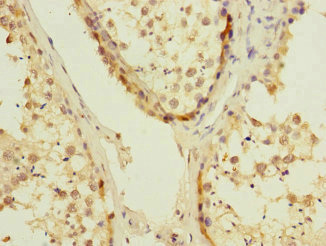
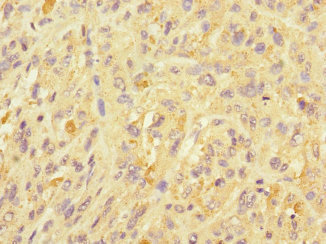
Recombinant Human Ubiquitin-conjugating enzyme E2 S protein (1-222AA)
Immunogen Species
Homo sapiens (Human)
Conjugate
Non-conjugated
Isotype
IgG
Purification Method
Antigen Affinity Purified
Concentration
It differs from different batches. Please contact us to confirm it.
Buffer
PBS with 0.02% sodium azide, 50% glycerol, pH7.3.
Tested Applications
ELISA, IHC
Recommended Dilution
Application
Recommended Dilution
IHC
1:20-1:200
Storage
Upon receipt, store at -20°C or -80°C. Avoid repeated freeze.
Lead Time
Basically, we can dispatch the products out in 1-3 working days after receiving your orders. Delivery time maybe differs from different purchasing way or location, please kindly consult your local distributors for specific delivery time.
Note: All of our proteins are default shipped with normal blue ice packs, if you request to ship with dry ice, please communicate with us in advance and extra fees will be charged.
Usage
For Research Use Only. Not for use in diagnostic or therapeutic procedures.
Accepts ubiquitin from the E1 complex and catalyzes its covalent attachment to other proteins. Catalyzes 'Lys-11'-linked polyubiquitination. Acts as an essential factor of the anaphase promoting complex/cyclosome (APC/C), a cell cycle-regulated ubiquitin ligase that controls progression through mitosis. Acts by specifically elongating 'Lys-11'-linked polyubiquitin chains initiated by the E2 enzyme UBE2C/UBCH10 on APC/C substrates, enhancing the degradation of APC/C substrates by the proteasome and promoting mitotic exit. Also acts by elongating ubiquitin chains initiated by the E2 enzyme UBE2D1/UBCH5 in vitro; it is however unclear whether UBE2D1/UBCH5 acts as an E2 enzyme for the APC/C in vivo. Also involved in ubiquitination and subsequent degradation of VHL, resulting in an accumulation of HIF1A. In vitro able to promote polyubiquitination using all 7 ubiquitin Lys residues, except 'Lys-48'-linked polyubiquitination.
Gene References into Functions
Ubiquitin-conjugating enzyme E2S (UBE2S) enhanced the ubiquitination of p53 protein to facilitate its degradation in hepatocellular carcinoma (HCC) cells.PMID:29928880
High UBE2S expression is associated with drug resistance in glioblastoma.PMID:27593939
RNF8- and Ube2S-dependent Lys11-linkage ubiquitin conjugation plays an important role in regulating DNA damage-induced transcriptional silencing, distinct from the role of Lys63-linkage ubiquitin in the recruitment of DNA damage repair proteins 53BP1 and BRCA1.PMID:28525740
Data indicate that UBE2S and APC3 co-regulate the expression level of P21 at G2/M check point via the ubiquitin-proteasome system.PMID:28257844
UBE2S is highly expressed in breast cancerPMID:26245992
Study identified APC/C substrates, including the kinase Nek2A, that require Ube2S for degradation. The reconstitution of Nek2A-ubiquitylation revealed that Ube2S does not simply extend a conjugate but instead branches multiple K11-linked chains off the assemblies produced by Ube2C.PMID:24813613
E2-EPF is overexpressed in cervical cancer and associates with tumor growthPMID:22895574
These findings reveal deregulation of the oxygen-sensing pathway impinging on the positive feedback mechanism of HIF1-mediated regulation of E2-EPF in papillary renal cell carcinoma.PMID:21281817
Linkage-specific ubiquitin chain formation by Ube2S is the result of substrate-assisted catalysis.PMID:21376237
K11 specificity is determined by an E2 enzyme, UBE2S/E2-EPF, that elongates ubiquitin chains after the substrates are pre-ubiquitinated by UbcH10 or UbcH5.PMID:20080579
E2-EPF UCP expression induced by growth factors or serum increased HIF-1alpha protein level under non-hypoxic conditions, suggesting that the Egr-1/SRF-UCP-VHL pathway is in part responsible for the increased HIF-1alpha protein levelPMID:18780286
Results suggest that UCP was significantly associated with poor prognosis of esophageal cancer and may be a new molecular target for therapeutic intervention for esophageal squamous cell carcinoma.PMID:19083192
UBE2S functions with the APC/C in a two-step mechanism to control substrate ubiquitylation that is essential for mitotic exit after prolonged SAC activation, providing a new model for APC/C function in human cellsPMID:19820702
UbcH10 and Ube2S constitute a physiological E2-module for anaphase-promoting complex, the activity of which is required for spindle assembly and cell division.PMID:19822757