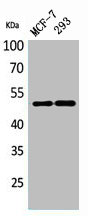
Synthesized peptide derived from the N-terminal region of Human PD-ECGF.
Immunogen Species
Homo sapiens (Human)
Conjugate
Non-conjugated
Isotype
IgG
Purification Method
The antibody was affinity-purified from rabbit antiserum by affinity-chromatography using epitope-specific immunogen.
Concentration
It differs from different batches. Please contact us to confirm it.
Buffer
Liquid in PBS containing 50% glycerol, 0.5% BSA and 0.02% sodium azide.
Tested Applications
WB, ELISA
Storage
Upon receipt, store at -20°C or -80°C. Avoid repeated freeze.
Lead Time
Basically, we can dispatch the products out in 1-3 working days after receiving your orders. Delivery time maybe differs from different purchasing way or location, please kindly consult your local distributors for specific delivery time.
Note: All of our proteins are default shipped with normal blue ice packs, if you request to ship with dry ice, please communicate with us in advance and extra fees will be charged.
Usage
For Research Use Only. Not for use in diagnostic or therapeutic procedures.
May have a role in maintaining the integrity of the blood vessels. Has growth promoting activity on endothelial cells, angiogenic activity in vivo and chemotactic activity on endothelial cells in vitro.; Catalyzes the reversible phosphorolysis of thymidine. The produced molecules are then utilized as carbon and energy sources or in the rescue of pyrimidine bases for nucleotide synthesis.
Gene References into Functions
Data show that thymidine phosphorylase (TYMP) positive patients had higher systemic immune-inflammation index (SII) score.PMID:27283904
Investigated the contribution of myeloma-expressed thymidine phosphorylase (TP) to bone lesions. In osteoblast progenitors, TP up-regulated the methylation of RUNX2 and osterix, leading to decreased bone formation. In osteoclast progenitors, TP up-regulated the methylation of IRF8, leading to increased bone resorption.PMID:27559096
TP(thymidine phosphorylase ) curbed the expression of three proteins-IRF8, RUNX2, and osterix. This downregulation was epigenetically driven: High levels of 2DDR, a product of TP secreted by myeloma cells, activated PI3K/AKT signaling and increased the methyltransferase DNMT3A's expressionPMID:27658717
TP expression is associated with tumor stage, histological grade and thrombocytosis in patients with renal cell carcinomaPMID:27532673
Studied the role of thymidine phosphorylase (TP) in promoting the invasion and metastasis of hepatocellular carcinoma (HCC). It was shown that TP correlated with MMP2 and MMP9 expression, and that TP mediated the migration of tumor cells through activity of MMPs in HCC cell lines.PMID:28530649
High VEGF expression was subsequently correlated with a short overall survival rate for patients exhibiting lymph node metastasis (P=0.0128); however, there was no significant difference in overall survival rate regarding the expression levels of TP and CD34PMID:26676225
Pretreatment expression of thymidine phosphorylase/HIF-1alpha were found to predict pathologic response and outcomes in clinical stage II/III rectal cancer receiving neoadjuvant chemoradiotherapy.PMID:26617778
Gastrointestinal cancer patient carriers of the thymidine phosphorylase rs11479 T allele, with a low platelet count, could be at risk of a poor outcome.PMID:25027354
4-methylumbelliferone exerts its antitumor effect on ovarian cancer through suppressing thymidine phosphorylase expression.PMID:25304388
action of thymidine phosphorylase in non-small cell lung cancer: crosstalk with Nrf2 and HO-1PMID:24819505
These results demonstrate that the use of AAV to direct TYMP expression in liver is feasible as a potentially safe gene therapy strategy for Mitochondrial neurogastrointestinal encephalomyopathy.PMID:24448160
thymidine phosphorylase could strongly influence gastric cancer progression via the dual activities of angiogenesis and lymphangiogenesisPMID:24798152
We suggest that a chip including DPYD, TYMS, TYMP, TK1, and TK2 genes is a potential tool to predict response in LARC following fluoropyrimidine-based CCRTPMID:24455740
our study shows that IFN-alpha enhanced 5'-DFUR-induced apoptosis in gastric cancer cells by upregulation of TP expression, which is partially regulated by activation of ERK signalingPMID:24027750
Case Report: thymidine phosphorylase deficiency is a multisystem and ultimately fatal disease.PMID:20151198
thymidine phosphorylase is more likely expressed by malignant B cells in higher-grade lymphomasPMID:24617035
the first evidence of the significant impact of the TYMP genotype upon the clinical outcome of patients treated with HLA-identical sibling allo-SCT.PMID:23813863
The expressions of PD-ECGF and VEGF are higher in the colorectal carcinoma patients with schistosomiasis than in the colorectal carcinoma patients without schistosomiasis.PMID:24024441
These findings suggest that thymidine phosphorylase plays an important role in angiogenesis, extracellular matrix remodeling and in the prognosis of patients with colorectal cancerPMID:23160694
Sp1 binding sites in the gliostatin (GLS)promoter are essential for GLS mRNA expression.PMID:22534375
Thymidine phosphorylase induced STAT3 phosphorylation and increased total amount of unphosphorylated-STAT3 in vascular smooth muscle cells (VSMC), which may play a critical role in inhibiting VSMC proliferationPMID:22668509
A report of two brothers in whom novel TYMP gene mutations (c.215-13_215delinsGCGTGA; c.1159 2T > A) were associated with different clinical presentations and outcomes.PMID:22618301
PD-ECGF and VEGF have a synergetic effect in the proliferation of micro-vessels, and they play an important role in the proliferation and involution of hemangioma.PMID:21837996
The enzymatic activity of thymidine phosphorylase was required for the enhanced expression of IL-8 in human cancer cells.PMID:22751949
TP gene expression levels in primary CRC tissues and the primary tumor site may be useful predictors of the efficacy of oral UFT/LV chemotherapy.PMID:22752215
Data indicate that high thymidine phosphorylase (TP) tumor gene expression was associated with obtaining pathological complete response (pCR).PMID:22610353
Elevated cytoplasmic hnRNP K and TP overexpression are associated with poorer survival in oral squamous cell carcinoma patientsPMID:22321252
High TP/PD-ECGF expression and thrombocytosis can be regarded as valuable tools for predicting overall survival in patients with gastric carcinoma.PMID:22595739
The expression of PD-ECGF may play an important role in the development and invasion of renal cell carcinoma.PMID:22340655
In Chinese advanced gastric cancer, Thymidine Phosphorylase positive & beta-tubulin III negative might predict response and prognosis to capecitabine plus paclitaxel chemotherapy.PMID:21586171
In grade 3 samples of CIN (Cervical Intraepithalial Neoplasia), expression of TP (separately or in combination with Ki-67 antigen) appeared to be related to imminent progression to invasive cancer. TP levels were shown to correlate directly with CIN gradePMID:21809665
Thymidine phosphorylase involvement in the enhancement of IgE productionPMID:21252618
A significant correlation was noticed between HIF-1alpha and vascular endothelial growth factor expression while the expression levels of thymidine phosphorylase, cyclooxygenase and microvessel density were significantly higher in high HIF-2alpha tumors.PMID:21362301
Both TP and MK are important for angiogenesis in laryngeal squamous cell carcinoma. The expression of TP, MK and CD105 were all correlated with T-stage and lymph node metastasis.PMID:18476626
Thymidine phosphorylase did not increase the tumour invasion, but stimulated the migration and invasion of endothelial cells by two different mechanisms.PMID:21386840
transition state for the arsenolytic reactionPMID:21222488
altered function of hnRNP H1/H2 in tumor cells is a novel determinant of aberrant thymidine phosphorylase splicing thereby resulting in acquired chemoresistance to TP-activated fluoropyrimidine anticancer drugs.PMID:21068389
thymidine phosphorylase is expressed differently in gallbladder and bile duct cancerPMID:20955617
MNGIE is caused by mutations in the gene encoding thymidine phosphorylase, which lead to absolute or nearly complete loss of its catalytic activity, producing systemic accumulations of its substrates, thymidine and deoxyuridine.PMID:20585803
thymidine phosphorylase has a role in the induction of early growth response protein-1 and thrombospondin-1 by 5-fluorouracil in human cancer carcinoma cellsPMID:20372793
Thymidine phosphorylase-derived sugars from overexpressing tumor cells accumulate in the cytoskeleton and to some extent in the cell membrane, enabling endothelial cells to migrate and invade towards tumor sites.PMID:20488166
TP may have a role in angiogenesis-dependent growth and migration of cholangiocarcinoma and in response to 5-fluorouracil chemotherapyPMID:20355241
Increased thymidine phosphorylase expression is associated with bladder cancers.PMID:20112501
dThdPase activity in gastric cancer cells was found to be correlated with venous invasion, supporting previous findings that it plays a role in tumor angiogenesisPMID:9857235
induction in tumoral stroma, but not in tumor cells, may promote angiogenesis in adenocarcinoma of the lung; may be important prognostic factor in adenocarcinoma of the lungPMID:11920479
inhibits the intracellular apoptotic signal transduction in the Fas-induced apoptotic pathwayPMID:11925935
COX-2 is upregulated in endometrial cancer and facilitates tumor growth via angiogenesis produced in associated with VEGF and TP.PMID:11957147
thymidine phosphorylase is a major angiogenic factor in prostate carcinoma and its upregulation is likely to occur in the context of host immune responsePMID:11986782
summary of research advances concerning thymidine phosphorylase in breast carcinoma (review)PMID:12174926
Biochemical defects of thymidine phosphorylase (hPD-ECGF) and a pathogenic G-to-A transition mutation at nucleotide 435 in the hPD-ECGF gene have been identified in two affected siblings with mitochondrial neurogastrointestinal encephalomyopathy (MNGIE).PMID:12177387
Show
More
Hide
All
Protein Families
Thymidine/pyrimidine-nucleoside phosphorylase family