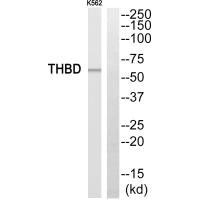
THBD; THRM; Thrombomodulin; TM; Fetomodulin; CD antigen CD141
Raised in
Rabbit
Species Reactivity
Human
Immunogen
Synthesized peptide derived from C-terminal of Human THBD.
Immunogen Species
Homo sapiens (Human)
Clonality
Polyclonal
Purification Method
The antibody was affinity-purified from rabbit antiserum by affinity-chromatography using epitope-specific immunogen.
Concentration
It differs from different batches. Please contact us to confirm it.
Form
Rabbit IgG in phosphate buffered saline (without Mg2+ and Ca2+), pH 7.4, 150mM NaCl, 0.02% sodium azide and 50% glycerol.
Note: We will preferentially ship the format that we have in stock, however, if you have any special requirement for the format, please remark your requirement when placing the order, we will prepare according to your demand.
Upon receipt, store at -20°C or -80°C. Avoid repeated freeze.
Lead Time
Basically, we can dispatch the products out in 1-3 working days after receiving your orders. Delivery time maybe differs from different purchasing way or location, please kindly consult your local distributors for specific delivery time.
Note: All of our proteins are default shipped with normal blue ice packs, if you request to ship with dry ice, please communicate with us in advance and extra fees will be charged.
Usage
For Research Use Only. Not for use in diagnostic or therapeutic procedures.
Thrombomodulin is a specific endothelial cell receptor that forms a 1:1 stoichiometric complex with thrombin. This complex is responsible for the conversion of protein C to the activated protein C (protein Ca). Once evolved, protein Ca scissions the activated cofactors of the coagulation mechanism, factor Va and factor VIIIa, and thereby reduces the amount of thrombin generated.
Gene References into Functions
Thrombomodulin gene C1418T polymorphism is associated with Kawasaki disease.PMID:30008974
SETD1A contributes to retinoic acid -induced thrombomodulin expression in vascular endothelial cells by modulating the activity and expression of KLF4.PMID:29940355
we for the first time demonstrated that TM binds to GPR15 via its EGF-like domain and exerts angiogenesis and cytoprotective function in vascular ECs.PMID:28386128
Bioinformatics analysis and screening of controls strongly suggested that the THBD-p.Trp153Gly mutation might be related to RPL aetiology.PMID:29195508
Taken together, our findings suggest that TM-PKCdelta interaction may contribute to cardiovascular disorders by affecting monocye differentiation, which may develop future therapeutic applications.PMID:27910925
A heterozygous variant displaying autosomal dominant inheritance (c.1611 C>A) was found in the gene THBD which encodes the glycoprotein thrombomodulin. This sequence change results in a stop codon (p.Cys537Stop) and truncation of the proteinPMID:28267383
Lys 42, Lys 43, Lys 44 and Arg 12 are critical for the interaction of TAFI with the thrombin-thrombomodulin complex, which modulates its antifibrinolytic potential.PMID:28640323
Ligation of anti-HLA class I and II antibodies produces different effects on the endothelial expression of TBM and on serum levels of TBM in transplant recipients.PMID:28239987
Fibrinogen gamma acts as thrombomodulin II. (Review)PMID:27784620
Thrombomodulin (TM) promotes angiogenesis by enhancing cell adhesion, migration, and FAK activation through interaction with fibronectin.PMID:27602495
The elevation of serum thrombomodulin (sTM)level suggests that endothelial damage occurs in Abdominal Aortic Aneurysm pathogenesis.PMID:28473982
This population-based cohort study within the ARIC study did not replicate the Hernandez et al. finding that carrying the minor allele of 3 THBD SNPs doubles the risk of venous thromboembolism in African Americans. In fact, the HRs of VTE among carriers of the minor allele were <1. HRs were similar for white subjects. A strand-flip did not explain the discrepancies.PMID:28619983
these results suggest a novel function for thrombomodulin as an adhesion molecule in monocytes, where it enhances cell adhesion by binding Ley, leading to beta2 integrin activation via p38 MAPKPMID:27808085
TM, especially TME45, maintains vascular integrity, at least in part, via Src signaling.PMID:27643869
The present study found that the fifth epidermal growth factor-like domain of thrombomodulin (TME5) possesses the cytoprotective function in association with an increase in levels of anti-apoptotic myeloid cell leukemia-1 protein in an activated protein C-independentPMID:27427915
Case Report: CD141+ myeloid dentritic cell differentiation of a juvenile myelomonocytic leukemia.PMID:28414089
the effect of thromobomodulin c.1418C > T polymorphism on the pathogenesis of venous thrombosisPMID:28710034
The finding of a previously unrecognized fibrinolytic phenotype indicates that bleeding in Thrombomodulin-associated coagulopathy has a complex pathogenesis and highlights the pivotal role of TM as a regulator of hemostasis.PMID:27436851
TM mediates cell proliferation and migration via the Epithelial-To-Mesenchymal Transition (EMT) biomarkercyclooxygenase (COX)-2PMID:27512995
the whole THBD gene sequenced in patients with recurrent venous thromboembolism (VTE); found 8 polymorphisms in the THBD gene in Swedish population; none of these polymorphisms was significantly associated with the risk of VTE recurrence; results indicate that THBD polymorphisms may not be a risk factor for VTE recurrencePMID:28049360
CORM-2 protects human umbilical vein endothelial cells from lipopolysaccharide-induced injury, by way of suppressing NF-kappaB activity, which downregulates TM and EPCR mRNAs. It also decreases MMP-2 expression and prevents the shedding of TM and EPCR from the surface of endothelial cells, so as to preserve their protective effect.PMID:28538400
The results demonstrate that the LFA-1 and Mac-1 integrins on leukocytes bind to thrombomodulin (TM), thereby establishing the molecular and structural basis underlying LFA-1 and Mac-1 integrin interaction with TM on endothelial cells.PMID:27055590
Human thrombomodulin transgenic aortic endothelial cells are less sensitive to activation by either HMGB1 or hTNFalpha, an effect that appears to be dependent on the lectin-like domain of TBM.PMID:27077599
In placenta of patients with preeclampsia, we detected abnormal expression of F3 and THBD with increased protein and mRNA levels. The role of these molecules in the pathogenesis of this disease and in alterations of hemostatic and histopathological aspects of placentas need further studying.PMID:27002259
recombinant TM (Solulin) can protect the intestine from toxicity in a clinically relevant rat modelPMID:27459702
TM up-regulated E-cadherin but down-regulated N-cadherin expression, resulting in reversal of epithelial-mesenchymal transition (EMT) in the lung cancer cells.PMID:27223053
High serum thrombomodulin expression is associated with non-alcoholic fatty liver disease.PMID:26959535
results do not suggest a predictive role for THBD c.1418C>T polymorphism in VTE recurrencePMID:26743062
R12 is a critical residue for the activation of TAFI by thrombin-thrombomodulinPMID:26816270
Study detected a statistically significant positive correlation between expanded disability status scale scores and thrombomodulin levels (p<0.01) and a 10% positive correlation between expanded disability status scale scores and APC levels in multiple sclerosis patientsPMID:27456888
Case Report: thrombotic microangiopathy with mutations in complement factor I and thrombomodulin.PMID:26613809
increased plasma TM levels and serum hs-CRP levels in cerebral infarction (CI) patients were associated with the development of CI in Asians.PMID:26133301
evidence of association between the -33G/A polymorphism in the TM gene and the risk of myocardial infarction in Asians; the Ala455Val variant was not associated with atherosclerotic risk [meta-analysis]PMID:26888356
Decreased thrombomodulin expression in preeclampsia may play a role in placental dysfunction in preeclampsia and is possibly caused by an angiogenic imbalance. Hypertension and obesity are associated with thrombomodulin downregulation.PMID:26891741
The presence of THBD proximal promoter polymorphisms do not explain variations in levels of serum and cell-expressed THBD in premature acute coronary syndrome patients in Bahrain.PMID:26226255
the functional relevance of the rs3176123 variation and indicate that higher thrombomodulin expression by individuals with the 2729C allele likely accounts for their decreased risk for acute GVHD development and subsequent mortality.PMID:26246110
The lack of any association between the sTM levels and genetic variants in ARDS suggests that the increased levels of sTM may reflect severity of endothelial damage rather than genetic heterogeneity.PMID:25643902
Identified Nur77/Nor1 as novel regulators of thrombomodulin expression and function in vascular endothelial cells.PMID:26634653
The results of this study supported the association of the epistatic interactions of ALOX5AP, THBD, and KNG1 and present novel evidence for the main effect of KNG1 gene on IS susceptibility.PMID:26159646
The EGF5, 6 domains of thrombomodulin appear to be the major domains for down-regulating the complement system rather than the lectin-like domain during xenogenic stimuli.PMID:26179123
A minimal TM fragment consisting of the fourth, fifth, and most of the sixth EGF-like domain (TM456m) that has been prepared has much improved solubility, thrombin binding capacity, and anticoagulant activity versus those of previous TM456 constructs.PMID:26468766
Data indicate that blood dendritic cell antigen 3 BDCA3(+) and C-type lectin domain family 9, member A CLEC9A(+) dendritic cells (DC) are of major importance in the induction of anti-viral and anti-tumor immunity.PMID:24910448
Recombinant thrombomodulin does not impair neutrophil functions.PMID:25214376
levels of protein C and soluble thrombomodulin in critically ill patients with acute kidney injuryPMID:25790110
Membrane-bound TM in macrophages plays an essential role in the development of abdominal aortic aneurysms by enhancing proinflammatory mediator elaboration, macrophage recruitment, and oxidative stress.PMID:26338301
Cyclic strain strongly downregulated TM expression in a p38- and receptor tyrosine kinase-dependent manner in aortic endothelial cells.PMID:25238231
kinetics of the interaction between serine/threonine-rich domain of thrombomodulin (rTMD23) and FGFR1 were analysed in umbilical vein endothelial cellsPMID:25388665
Thrombomodulin is differentially regulated within cultured brain microvascular endothelial cells by cytokines and shear stress.PMID:25250518
Review/Meta-analysis: TM -33G/A and Ala455Val polymorphisms were risk factors for coronary artery disease.PMID:25144670
function and regulation of BDCA3 expression and IFN-lambda production by dendritic cellsPMID:25616220
Show
More
Hide
All
Subcellular Location
Membrane; Single-pass type I membrane protein.
Tissue Specificity
Endothelial cells are unique in synthesizing thrombomodulin.