Upon receipt, store at -20°C or -80°C. Avoid repeated freeze.
Lead Time
Basically, we can dispatch the products out in 1-3 working days after receiving your orders. Delivery time maybe differs from different purchasing way or location, please kindly consult your local distributors for specific delivery time.
Note: All of our proteins are default shipped with normal blue ice packs, if you request to ship with dry ice, please communicate with us in advance and extra fees will be charged.
Usage
For Research Use Only. Not for use in diagnostic or therapeutic procedures.
Western Blot
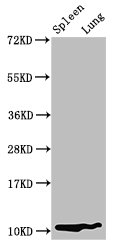
Positive WB detected in: Rat spleen tissue, Rat lung tissue
All lanes: S100a8 antibody at 3.2µg/ml
Secondary
Goat polyclonal to rabbit IgG at 1/50000 dilution
Predicted band size: 11 kDa
Observed band size: 11 kDa
S100A8 is a calcium- and zinc-binding protein which plays a prominent role in the regulation of inflammatory processes and immune response. It can induce neutrophil chemotaxis and adhesion. Predominantly found as calprotectin (S100A8/A9) which has a wide plethora of intra- and extracellular functions. The intracellular functions include: facilitating leukocyte arachidonic acid trafficking and metabolism, modulation of the tubulin-dependent cytoskeleton during migration of phagocytes and activation of the neutrophilic NADPH-oxidase. Activates NADPH-oxidase by facilitating the enzyme complex assembly at the cell membrane, transferring arachidonic acid, an essential cofactor, to the enzyme complex and S100A8 contributes to the enzyme assembly by directly binding to NCF2/P67PHOX. The extracellular functions involve proinflammatory, antimicrobial, oxidant-scavenging and apoptosis-inducing activities. Its proinflammatory activity includes recruitment of leukocytes, promotion of cytokine and chemokine production, and regulation of leukocyte adhesion and migration. Acts as an alarmin or a danger associated molecular pattern (DAMP) molecule and stimulates innate immune cells via binding to pattern recognition receptors such as Toll-like receptor 4 (TLR4) and receptor for advanced glycation endproducts (AGER). Binding to TLR4 and AGER activates the MAP-kinase and NF-kappa-B signaling pathways resulting in the amplification of the proinflammatory cascade. Has antimicrobial activity towards bacteria and fungi and exerts its antimicrobial activity probably via chelation of Zn(2+) which is essential for microbial growth. Can induce cell death via autophagy and apoptosis and this occurs through the cross-talk of mitochondria and lysosomes via reactive oxygen species (ROS) and the process involves BNIP3. Can regulate neutrophil number and apoptosis by an anti-apoptotic effect; regulates cell survival via ITGAM/ITGB and TLR4 and a signaling mechanism involving MEK-ERK. Its role as an oxidant scavenger has a protective role in preventing exaggerated tissue damage by scavenging oxidants. The iNOS-S100A8/A9 transnitrosylase complex is proposed to direct selective inflammatory stimulus-dependent S-nitrosylation of multiple targets such as GAPDH, ANXA5, EZR, MSN and VIM by recognizing a [IL]-x-C-x-x-[DE] motif; S100A8 seems to contribute to S-nitrosylation site selectivity.
Gene References into Functions
Establish S100A8 transgenic rats to elucidate role as a regulator in acute inflammation.PMID:28913572
Recombinant rat r-S100A8 bound to r-CD68. The expression levels of S100A8 were significantly suppressed after the macrophages had been treated with an anti-CD68 antibody. Small interfering CD68 also significantly suppressed activation of macrophages through an autocrine pathway by r-S100A8.PMID:27312849
results support S100A8 as a novel therapeutic target to control ASM contraction in asthmaPMID:28088518
vagus nerve electrical stimulation may produce a protective effect on septic shock in rats by decreasing the production of S100A8.PMID:27035526
Expression of S100A8 mRNA and the corresponding protein in cultured NRVCs was similar between control cells and norepinephrine-stimulated cells, but was markedly upregulated at 12 hours after the withdrawal of NE.PMID:25820336
Mrp8 may potentiate the perpetuation of mesial temporal lobe epilepsy by activating the NF-kappaB pathway in astrocytes.PMID:23982744
Report role for MRP8 for exaggerated in-stent restenosis in diabetes mellitus type 2.PMID:22381691
In vivo zinc regulates S100A8 expression and modulates the link between S100A8-RAGE interaction and downstream nuclear factor kappaBeta/COX-2 signalingPMID:19111725
The bladder uroepithelium was a prominent cell source of S100A8-S100A9 in animals with complicated urinary tract infection, which was not detected in animals with asymptomatic urinary tract infection.PMID:19667050