RRAGA/RRAGB Antibody

CSB-PA590465
Size:
100μl
100μl
US$297
Quantity:
Species Reactivity: Human,Mouse,Rat
Raised in: Rabbit
Application: ELISA,WB
For inquiries on large quantities or another requirements
Send an Inquiry
Start an on-line Chat
Orders can only be placed from within the U.S.

Product Details

Uniprot NO.
Target Names
RRAGA/RRAGB
Alternative Names
Adenovirus E3 14.7 kDa-interacting protein 1 antibody; FIP-1 antibody; Rag A antibody; RagA antibody; Ras-related GTP-binding protein A antibody; RRAGA antibody; RRAGA_HUMAN antibody
Raised in
Rabbit
Species Reactivity
Human,Mouse,Rat
Immunogen
Synthesized peptide derived from internal of Human RRAGA/B.
Immunogen Species
Homo sapiens (Human)
Purification Method
The antibody was affinity-purified from rabbit antiserum by affinity-chromatography using epitope-specific immunogen.
Concentration
It differs from different batches. Please contact us to confirm it.
Tested Applications
ELISA,WB
Storage
Upon receipt, store at -20°C or -80°C. Avoid repeated freeze.
Lead Time
Basically, we can dispatch the products out in 1-3 working days after receiving your orders. Delivery time maybe differs from different purchasing way or location, please kindly consult your local distributors for specific delivery time.
Usage
For Research Use Only. Not for use in diagnostic or therapeutic procedures.
Datasheet & COA
Images
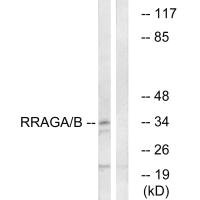
  • Western blot analysis of extracts from HepG2 cells, using RRAGA/B antibody.
Description

Customer Reviews and Q&A

 Customer Reviews

Target Background

Function
Guanine nucleotide-binding protein that plays a crucial role in the cellular response to amino acid availability through regulation of the mTORC1 signaling cascade. Forms heterodimeric Rag complexes with RRAGC or RRAGD and cycles between an inactive GDP-bound and an active GTP-bound form. In its active form participates in the relocalization of mTORC1 to the lysosomes and its subsequent activation by the GTPase RHEB. Involved in the RCC1/Ran-GTPase pathway. May play a direct role in a TNF-alpha signaling pathway leading to induction of cell death.; (Microbial infection) May alternatively act as a cellular target for adenovirus E3-14.7K, an inhibitor of TNF-alpha functions, thereby affecting cell death.
Gene References into Functions
  1. cryo-electron microscopy to solve structures of GATOR1 and GATOR1-RagA GTPase complexes; GATOR1 adopts an extended architecture with a cavity in the middle; NPRL2 links DEPDC5 and NPRL3, and DEPDC5 contacts the RagA GTPase heterodimer PMID:29590090
  2. Full-length RagA(GTP):RagC(GDP) dimer binds to regulator to activate mTORC1. PMID:29107538
  3. NUDT2 is a novel complex formation enhancing factor regulating mTORC1-Rag GTPase signaling that is crucial for cell growth control. PMID:28089905
  4. The dynamic response of mTORC1 requires intersubunit communication by the Rag GTPases, providing a rationale for why they exist as a dimer and revealing a distinct mode of control for a GTP-binding protein. PMID:29056322
  5. The data indicate that the RRAGA mutations, associated with autosomal dominant cataracts, play a role in the disease by acting through disruption of mTORC1 signaling. PMID:27294265
  6. Data suggest that both microtubule-associated DYNLT (dynein light chain Tctex-type 1) and cytoplasmic DYNLT (dynein 1 intermediate chain 2 DYNC1LI2) are equally able to bind to small GTPases Rab3D (Rab3d GTPase) and RagA (Ras-related GTP binding A). PMID:26227614
  7. Data suugest that S-phase kinase-associated protein 2 (Skp2)-mediated Ras-related GTP-binding protein RagA ubiquitination recruits GATOR1 to restrict mTORC1 signaling upon sustained amino acid stimulation. PMID:26051179
  8. A mechanism for regulation of mTORC1 signaling by RNF152-mediated K63-linked polyubiquitination of RagA. PMID:25936802

Show More

Hide All

Subcellular Location
Cytoplasm. Nucleus. Lysosome.
Protein Families
GTR/RAG GTP-binding protein family
Tissue Specificity
Ubiquitously expressed with highest levels of expression in skeletal muscle, heart, and brain.
Database Links

HGNC: 16963

UNIGENE: Hs.743260

KEGG: hsa:10670

STRING: 9606.ENSP00000369899

OMIM: 612194

icon of phone
Call us
301-363-4651 (Available 9 a.m. to 5 p.m. CST from Monday to Friday)

icon of address
Address
7505 Fannin St., Ste 610, Room 7 (CUBIO Innovation Center), Houston, TX 77054, USA
icon of social media
Join us with

Subscribe newsletter

Leave a message

* To protect against spam, please pass the CAPTCHA test below.
CAPTCHA verification
© 2007-2025 CUSABIO TECHNOLOGY LLC All rights reserved. 鄂ICP备15011166号-1
Select 0 Products