Peptide sequence around phosphorylation site of tyrosine 309(A-A-V(p)-W-S) derived from Human Pim-1.
Immunogen Species
Mus musculus (Mouse)
Purification Method
Antibodies were produced by immunizing rabbits with synthetic phosphopeptide and KLH conjugates. Antibodies were purified by affinity-chromatography using epitope-specific phosphopeptide. Non-phospho specific antibodies were removed by chromatogramphy usi
Concentration
It differs from different batches. Please contact us to confirm it.
Tested Applications
ELISA,WB
Storage
Upon receipt, store at -20°C or -80°C. Avoid repeated freeze.
Lead Time
Basically, we can dispatch the products out in 1-3 working days after receiving your orders. Delivery time maybe differs from different purchasing way or location, please kindly consult your local distributors for specific delivery time.
Note: All of our proteins are default shipped with normal blue ice packs, if you request to ship with dry ice, please communicate with us in advance and extra fees will be charged.
Usage
For Research Use Only. Not for use in diagnostic or therapeutic procedures.
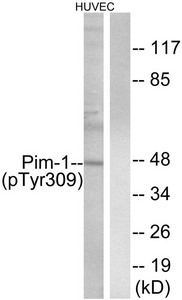
Western blot analysis of extracts from HUVEC cells treated with PMA using Pim-1 (Phospho-Tyr309) Antibody.The lane on the right is treated with the antigen-specific peptide.
Proto-oncogene with serine/threonine kinase activity involved in cell survival and cell proliferation and thus providing a selective advantage in tumorigenesis. Exerts its oncogenic activity through: the regulation of MYC transcriptional activity, the regulation of cell cycle progression and by phosphorylation and inhibition of proapoptotic proteins (BAD, MAP3K5, FOXO3). Phosphorylation of MYC leads to an increase of MYC protein stability and thereby an increase of transcriptional activity. The stabilization of MYC exerted by PIM1 might explain partly the strong synergism between these two oncogenes in tumorigenesis. Mediates survival signaling through phosphorylation of BAD, which induces release of the anti-apoptotic protein Bcl-X(L)/BCL2L1. Phosphorylation of MAP3K5, another proapoptotic protein, by PIM1, significantly decreases MAP3K5 kinase activity and inhibits MAP3K5-mediated phosphorylation of JNK and JNK/p38MAPK subsequently reducing caspase-3 activation and cell apoptosis. Stimulates cell cycle progression at the G1-S and G2-M transitions by phosphorylation of CDC25A and CDC25C. Phosphorylation of CDKN1A, a regulator of cell cycle progression at G1, results in the relocation of CDKN1A to the cytoplasm and enhanced CDKN1A protein stability. Promotes cell cycle progression and tumorigenesis by down-regulating expression of a regulator of cell cycle progression, CDKN1B, at both transcriptional and post-translational levels. Phosphorylation of CDKN1B, induces 14-3-3 binding, nuclear export and proteasome-dependent degradation. May affect the structure or silencing of chromatin by phosphorylating HP1 gamma/CBX3. Acts also as a regulator of homing and migration of bone marrow cells involving functional interaction with the CXCL12-CXCR4 signaling axis. Also phosphorylates and activates the ATP-binding cassette transporter ABCG2, allowing resistance to drugs through their excretion from cells. Promotes brown adipocyte differentiation.
Gene References into Functions
Pim-1 is a novel kinase that phosphorylates cTnI primarily at Ser23/24 and Ser150 in cardiomyocytes, which in turn may modulate myofilament function under a variety of physiological and pathophysiological conditions.PMID:29544221
this study shows that Pim-1 dysregulation has developmental-stage-specific effects on B lymphopoiesis and early myeloid, but not erythroid progenitorsPMID:27287229
Results show that elevated miR-15b as an early response to Dicer depletion silenced Pim-1 kinase resulting in mitochondrial dysfunction. Rescue experiments demonstrated that suppression of miRNA-15b induction in Dicer-deleted adult hearts result in marked amelioration of cardiac dysfunction.PMID:23840532
Pim-1L protects hepatic ABCA1 from lysosomal degradation by facilitating the physical interaction between ABCA1 and liver X receptor beta and subsequent stabilization of the ABCA1-Pim-1L complex and thereby regulates the circulating level of high-density lipoprotein.PMID:27765770
Pim1 kinase activity maintains airway epithelial integrity and protects against house dust mite-induced proinflammatory activation of the airway epithelium.PMID:26453516
Pim kinases prevent premature cardiac aging and maintain a healthy pool of functional mitochondria leading to efficient cellular energetics.PMID:24916111
these results identify Pim1 as a novel effector molecule sufficient to drive CD4( ) alphabeta T-cell development and survival in the absence of gammac cytokine receptor signaling.PMID:23712827
Our data suggest that Pim1 might contribute to progression rather than initiation in prostate neoplasia.PMID:23565217
Loss of PIM1 is associated with abnormal hematopoietic phenotypes.PMID:23360755
Pim-1 activity prevents Drp1 compartmentalization to the mitochondria and preserves reticular mitochondrial morphology in response to sIPMID:23530233
Pim1 kinase deletion and inhibition slows endothelial cell detachment by trypsinization and increases cell adhesion.PMID:23202547
Telomere elongation consistent with a young phenotype is observed following Pim-1 overexpression.PMID:22915504
demonstrated that over-expression of miR-16 mimics suppressed Pim-1 expression in FD-FLT3/ITD cells suggesting that increased miR-16 expression contributes to depletion of Pim-1 after FLT3 inhibitionPMID:22970245
a novel regulatory axis involving Pim1 kinase and Runx3 in the control of food-induced allergic reactions through the regulation of T(H)2 and T(H)17 differentiation.PMID:22944483
Inhibition of Pim-1 kinase abolished desflurane-induced postconditioning & ischemic postconditioning. Pim-1 kinase mediates both processes in mice.PMID:22385356
Pim-1 kinase is involved in mucosal injury/inflammation.PMID:22466098
the important role of Pim1 kinase in the full development of allergen-induced airway responsesPMID:22074702
Pim-1 expression correlates with lymphocyte proliferation and activation.PMID:21974958
Pim-1 kinase is upregulated by STAT3 activation in cardiac Sca-1+ cells and plays a pivotal role in EC differentiation both in vitro and in vivo.PMID:21600215
Targeting cap-dependent translation blocks converging survival signals by AKT and PIM 1, 2 kinases in lymphomaPMID:21859846
RAGE activation accounts for many features of Vascular remodeling diseases including VSMC proliferation and resistance to apoptosis by the activation of STAT3/Pim1/NFAT axis.PMID:21680901
Pim-1 sustains survival of rapidly proliferating cells by antiapoptotic and prometabolic effects that are independent of the mammalian target of rapamycin (mTOR) pathway.PMID:21048108
Data show that Pim-1 is able to cooperate with Skp2 to signal S phase entry.PMID:20663873
PDGF(bb)-induced proliferation of vascular smooth muscle cells is partly attributed to transcriptionally upregulated Pim-1.PMID:19711112
Pim-1 expression is sufficient to induce cytokine independence in murine hematopoietic cells, but is dispensable for BCR-ABL-mediated transformation.PMID:12135666
Pim-1 interacts with SOCS1 and SOCS3 and potentiates their inhibitory effects on STAT5, most likely via phosphorylation-mediated stabilization of the SOCS proteinsPMID:14764533
Pim-1 is required for differentiation into vascular endothelium and smooth muscle cells.PMID:14982870
Pim-1 kinase stability is regulated by heat shock proteins and the ubiquitin-proteasome pathwayPMID:15798097
Pim-1 expression may be regulated by progesterone during mammary development and Pim-1 associates with p21 in mammary epithelial cellsPMID:16712793
Pim-1 kinase has a novel role in the control of self-renewal of embryonic stem cells.PMID:17717068
Pim-1 is a crucial facet of cardioprotection downstream of AktPMID:18037896
Pim kinases play a key role in the v-Abl transformation, possibly via participating in modulation of SOCS-1 and via regulating the apoptotic signalingPMID:18042805
Nucleostemin expression in cardiomyocytes is induced by fibroblast growth factor-2 and accumulates in response to Pim-1 kinase activity.PMID:18519946
Pim-1 phosphorylates four Ser/Thr residues within the Runt domain and stabilizes RUNX3 protein, alterING the cellular localization of RUNX3 from the nucleus to the cytoplasmPMID:18767071
ALDH2 may effectively ameliorate alcohol-induced hepatic apoptosis and changes in Akt as well as Pim signalling.PMID:19215238
Pim-1 plays a distinct role in solid tumor formationPMID:19528349
PIM1 regulates surface CXCR4 expression in hematopoietic cells lines, and is a regulator of homing and migration of bone marrow cells involving functional interaction with the CXCL12-CXCR4 signaling axis.PMID:19687226
Pim-1 kinase mediates at least in part desflurane-induced preconditioning and IPC against myocardial infarction in micePMID:19934869
Show
More
Hide
All
Subcellular Location
Cytoplasm. Nucleus. Cell membrane. Note=Mainly located in the cytoplasm.
Protein Families
Protein kinase superfamily, CAMK Ser/Thr protein kinase family, PIM subfamily