CD 148 antibody; CD148 antibody; CD148 antigen antibody; Density enhanced phosphatase 1 antibody; Density-enhanced phosphatase 1 antibody; DEP 1 antibody; DEP-1 antibody; HPTP eta antibody; HPTPeta antibody; Human density enhanced phosphatase 1 antibody; Protein tyrosine phosphatase eta antibody; Protein tyrosine phosphatase receptor type J antibody; Protein tyrosine phosphatase receptor type J polypeptide antibody; Protein-tyrosine phosphatase eta antibody; Protein-tyrosine phosphatase receptor type J antibody; PTPJ antibody; Ptprj antibody; PTPRJ_HUMAN antibody; R PTP Eta antibody; R-PTP-eta antibody; R-PTP-J antibody; Receptor type tyrosine protein phosphatase eta antibody; Receptor-type tyrosine-protein phosphatase eta antibody; SCC 1 antibody; SCC1 antibody; susceptibility to colon cancer 1; mouse; homolog of antibody
Raised in
Rabbit
Species Reactivity
Human,Mouse
Immunogen
Synthetic peptide of Human PTPRJ
Immunogen Species
Homo sapiens (Human)
Conjugate
Non-conjugated
Isotype
IgG
Purification Method
Antigen affinity purification
Concentration
It differs from different batches. Please contact us to confirm it.
Buffer
-20°C, pH7.4 PBS, 0.05% NaN3, 40% Glycerol
Tested Applications
ELISA,IHC
Storage
Upon receipt, store at -20°C or -80°C. Avoid repeated freeze.
Lead Time
Basically, we can dispatch the products out in 1-3 working days after receiving your orders. Delivery time maybe differs from different purchasing way or location, please kindly consult your local distributors for specific delivery time.
Usage
For Research Use Only. Not for use in diagnostic or therapeutic procedures.
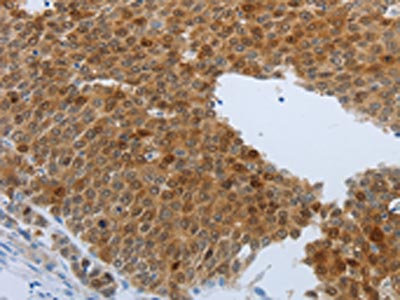
The image on the left is immunohistochemistry of paraffin-embedded Human liver cancer tissue using CSB-PA438177(PTPRJ Antibody) at dilution 1/40, on the right is treated with synthetic peptide. (Original magnification: ×200)
Tyrosine phosphatase which dephosphorylates or contributes to the dephosphorylation of CTNND1, FLT3, PDGFRB, MET, RET (variant MEN2A), KDR, LYN, SRC, MAPK1, MAPK3, EGFR, TJP1, OCLN, PIK3R1 and PIK3R2. Plays a role in cell adhesion, migration, proliferation and differentiation. Involved in vascular development. Regulator of macrophage adhesion and spreading. Positively affects cell-matrix adhesion. Positive regulator of platelet activation and thrombosis. Negative regulator of cell proliferation. Negative regulator of PDGF-stimulated cell migration; through dephosphorylation of PDGFR. Positive regulator of endothelial cell survival, as well as of VEGF-induced SRC and AKT activation; through KDR dephosphorylation. Negative regulator of EGFR signaling pathway; through EGFR dephosphorylation. Enhances the barrier function of epithelial junctions during reassembly. Negatively regulates T-cell receptor (TCR) signaling. Upon T-cell TCR activation, it is up-regulated and excluded from the immunological synapses, while upon T-cell-antigen presenting cells (APC) disengagement, it is no longer excluded and can dephosphorylate PLCG1 and LAT to down-regulate prolongation of signaling.
Gene References into Functions
PTPRJ variant of uncertain significance in candidate gene was identified in Familial Mitral Valve Prolapse.PMID:29762926
Short variant of the receptor protein phosphatase PTPRJ generated by an alternative splicing promotes angiogenesis in HUVEC cells and tumor angiogenesis.PMID:28052032
study reveals the crucial role of miR-155/PTPRJ/AKT axis in proliferation and migration of colorectal cancer cells and suggests a therapeutic potential of PTPRJ.PMID:28316102
Authors demonstrate that mtp53 prevents the COP1/DET1 complex from ubiquitinating ETS2 and thereby marking it for destruction. Authors show that mtp53 destabilizes DET1 and also disrupts the DET1/ETS2 complex thereby preventing ETS2 degradation.PMID:26871468
These data support that PTPN22 1858C/T, PTPRJ 2965C/G and 1176 A/C polymorphisms and ACP1 A, B and C alleles are not associated with a higher risk of immune thrombocytopenia P in adults.PMID:27309885
Loss of PTPRJ expression may predict an aggressive clinical course in ESCC patients.PMID:26694178
The strongest association with frailty was observed in the Protein Tyrosine Phosphatase, Receptor type, J (PTPRJ) (rs1566729, P = 0.001372, beta = 0.09397) gene.PMID:26248682
the combination of CD200 and CD148 may have a potential differential diagnostic value in leukemic B-CLPDs, especially between CLL and MCL.PMID:25791119
These results demonstrated Ptprj as a physiological enzyme that attenuates insulin signalling in vivo, and indicate that an inhibitor of Ptprj may be an insulin-sensitizing agent.PMID:26063811
The studies suggest induction of MMP-9 expression promoted by DEP-1 deficiency.PMID:25672645
Moderate expression of DEP-1 was associated with the increased relapse.PMID:25772245
C33A cells lacking PTPRJ had increased cell viability, growth, migration, G1-S transition, and 5-FU resistance. PTPRJ negatively regulated the JAK1/STAT3 pathway by decreasing phosphorylation levels of JAK1 and STAT3 and expression of downstream factors.PMID:25634668
The expression profiles of DEP1 and B2MG correlate with increased cell senescence and survival in breast cancer.PMID:25412306
Phosphorylation of T1318 is part of a regulatory mechanism that channels the activity of DEP-1 towards Src to allow its optimal activation and the promotion of endothelial cell permeability.PMID:24583284
Data indicate that CD148 is upregulated in macrophages and T cells in rheumatoid arthritis (RA) samples, and its activity is enhanced by treatment with tumour necrosis factor alpha (TNFalpha), and reduced by synovial fluid or oxidising conditions.PMID:24016860
our data support the notion of DEP-1 as positive functional regulator in vascular cerebral arteriogenesis, involving differential PDGF-B gene expression.PMID:24027763
FLT3 is a bona fide substrate of DEP-1 and that interaction occurs mainly via an enzyme-substrate complex formation triggered by FLT3 ligand stimulation.PMID:23650535
haplotypes in PTPRJ gene may play a role in susceptibility to Non-Hodgkin's lymphoma, by affecting activation of PTPRJ in these B-cell lymphomas.PMID:23341091
Data indicate that miR-328 regulated PTPRJ expression, and suggest that the interaction of miR-328 with PTPRJ is responsible for miR-328-dependent increase of epithelial cell proliferation.PMID:22564856
These data indicate that PTPRJ may regulate differentiation of normal mammary epithelia and that dysregulation of protein localisation may be associated with tumorigenesis.PMID:22815804
CD148 polymorphisms affect platelet activation and probably exert a protective effect on the risk of Heparin-induced thrombocytopenia in patients with antibodies to PF4/Heparin complexes.PMID:22677127
DEP-1 oxidation is a novel event contributing to cell transformation by FLT3 ITD.PMID:22438257
These findings provide evidence that CD148 functions as a receptor for TSP1 and mediates its inhibition of cell growth.PMID:22308318
Here the protein tyrosine phosphatase receptor CD148 is shown to be a key intermediary in cell adhesion to S2ED, with downstream beta1 integrin-mediated adhesion and cytoskeletal organizationPMID:21813734
We propose that positive regulation of adhesion signaling by DEP-1 is involved in inhibition of meningioma cell motility, and possibly tumor invasiveness.PMID:21091576
differential effects of CD148 in T cells and other leukocyte subsetsPMID:21543337
That DEP-1 plays a biologic role in angiogenic endothelial cell behavior was demonstrated in endothelial cell migration, proliferation, and capillary-like tube formation assays in vitroPMID:21304107
DEP-1 is negatively regulating FLT3 signaling activity and that its loss may contribute to but is not sufficient for leukemogenic cell transformation.PMID:21262971
Therefore, the results reported here show that the homozygous genotype for Asp872 of PTPRJ is associated with an increased risk to develop papillary thyroid carcinoma.PMID:20823296
PTPRJ is a candidate colorectal cancer susceptibility genePMID:21036128
DEP-1 is a tumor suppressor that dephosphorylates and thereby stabilizes EGFR by hampering its ability to associate with the CBL-GRB2 ubiquitin ligase complex.PMID:19836242
PTPRJ SNPs were found to influence susceptibility to a wide spectrum of cancers.PMID:19672627
This protein is frequently deleted in human breast cancers.PMID:12089527
CD148 and CD27 are expressed in a wide range of B cell non-Hodgkin's lymphomas and do not serve to distinguish between neoplastic cells of naive and memory B cell derivationPMID:12685844
DEP-1 is a negative regulator of cell proliferation, cell-substratum contacts, motility and chemotaxis in fibroblastsPMID:14709717
propose that the expression and activation of DEP-1/PTPeta is required for somatostatin inhibition of glioma proliferationPMID:15123617
A candidate tumor suppressor gene because its expression was blocked in rat and human thyroid transformed cells, and its restoration reverted their neoplastic phenotype.PMID:15231692
genotypic profile of PTPRJ affects susceptibility to thyroid carcinomas, loss involved in thyroid carcinogenesisPMID:15378013
single nucleotide polymorphisms in protein tyrosine phosphatase receptor type J is associated with breast cancerPMID:16000320
Male, dizygotic twins were diagnosed with sensori-neural deafness at ages 5 and 21 months and later developed hypothyroidism at ages 24 and 28 months, respectively. Analysis for anti-DEP-1/CD148 autoantibodies described in Cogan syndrome proved positive.PMID:16582570
Chemoprotective nutrients elevated transcription of endogenous DEP-1 mRNA & expression of DEP-1 protein. Upregulation of DEP-1 expression & inhibition of cell growth & migration may be a previously unrecognized mechanism of chemoprevention by nutrients.PMID:16682945
These results demonstrate that CD148 may interact with and dephosphorylate p85 when it is phosphorylated and modulate the magnitude of phosphoinositide 3-kinase activity.PMID:18348712
The translation of the region between AUG(191) and AUG(356) inhibits the overall expression of PTPRJ mRNA.PMID:18603590
No significant evidence for the A1176C allele of PTPRJ or previously described haplotypes of tagSNPs in PTPRJ on CRC risk.PMID:18843023
DEP-1 is a positive regulator of VEGF-mediated Src and Akt activation and endothelial cell survival.PMID:18936167
The intact structure of the eighth fibronectin domain of PTPRJ is critical for its localization in plasma membrane and biological function.PMID:19122201
DEP-1 can modify the phosphorylation state of tight junction proteins and play a role in regulating permeability.PMID:19332538
CD148 may have a role in mantle cell lymphomaPMID:19413345
In this paper, frequent deletion of PTPRJ is shown in human colon, lung, and breast cancers.PMID:12089527
Show
More
Hide
All
Subcellular Location
Cell membrane; Single-pass type I membrane protein. Cell projection, ruffle membrane. Cell junction. Note=After T-cell stimulation, it is temporarily excluded from immunological synapses.
Protein Families
Protein-tyrosine phosphatase family, Receptor class 3 subfamily
Tissue Specificity
Expressed in the promyelocytic cell line HL-60, the granulocyte-macrophage colony-stimulating factor-dependent leukemic cell line F-36P, and the IL3 and erythropoietin-dependent leukemic cell line F-36E. Expressed predominantly in epithelial cells and lym