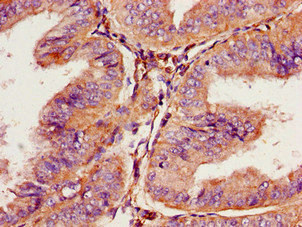
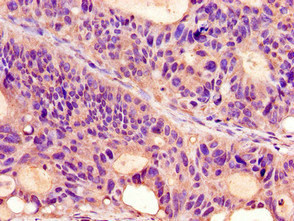
Upon receipt, store at -20°C or -80°C. Avoid repeated freeze.
Lead Time
Basically, we can dispatch the products out in 1-3 working days after receiving your orders. Delivery time maybe differs from different purchasing way or location, please kindly consult your local distributors for specific delivery time.
Usage
For Research Use Only. Not for use in diagnostic or therapeutic procedures.
Receptor for prokineticin 2. Exclusively coupled to the G(q) subclass of heteromeric G proteins. Activation leads to mobilization of calcium, stimulation of phosphoinositide turnover and activation of p44/p42 mitogen-activated protein kinase.
Gene References into Functions
EG-VEGF and PROKR2 were highly expressed in colorectal primary lesions compared to positive controls. PROKR1 expression was lower and did not change in tumor specimens.PMID:29226856
The deletion contained 17 protein coding genes including PROKR2 and BMP2, both of which are expressed during embryological development of the pituitary gland. PROKR2 mutations have been associated with hypopituitarism but a heterozygous deletion of this gene with hypopituitarism is a novel observation.PMID:28586151
PROKR2 genetic mutation plays a role in the pathogenesis of pituitary stalk interruption syndrome.PMID:28453858
a significant association between PKR2 rs6053283 polymorphism and Recurrent pregnancy loss (RPL) (P=0.003), whereas no association was observed between PKR1 rs4627609 polymorphism and RPL (P=0.929) in the Chinese Han population.PMID:26984842
PROKR2 may play a role in susceptibility of pituitary stalk interruption syndromePMID:26956854
PROKR2 expression in human fetal ovary remained unchanged throughout gestation.PMID:26192875
PKR2 protomers form type II dimers involving TMs 4 and 5, with a role for TM5 in modulation of PKR2 function.PMID:25449422
PK2-induced PKR2 endocytosis is GRK2- and clathrin-dependent, but beta-arrestin-independent.PMID:24509228
Wild-type PROKR2 activates different G-protein subtypes (Gq, Gs, and Gi/o) and recruits beta-arrestins. The effects of 9 missense mutations on these 2 processes showed that some mutations affected both or only one of them.PMID:24830383
Single PROKR2 missense allelic variants can either affect both cAMP and IP signaling pathways differently or selectively.PMID:24276467
Prokineticin (PK)1/PKR2-signalling pathway is involved in the regulation of the functional adequate capillarization in late pregnancyPMID:23891065
TSHZ1 is a key regulator of mammalian olfactory bulb development and function and controls the expression of PROKR2.PMID:24487590
V331M variant confers lower risk for recurrent miscarriagePMID:23687280
An unexpectedly large prevalence of PROKR2 mutations was found in Kallmann syndrome patients from the Maghreb.PMID:24031091
the distal region of the IL3 region of PROKR2 may differentially influence receptor trafficking and G-protein couplingPMID:23969157
PROKR2 signaling does not directly affect Sertoli cell function in autosomal recessive Kallmann syndrome.PMID:23200691
The role of PROKR2 in the etiology of congenital hypopituitarism, septo-optic dysplasia, and Kallmann syndrome is uncertain.PMID:23386640
An ancient founder missense mutation in PROKR2 impairs human reproduction.PMID:22773735
The R80C mutant of PROKR2 exerts a dominant negative effect on wild type PROKR2 by interfering with wild type receptor expression.PMID:22745195
We report PROKR2 variants in congenital hypopituitarism with pituitary stalk interruption, suggesting a potential role of the prokineticin pathway in pituitary development.PMID:22466334
hCG increases EG-VEGF, PROKR1 and PROKR2 mRNA and protein expression in a dose- and time-dependent manner, demonstrating a new role for hCG in the regulation of EG-VEGF and its receptorsPMID:22138749
genetic association studies in 103 patients from US and UK: Mutations in PROKR2, FGFR1, or FGF8 contributed to 7.8% of patients with combined pituitary hormone deficiency or septo-optic dysplasia. Data suggest genetic overlap with Kallmann syndrome.PMID:22319038
The results suggest an identical transmembrane-bundle binding site for hPKR1 and hPKR2.PMID:22132188
positive charges in the second intracellular loop mutations of the PKR2 receptor have roles in G-protein coupling and receptor traffickingPMID:21454486
ligation of tubal TLR2 and activation of NFkappaB by C. trachomatis leads to increased tubal PROKR2, thereby predisposing the tubal microenvironment to ectopic implantation.PMID:21224062
one tag SNP of PKR2 (rs6053283) was significantly associated with idiopathic recurrent pregnancy loss.PMID:20847187
Patients with this genetic form of Kallmann syndrome have been reported to have a possible increased prevalence of obesity and sleep disorders, which may be related to the role of PROKR2 in food intake and circadian rhythms (Review)PMID:20389090
PROKR2 may play a role in the pathophysiology of methamphetamine dependence in the Japanese population.PMID:20576534
The functional characteristics of coronary endothelial cells depend on the expression of PKR1 and PKR2 levels and the divergent signaling pathways used by these receptors.PMID:20023120
molecular cloning, amino acid sequence and expression in several human tissuesPMID:12427552
Two Kallmann syndrome patients presented a heterozygous T-to-G transversion in exon 2 (c.518T>G).PMID:18723471
In Kallmann syndrome patients, ten different missense mutations have been identified in PROKR2.PMID:18826963
Results suggest that PROKR2 may play a role in the pathophysiology of mood disorders in the Japanese population.PMID:19544013
Show
More
Hide
All
Subcellular Location
Cell membrane; Multi-pass membrane protein.
Protein Families
G-protein coupled receptor 1 family
Tissue Specificity
Expressed in the ileocecum, thyroid gland, pituitary gland, salivary gland, adrenal gland, testis, ovary and brain.