Recombinant Human cGMP-dependent protein kinase 1 protein (1-300AA)
Immunogen Species
Homo sapiens (Human)
Conjugate
Non-conjugated
Clonality
Polyclonal
Isotype
IgG
Purification Method
Antigen Affinity Purified
Concentration
It differs from different batches. Please contact us to confirm it.
Buffer
PBS with 0.02% sodium azide, 50% glycerol, pH7.3.
Form
Liquid
Note: We will preferentially ship the format that we have in stock, however, if you have any special requirement for the format, please remark your requirement when placing the order, we will prepare according to your demand.
Upon receipt, store at -20°C or -80°C. Avoid repeated freeze.
Lead Time
Basically, we can dispatch the products out in 1-3 working days after receiving your orders. Delivery time maybe differs from different purchasing way or location, please kindly consult your local distributors for specific delivery time.
Note: All of our proteins are default shipped with normal blue ice packs, if you request to ship with dry ice, please communicate with us in advance and extra fees will be charged.
Usage
For Research Use Only. Not for use in diagnostic or therapeutic procedures.
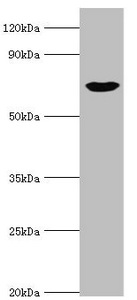
Western blot
All lanes: cGMP-dependent protein kinase 1 antibody at 3μg/ml + Mouse lung tissue
Secondary
Goat polyclonal to rabbit IgG at 1/10000 dilution
Predicted band size: 77, 78, 45 kDa
Observed band size: 77 kDa

Serine/threonine protein kinase that acts as key mediator of the nitric oxide (NO)/cGMP signaling pathway. GMP binding activates PRKG1, which phosphorylates serines and threonines on many cellular proteins. Numerous protein targets for PRKG1 phosphorylation are implicated in modulating cellular calcium, but the contribution of each of these targets may vary substantially among cell types. Proteins that are phosphorylated by PRKG1 regulate platelet activation and adhesion, smooth muscle contraction, cardiac function, gene expression, feedback of the NO-signaling pathway, and other processes involved in several aspects of the CNS like axon guidance, hippocampal and cerebellar learning, circadian rhythm and nociception. Smooth muscle relaxation is mediated through lowering of intracellular free calcium, by desensitization of contractile proteins to calcium, and by decrease in the contractile state of smooth muscle or in platelet activation. Regulates intracellular calcium levels via several pathways: phosphorylates IRAG1 and inhibits IP3-induced Ca(2+) release from intracellular stores, phosphorylation of KCNMA1 (BKCa) channels decreases intracellular Ca(2+) levels, which leads to increased opening of this channel. PRKG1 phosphorylates the canonical transient receptor potential channel (TRPC) family which inactivates the associated inward calcium current. Another mode of action of NO/cGMP/PKGI signaling involves PKGI-mediated inactivation of the Ras homolog gene family member A (RhoA). Phosphorylation of RHOA by PRKG1 blocks the action of this protein in myriad processes: regulation of RHOA translocation; decreasing contraction; controlling vesicle trafficking, reduction of myosin light chain phosphorylation resulting in vasorelaxation. Activation of PRKG1 by NO signaling alters also gene expression in a number of tissues. In smooth muscle cells, increased cGMP and PRKG1 activity influence expression of smooth muscle-specific contractile proteins, levels of proteins in the NO/cGMP signaling pathway, down-regulation of the matrix proteins osteopontin and thrombospondin-1 to limit smooth muscle cell migration and phenotype. Regulates vasodilator-stimulated phosphoprotein (VASP) functions in platelets and smooth muscle.
Gene References into Functions
our study provides the first genome-wide evidence regarding a mechanism by which traumatic life events interact with human genetic variation of PRKG1 in relation to alcohol misusePMID:28265120
Disulfide-activated PKGIalpha regulates cardiac diastolic relaxation and fine-tunes the Frank-Starling response.PMID:27782102
PRKG1, known to induce apoptosis when activated, is increased in all patient derived glioblastoma spheresPMID:27564115
redox-mediated guidance required PKG1 and consequently, its deficiency in vivo resulted in defective repair and enhanced neuropathic pain after nerve injury. PKG1-dependent repair functions will outweigh its signaling functions in spinal nociceptive LTP, so that inhibition of PKG1 is no option for neuropathic pain.PMID:27978504
Oxidant signaling underlies PKGIalpha modulation of Ca2+ sparks and BKCa in myogenically active arteriolesPMID:27729549
These affinity and activation measurements show that beta-phenyl-1,N2-ethenoguanosine 3',5'-monophosphate (PET-cGMP) is most selective for PKG I, whereas 8-(4-chlorophenylthio)guanosine-3'-5'-cyclic monophosphate (8-pCPT-cGMP) is most selective for PKG II.PMID:28793191
Hence, SO2 exerted its vasodilatory effects at least partly by promoting disulfide-dependent dimerization of sGC and PKG, resulting in an activated sGC/cGMP/PKG pathway in blood vessels. These findings revealed a new mode of action and mechanisms by which SO2 regulated the vascular tone.PMID:27009048
these data indicate PKG as an intermediary in EGFR-mediated cell death, likely via apoptotic pathway.PMID:27381222
The heterozygous c.530G>A:p.Arg177Gln PRKG1 variant was associated with early-onset thoracic aortic aneurysm and dissection in a Spanish family.PMID:27442293
cAMP is a partial agonist for PKG, and we elucidate the mechanism for cAMP partial agonism through the comparative NMR analysis of the apo, cGMP-, and cAMP-bound forms of the PKG cyclic nucleotide-binding domain B.PMID:26370085
Protein kinase G has a role in regulating production of H2S, which governs oxygen sensingPMID:25900831
The C42-C42' disulfide bond dramatically stabilizes PRKG1.PMID:26132214
The Golgi apparatus regulates PKGIalpha compartmentation and proteolysis.PMID:25855081
Study of genetic heterogeneity in systemic lupus erythematosus, the top associations in European ancestry were protein kinase, cyclic GMP-dependent, type I (PRKG1) rs7897633 (P(Meta) = 2.75 x 10(-8)) and purine nucleoside phosphorylase (PNP) rs1049564 (P(Meta) = 1.24 x 10(-7)).PMID:25338677
Expression levels of miR-517a-3p and its target mRNA PRKG1 were inversely correlated in NK cells before and after obstetric delivery.PMID:25273530
miR-20a expression is up-regulated in response to hypoxia in both mouse and human pulmonary arterial smooth muscle cellsPMID:25447536
Data show that functional cGMP/protein kinase G type 1 (PKG1) is expressed in pancreatic adenocarcinoma cells.PMID:24826884
These findings characterize PKG as a novel regulator of AR-mediated transcription by enhancing AR cofactor p44/WDR77's function.PMID:23755100
Neutron diffraction reveals hydrogen bonds critical for cGMP-selective activation: insights for cGMP-dependent protein kinase agonist design.PMID:25271401
Leucine296 and Arginine297 are key residues of PKG I that mediate cGMP selectivity.PMID:24239458
These data suggest that increased PKG II activity attenuates bFGFinduced proliferation and migration by inhibiting the MAPK/ERK signaling pathway, whereas PKG I does notPMID:23404188
nitration of Tyr(247) and the attenuation of cGMP binding is an important mechanism regulating in PKG-1alpha activity and SMC proliferation/differentiationPMID:24469460
Authors show for the first time that PKG is also able to stably interact with a viral substrate, West Nile virus NS5, in cell culture and in vitro.PMID:23876037
These findings indicate that PRKG1 risk alleles associate with salt-sensitivity related to a loss of the inhibitory control of renal Na(+) reabsorption, suggestive of a blunt pressure-natriuresis response.PMID:24060892
left ventricular systolic radial function was associated with common polymorphisms in PRKG1.PMID:24060898
Recurrent gain-of-function mutation in PRKG1 causes thoracic aortic aneurysms and acute aortic dissections.PMID:23910461
activation of PKGI with cGMP regulated SSG1 intracellular distribution.PMID:23831687
ANP attenuates the inflammatory actions of histamine via endothelial GC-A/cGMP/cGKI signaling and inhibitory phosphorylation of TRPC6 channels.PMID:23814119
The data suggest that PKGIbeta enhances breast cancer cell motility and invasive capacity, at least in part, by phosphorylating CaD.PMID:23418348
PKG positively regulates proteasome activities and proteasome-mediated degradation of misfolded proteins, likely through posttranslational modifications to proteasome subunits.PMID:23770744
overexpression of PCs, furin and PC5, but not PC7, which are all expressed in SMC, increase PKGI cleavage in a dose-dependent mannerPMID:23686857
The cyclic GMP-dependent kinase Ialpha -induced RhoA activation is dependent on the activity of ROCK and serine/threonine phosphatases.PMID:23195829
Studies indicate the presence of the switch helix (SW), a novel motif that promotes the formation of a domain-swapped dimer in the asymmetric unit.PMID:23416533
Low myocardial PKG activity in heart failure with preserved ejection fraction was associated with raised cardiomyocyte F(passive) and was related to increased myocardial nitrosative/oxidative stress.PMID:22806632
RhoA is a PKGIalpha target and direct binding of activated PKGIalpha to RhoA is central to cGMP-mediated inhibition of the VSMC Rho kinase contractile pathwayPMID:23066013
Downregulation of PKG1 was associated with malignant and benign breast tumors.PMID:22791569
These results suggest that DAPK2 is one of the targets of cGK-I in apoptosis induction.PMID:22580283
PKGIbeta inhibited cell growth and inducd apoptosis in breast cancer cells.PMID:22095901
cGMP-dependent protein kinase (PKG) Ialpha transfection significantly attenuated the hypoxia-induced down-regulation of the expressions of SM-alpha-actin, MHC and calponin.PMID:22293199
found in smooth muscle wall of blood vessels transversing the clitoral supepithelial and stromal spacePMID:21697861
Cyclic 3',5'-guanosine monophosphate-dependent protein kinase inhibits colon cancer cell adaptation to hypoxia.PMID:21563174
cGMP dependent kinase 1 alpha interacts with and phosphorylates transient receptor potential cation channel subfamily C member 7PMID:21402151
data suggest that activation of PKG signaling in pericytes inhibits focal adhesion formation by inhibiting Rac1PMID:21451103
NO, depending on its concentration, may act in human PBMCs as a stimulator of IL-6 expression and modulator of NF-KB involving the sGC/cGMP/PKG pathwayPMID:21414799
The mechanism of cyclic nucleotide binding to PKG was investigated by determining crystal structures of the amino-terminal cyclic nucleotide-binding domain (CNBD-A) of human PKG I bound to either cGMP or cAMP.PMID:21526164
The novel cGMP/PKG/ROS/calmodulin/CaMKII signaling pathway may regulate cardiomyocyte excitability by opening K(ATP) channels and contribute to cardiac protection against ischemia-reperfusion injury.PMID:21479273
These findings provide evidence of a physical and compartmentalized association between SERT and PKGIalpha that supports.PMID:19656393
A novel mechanism has been elucidated that is able to increase PKG-I protein content in contractile cells, with hypotensive consequences in rat thoracic aorta.PMID:21160032
disruption of the IP3R1-IRAG calcium regulation system is a novel cause of dysfunctional osteoclasts unrelated to defects in attachment proteins or acid secretionPMID:20567233
structure provides molecular details of this unique leucine/isoleucine zipper, revealing specific hydrophobic and ionic interactions that mediate dimerization and demonstrating the topology of the GKAP interaction surface.PMID:20826808
Show
More
Hide
All
Subcellular Location
Cytoplasm.
Protein Families
Protein kinase superfamily, AGC Ser/Thr protein kinase family, cGMP subfamily