PRDM5 Antibody

Code: CSB-PA868292LA01HU
Size:
20μg
20μg50μg100μg
US$83
Quantity:
Species Reactivity: Human, Mouse
Raised in: Rabbit
Application: ELISA, WB
For inquiries on large quantities or another requirements
Send an Inquiry
Start an on-line Chat
Online ordering is currently available for U.S. customers only. For orders outside the U.S., please kindly submit an inquiry or start a chat with us.

Product Details

Uniprot NO.
Target Names
PRDM5
Alternative Names
BCS2 antibody; PFM 2 antibody; PFM2 antibody; PR domain containing 5 antibody; PR domain containing protein 5 antibody; PR domain zinc finger protein 5 antibody; PR domain-containing protein 5 antibody; PRDM 5 antibody; PRDM5 antibody; PRDM5 protein antibody; PRDM5_HUMAN antibody
Raised in
Rabbit
Species Reactivity
Human, Mouse
Immunogen
Recombinant Human PR domain zinc finger protein 5 protein (29-111AA)
Immunogen Species
Homo sapiens (Human)
Conjugate
Non-conjugated
Isotype
IgG
Purification Method
>95%, Protein G purified
Concentration
It differs from different batches. Please contact us to confirm it.
Buffer
Preservative: 0.03% Proclin 300
Constituents: 50% Glycerol, 0.01M PBS, pH 7.4
Tested Applications
ELISA, WB
Recommended Dilution
ApplicationRecommended Dilution
WB1:500-1:5000
Storage
Upon receipt, store at -20°C or -80°C. Avoid repeated freeze.
Lead Time
Basically, we can dispatch the products out in 1-3 working days after receiving your orders. Delivery time maybe differs from different purchasing way or location, please kindly consult your local distributors for specific delivery time.
Note: All of our proteins are default shipped with normal blue ice packs, if you request to ship with dry ice, please communicate with us in advance and extra fees will be charged.
Usage
For Research Use Only. Not for use in diagnostic or therapeutic procedures.
Datasheet & COA
Images
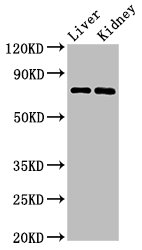
  • Western Blot
    Positive WB detected in: Mouse liver tissue, Mouse kidney tissue
    All lanes: PRDM5 antibody at 3μg/ml
    Secondary
    Goat polyclonal to rabbit IgG at 1/50000 dilution
    Predicted band size: 74, 70, 13, 59 kDa
    Observed band size: 74 kDa

Customer Reviews and Q&A

 Customer Reviews

Target Background

Function(From Uniprot)
Sequence-specific DNA-binding transcription factor. Represses transcription at least in part by recruitment of the histone methyltransferase EHMT2/G9A and histone deacetylases such as HDAC1. Regulates hematopoiesis-associated protein-coding and microRNA (miRNA) genes. May regulate the expression of proteins involved in extracellular matrix development and maintenance, including fibrillar collagens, such as COL4A1 and COL11A1, connective tissue components, such as HAPLN1, and molecules regulating cell migration and adhesion, including EDIL3 and TGFB2. May cause G2/M arrest and apoptosis in cancer cells.
Gene References into Functions
  1. Inhibiting PRDM5 expression by siRNA attenuated the IFN-gamma-triggered accumulation of active caspase-3 and cleaved PARP in intestinal epithelial cells. Moreover, flow cytometry assay and CCK-8 analysis revealed that PRDM5 knockdown significantly alleviated the IFN-gamma-induced cellular apoptosis in HT29 cells. PMID:28476379
  2. Both Prdm 4 and Prdm 5 are expressed in human corneal endothelium, primary hCECs and in HCECs-12 cells, characterised by expression of the Na(+)/K(+)-ATPase. PMID:28228349
  3. The miR-182 promoter is rarely methylated in epithelial ovarian cancers (EOCs), and its methylation status is associated with lower miR-182 expression. Deletion of the PRDM5 locus may play a supportive role in miR-182 overexpression in EOC. miR-182 is an unfavorable prognostic factor in EOC. PMID:27295517
  4. The current study revealed a novel mutation in the PRDM5 gene in a Brittle cornea syndrome (BCS) family and recurrent mutation in a sporadic BCS patient. PMID:27032025
  5. Genetic variants in PRDM5 can lead to various syndromic and nonsyndromic disorders affecting the anterior segment of the eye. PMID:26489929
  6. Defective interaction of PRDM5 with repressive complexes, and dysregulation of H3K9me2, play a role in PRDM5-associated disease. PMID:26395458
  7. Reduced expression of PRDM5 was observed in the cornea and retina of brittle cornea syndrome patients. PMID:26560304
  8. These data suggest that PRDM5 is a relevant tumour suppressor gene that is frequently targeted in colorectal tumourigenesis. PMID:25613750
  9. PRDM2, PRDM5, PRDM16 promoters are methylated and their expression is suppressed in lung cancer cells. PMID:24966940
  10. Data provide the first causal link between Prdm5 loss and intestinal carcinogenesis, and uncover an extensive and novel PRDM5 target repertoire likely facilitating the tumor-suppressive functions of PRDM5. PMID:23873026
  11. Promoter methylation-mediated downregulation of PRDM5 contributes to the development of lung squamous cell carcinoma. PMID:24395656
  12. Frequent epigenetic silencing of PRDM5 is involved in multiple tumorigeneses, which could serve as a tumor biomarker PMID:22087297
  13. ZNF469 and PRDM5, two genes that when mutated cause brittle cornea syndrome, participate in the same regulatory pathway. PMID:21664999
  14. Data show that reduced expression of PRDM5 may play an important role in the pathogenesis and/or development of cervical cancer, and is considered to be caused in part by aberrant DNA methylation. PMID:20213097
  15. PRDM5 caused G2/M arrest and apoptosis upon infection of tumor cells. These results suggest that inactivation of PRDM5 may play a role in carcinogenesis. PMID:15077163
  16. Results identify PRDM5, which acts as a sequence-specific, DNA binding transcription factor that targets hematopoiesis-associated protein-coding and microRNA genes, some of which are targets of Gfi1. PMID:17636019
  17. Data suggest that epigenetic alteration of PRDM5 (e.g., methylation of its 5'-CpG island or trimethylation of Lys(27) of histone H3) likely plays a key role in the progression of gastrointestinal cancers and may be a useful molecular marker. PMID:17699856

Show More

Hide All

Subcellular Location
Nucleus.
Protein Families
Class V-like SAM-binding methyltransferase superfamily
Tissue Specificity
Widely expressed with highest levels in colon and ovary. Tends to be silenced in breast, colorectal, gastric and liver cancer tissues.
Database Links

HGNC: 9349

UNIGENE: Hs.666782

KEGG: hsa:11107

STRING: 9606.ENSP00000264808

OMIM: 614161

icon of phone
Call us
301-363-4651 (Available 9 a.m. to 5 p.m. CST from Monday to Friday)

icon of address
Address
No. 269, Shendun 5th Road, Donghu Hi-Tech Development Area, Hubei Province, 430206, P.R.China
icon of social media
Join us with

Subscribe newsletter

Leave a message

* To protect against spam, please pass the CAPTCHA test below.
CAPTCHA verification
© 2007-2025 CUSABIO TECHNOLOGY LLC All rights reserved. 鄂ICP备15011166号-1
Select 0 Products