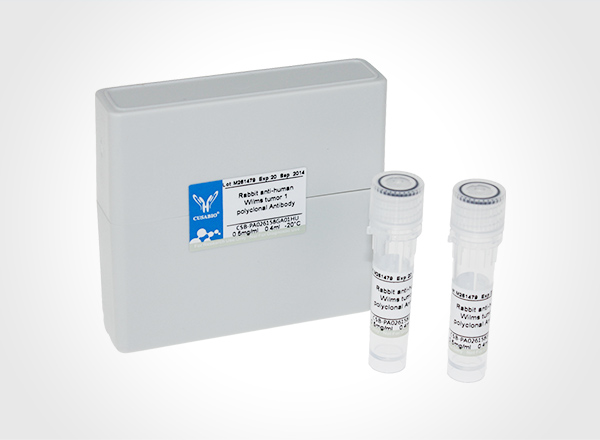
Liquid
Note: We will preferentially ship the format that we have in stock, however, if you have any special requirement for the format, please remark your requirement when placing the order, we will prepare according to your demand.
Upon receipt, store at -20°C or -80°C. Avoid repeated freeze.
Lead Time
Basically, we can dispatch the products out in 1-3 working days after receiving your orders. Delivery time maybe differs from different purchasing way or location, please kindly consult your local distributors for specific delivery time.
Note: All of our proteins are default shipped with normal blue ice packs, if you request to ship with dry ice, please communicate with us in advance and extra fees will be charged.
Usage
For Research Use Only. Not for use in diagnostic or therapeutic procedures.
Component of a heteromeric calcium-permeable ion channel formed by PKD1 and PKD2 that is activated by interaction between PKD1 and a Wnt family member, such as WNT3A and WNT9B. Can also form a functional, homotetrameric ion channel. Functions as a cation channel involved in fluid-flow mechanosensation by the primary cilium in renal epithelium. Functions as outward-rectifying K(+) channel, but is also permeable to Ca(2+), and to a much lesser degree also to Na(+). May contribute to the release of Ca(2+) stores from the endoplasmic reticulum. Together with TRPV4, forms mechano- and thermosensitive channels in cilium. PKD1 and PKD2 may function through a common signaling pathway that is necessary to maintain the normal, differentiated state of renal tubule cells. Acts as a regulator of cilium length, together with PKD1. The dynamic control of cilium length is essential in the regulation of mechanotransductive signaling. The cilium length response creates a negative feedback loop whereby fluid shear-mediated deflection of the primary cilium, which decreases intracellular cAMP, leads to cilium shortening and thus decreases flow-induced signaling. Also involved in left-right axis specification via its role in sensing nodal flow; forms a complex with PKD1L1 in cilia to facilitate flow detection in left-right patterning. Detection of asymmetric nodal flow gives rise to a Ca(2+) signal that is required for normal, asymmetric expression of genes involved in the specification of body left-right laterality.
Gene References into Functions
PKD2 and PKD1 genes are mutated in autosomal dominant polycystic kidney disease. PKD2 can form either a homomeric cation channel or a heteromeric complex with the PKD1 receptor, presumed to respond to ligand(s) and/or mechanical stimuli. Here, we identify a two-residue hydrophobic gate in PKD2L1, and a single-residue hydrophobic gate in PKD2.PMID:29899465
this is the first report of autosomal dominant polycystic kidney disease complicated with aortic dissection caused by PKD2 mutationPMID:29378535
This noticeable hot spot regions hold higher frequency (50%) of pathogenic / likely pathogenic genetic variants constituting single nucleotide variants than large deletion and insertion that actually represents only 41.08% of coding sequence of PKD2. Statistically significant association for IVS3-22AA genotype was observed with PKD, while association of IVS4+62C>T was found insignificant.PMID:29321346
The novel pathogenic variant in c.637C> T in PKD2 is very interesting since they may represent Italian clusters.PMID:27499327
Upregulation of miR-106b-5p or downregulation of PKD2 expression can cause A549/DDP cells to become considerably more sensitive to cisplatin. The results showed that miR-106b-5p enhanced the sensitivity of A549/DDP cells to cisplatin by targeting the expression of PKD2.PMID:28723865
investigated the interaction network of human PKD2 in the cytosol and in Golgi-enriched subcellular protein fractionsPMID:27559607
We aimed to revisit PKD2 prevalence, clinical presentation, mutation spectrum, and prognosis through the Genkyst cohort. Patients with PKD2-related dominant polycystic kidney disease typically present with mild diseasePMID:28356211
Here, we review previous studies that connect the molecular properties of the domains of PC2 Cterm to distinct aspects of PC2 functions and regulation.PMID:26857659
TRPP2 mutations are associated with autosomal dominant polycystic kidney disease.PMID:28154010
Two cryo-EM structures of distinct channel states of full-length human PC2 in complex with lipids and cations.PMID:28092368
The structure of human PC2 in a closed conformation, solved by electron cryomicroscopy at 4.2-A resolution.PMID:27991905
SNPs in and near PKD2 showed significant evidence of association in individual samples of black adults (rs17013735, P-value=0.0009) and white adults (rs11938025; P-value=0.0005; rs2725270, P-value=0.003).PMID:28100911
Pancreatic cysts were more prevalent in patients with ADPKD with PKD2 mutation than in control subjects or patients with PKD1 mutation.PMID:27046073
This suggests that a precise dosage of PC2 is necessary for an adequate mechanosensitive alpha-actinin recruitment at junctions.PMID:27575580
TRPP2 may be used as a biomarker for evaluating patient prognosis and as a novel therapeutic target in human laryngeal squamous cell carcinoma.PMID:27832627
Novel PKD2 mutations in Chinese autosomal dominant polycystic kidney disease patientsPMID:26632257
Two neutral missense PKD2 variants indentified in exon1 c.83G>C (p.R28P) and c.568G>A (p.A190T), which the former segregate with the mutation in affected relatives, and two new intronic and 3'UTR variants, c.1548+63C>T and c.*363delA.PMID:26950445
this study presents the cryo-EM structure of PKD2 in lipid bilayers at 3.0 A resolution, which establishes PKD2 as a homotetrameric ion channel and provides insight into potential mechanisms for its activation.PMID:27768895
PKD2 and RSK1 regulate integrin beta4 phosphorylation at threonine 1736 to stabilize keratinocyte cell adhesion and its hemidesmosomes.PMID:26580203
The coiled-coil domain in the PC2 C-terminal forms a stable helix bundle regardless of the presence of Ca(2+).PMID:26574436
Results show that some of the previously reported missense or synonymous mutations in PKD2 gene caused altered pre-mRNA splicing.PMID:26692149
PKD2 is a core factor in the formation of this multiprotein complex at the TGN that controls constitutive secretion of matrix metalloproteinase cargo.PMID:26507660
Human polycystin-2 transgene dose-dependently rescues autosomal-dominant polycystic kidney disease phenotypes in Pkd2 mutant micePMID:26435415
FLNA anchors PC2 to the actin cytoskeleton through complex PC2-FLNA-actin to reduce degradation and increase stability, and possibly regulate PC2 function in a Ca-dependent manner.PMID:25861040
The data indicate that the cAMP pathway regulates PC2-mediated cation transport in the hSTPMID:26269590
POlycystin-2 and its patogenic mutants inhibit PIEZO1 activity in renal tubular epithelial cells.PMID:24157948
There is only one Ca2+ binding site in the human PC2 C-terminus, located within its EF-hand domain; the Ca2+ binding affinity of the C-terminal trimer is greatly enhanced.PMID:25716316
TRPV4, TRPC1, and TRPP2 contribute to the ion permeation pore of the channelsPMID:25114176
Data indicate that N-Glycosylation of transient receptor potential channel TRPP2 is required for adequate TRPP2 protein levels.PMID:24719335
The molecular analysis of an Iranian family showed that the PKD was due to a PKD2 mutation.PMID:24011172
Probable pathogenic mutations in the PKD2 gene were detected in patients with autosomal dominant polycystic kidney disease.PMID:24694054
analysis of EF hand motifs and how they affect the calcium dependence of polycystin-2 functionPMID:24558196
CIB1a is a novel mediator of PKD2-driven carcinogenesis.PMID:23503467
The median age at onset of dialysis was significantly earlier in patients with PKD1 mutations (52 years) than in patients with PKD2 mutations (65.5 years) and those with an undetermined genotype (67 years) by survival analysis.PMID:23985799
Overexpression of polycystin (PC)1, but not a carboxy-terminal truncation mutant, increases ciliary PC2 expression levels in mouse kidney cells.PMID:24009235
In human subjects we found an association between ADPKD and IDCM and suggest that PKD mutations contribute to the development of heart failurePMID:23376035
C-terminal polycystin-2 phosphorylation influences the interaction with PIGEA14PMID:23838289
early growth response 1, a transcription factor that binds to the NDRG1 promoter, was mediated in the NDRG1 expression regulation by PKD2.PMID:23212942
these data suggest that PKD2 and PKD3 coordinate to promote prostate cancer cell invasion through p65 NF-kappaB- and HDAC1-mediated expression and activation of uPA.PMID:22797919
PKD2 testing has a clinically significant detection rate in the pre-ESRF population.PMID:22863349
rs2728121 in PKD2 may contribute to the development of gout in Europeans.PMID:22609445
study indicates that filamins are important regulators of polycystin-2 channel function, and further links actin cytoskeletal dynamics to the regulation of this channel proteinPMID:22802962
PC2 and the Ca(2+)-dependent transient receptor potential channels in general are regulated by similar conformational changes in their cytoplasmic domains that are propagated to the channel pore.PMID:22474326
role in interferon-gamma-induced PD-L1 surface expression on human oral squamous carcinomaPMID:22204817
This study reports for the first time a patient with neonatal onset of polycystic kidney disease homozygous for an incomplete penetrant PKD2 missense variant due to uniparental disomyPMID:22114106
PKD2:c.2020 1_2020delAG is a mutation found in a Chinese family with autosomal dominant polycystic kidney disease.PMID:21983717
study reports the association of autosomal dominant polycystic kidney disease resulting from a mutation in PKD2 and left-right asymmetry defectPMID:21719175
High Protein kinase D2 is associated with glioblastoma growth and tumor formation.PMID:21727210
Findings clarify the structural properties of PC2t domain and strongly support a homotetramer assembly of PC2.PMID:21622852
In the molecular pathway to secretion, PKD2 is a key component of the PKC-mediated pathway to platelet activation and thrombus formation through its selective regulation of dense granule secretion.PMID:21527521
Detected in fetal and adult kidney. Detected at the thick ascending limb of the loop of Henle, at distal tubules, including the distal convoluted tubule and cortical collecting tubules, with weak staining of the collecting duct. Detected on placenta syncy