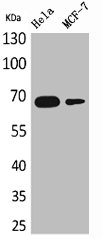
Synthesized peptide derived from the Internal region of Human PEPCK-C.
Immunogen Species
Homo sapiens (Human)
Conjugate
Non-conjugated
Isotype
IgG
Purification Method
The antibody was affinity-purified from rabbit antiserum by affinity-chromatography using epitope-specific immunogen.
Concentration
It differs from different batches. Please contact us to confirm it.
Buffer
Liquid in PBS containing 50% glycerol, 0.5% BSA and 0.02% sodium azide.
Tested Applications
WB, ELISA
Storage
Upon receipt, store at -20°C or -80°C. Avoid repeated freeze.
Lead Time
Basically, we can dispatch the products out in 1-3 working days after receiving your orders. Delivery time maybe differs from different purchasing way or location, please kindly consult your local distributors for specific delivery time.
Note: All of our proteins are default shipped with normal blue ice packs, if you request to ship with dry ice, please communicate with us in advance and extra fees will be charged.
Usage
For Research Use Only. Not for use in diagnostic or therapeutic procedures.
Cytosolic phosphoenolpyruvate carboxykinase that catalyzes the reversible decarboxylation and phosphorylation of oxaloacetate (OAA) and acts as the rate-limiting enzyme in gluconeogenesis. Regulates cataplerosis and anaplerosis, the processes that control the levels of metabolic intermediates in the citric acid cycle. At low glucose levels, it catalyzes the cataplerotic conversion of oxaloacetate to phosphoenolpyruvate (PEP), the rate-limiting step in the metabolic pathway that produces glucose from lactate and other precursors derived from the citric acid cycle. At high glucose levels, it catalyzes the anaplerotic conversion of phosphoenolpyruvate to oxaloacetate. Acts as a regulator of formation and maintenance of memory CD8(+) T-cells: up-regulated in these cells, where it generates phosphoenolpyruvate, via gluconeogenesis. The resultant phosphoenolpyruvate flows to glycogen and pentose phosphate pathway, which is essential for memory CD8(+) T-cells homeostasis. In addition to the phosphoenolpyruvate carboxykinase activity, also acts as a protein kinase when phosphorylated at Ser-90: phosphorylation at Ser-90 by AKT1 reduces the binding affinity to oxaloacetate and promotes an atypical serine protein kinase activity using GTP as donor. The protein kinase activity regulates lipogenesis: upon phosphorylation at Ser-90, translocates to the endoplasmic reticulum and catalyzes phosphorylation of INSIG proteins (INSIG1 and INSIG2), thereby disrupting the interaction between INSIG proteins and SCAP and promoting nuclear translocation of SREBP proteins (SREBF1/SREBP1 or SREBF2/SREBP2) and subsequent transcription of downstream lipogenesis-related genes.
Gene References into Functions
This study reveals a unique mechanism to suppress hepatocellular carcinoma by switching from glycolysis to gluconeogenesis through Nur77 antagonism of PEPCK1 degradation.PMID:28240261
circC3P1 acts as a tumor suppressor via enhancing PCK1 expression by sponging miR-4641 in hepatocellular carcinoma.PMID:29608893
The expression levels of PCK1 were suppressed in hepatocellular carcinoma (HCC) samples and in cells derived from HCC tissues.PMID:29768256
Study investigated the molecular basis of such effects focusing on a commonly studied polymorphism in pig Pgc1alpha, which changes a cysteine at position 430 (WT) of the protein to a serine (C430S); found that differential O-GlcNAcylation of Pgc1alpha regulates PCK1 activity and this molecular mechanism could explain at least in part the epistatic interaction between both genes.PMID:28644880
Study identified a novel homozygous PCK1 missense mutation causing cytosolic phosphoenolpyruvate carboxykinase deficiency presenting as childhood hypoglycemia.PMID:28216384
HBXIP is able to depress the gluconeogenesis in hepatoma cells by suppressing PCK1 to promote hepatocarcinogenesis, involving miR-135a/FOXO1 axis and PI3K/Akt/p-FOXO1 pathway.PMID:27609066
an extended binding site in the catalytic cleft of cPEPCK which is used by 3-MPA to inhibit cPEPCK non-competitively.PMID:26528723
A mutation of PCK1 associated with Smith-Magenis Syndrome, cytosolic PEPCK deficiency and NMDA receptor glutamate insensitivity.PMID:24863970
Insulin-dependent translocation of FOXO1 regulated transcriptional repression of PCK1 concomitant with the formation of the FOXO1-euchromatic histone-lysine N-methyltransferase2 (EHMT2) complex and histone modifications of the PCK1 promoter regionPMID:25736587
Lipopolysaccharide and monophosphoryl lipid A also up-regulated G6PC and PCK1 transcript abundance in a TLR4-dependent manner.PMID:23465595
The PCK1 tag-single nucleotide polymorphisms influenced insulin resistance by interacting with plasma n-3 polyunsaturated fatty acids levels in metabolic syndrome patients.PMID:23092637
HCV core protein expression-mediated FOXO1 activation and the increased PGC-1alpha leaded to the elevation of PCK1 at the mRNA levelPMID:22489460
Acetylation regulates the stability of the gluconeogenic rate-limiting enzyme PEPCK1.PMID:21726808
Data show PEPCK-C and CPT-1 mRNAs are more abundant in non-tumoral tissues than in the tumoral counterpart, whereas the opposite occurred for the FAS gene.PMID:20691246
Studies demonstrate the association between PCK1 and smaller average brain volume.PMID:21152065
Study in the EYHS cohort failed to identify an association of PCK1 polymorphisms with obesity, physical activity, and fitness.PMID:20134411
crystal structure of human cytosolic phosphoenolpyruvate carboxykinase reveals a new GTP-binding sitePMID:11851336
Conserved amino acids within CCAAT enhancer-binding proteins (C/EBP(alpha) and beta) regulate gene expressionPMID:11997389
promoter context may influence which domains within a transcription factor are employed to mediate transactivation of PEPCKPMID:12237288
the PGC- 1-regulated phospho(enol)pyruvate carboxykinase (PEPCK) promoter is a novel target promoter for SHP inhibitionPMID:12324453
transcription of the gene for phosphoenolpyruvate carboxykinase (GTP) in the liver is regulated by SREBP-1c and Sp1PMID:14744869
Promoter single nucleotide polymorphism in PCK1 was resistant to down-regulation by insulin in vitro and associated with type 2 diabetes mellitus.PMID:14764811
PCK1 has been implicated as one of many genes associated with type 2 diabetes mellitus [review]PMID:15046742
AUF1 binds to multiple destabilizing elements within the 3'-UTR that participate in the rapid turnover of the phosphoenolpyruvate carboxykinase mRNA.PMID:15951444
The multiple instability elements present within the 3'-UTR may function synergistically to mediate both the rapid degradation and the cAMP-induced stabilization of PEPCK mRNA. The latter process may result from a PKA-dependent phosphorylation of AUF1.PMID:16144962
Subjects with the PCK1-232G/G genotype had more carotid IMT (0.80+/-0.02 versus 0.73+/-0.03 mm; P=0.007) but less TPV (0.10+/-0.09 versus 0.38+/-0.13; P=0.03) than subjects with other genotypes.PMID:16282543
Significant association of single nucleotide polymorphism within three genes--PPARgamma, SOS2, and PCK1--with Alzheimer's disease, was confirmed.PMID:17440948
IFN-gamma exerts a tissue-specific action in rodents and humans, having glyceroneogenesis and the PEPCK-C gene as selective targets to intensify fatty acids release from adipocytesPMID:17495004
The effects of several variants of retinoic acid on the expression and activity of PEPCK in human, mouse, and rat adipose tissue are reported.PMID:18492826
Reduced CREB phosphorylation (Ser-129) associated with inactivation of GSK3beta by Ser-9 phosphorylation may be the major mechanism underlying PEPCK-C gene suppression by AMPK-activating agents such as biguanidePMID:18801732
The aromatic ring of Tyr235 in PEPCK helps to position PEP in the active site and the hydroxyl group allows an optimal PEP-Mn(2+) distance for efficient phosphoryl transfer and overall catalysis.PMID:19021757
Val184 of PCK1 gene might increase the risk of type 2 diabetes in eastern Chinese population with BMI<23 kg/m(2) via reducing the PEPCK-C activity.PMID:19070910
Study validated a predicted SP1 binding site in the control of PCK1 transcription using gel shift and reporter assays.PMID:19329064
study is the first to investigate the association between variants of the PCK1 gene and type 2 diabetes in South AsiansPMID:19725958
Show
More
Hide
All
Subcellular Location
Cytoplasm, cytosol. Endoplasmic reticulum.
Protein Families
Phosphoenolpyruvate carboxykinase [GTP] family
Tissue Specificity
Major sites of expression are liver, kidney and adipocytes.