Upon receipt, store at -20°C or -80°C. Avoid repeated freeze.
Lead Time
Basically, we can dispatch the products out in 1-3 working days after receiving your orders. Delivery time maybe differs from different purchasing way or location, please kindly consult your local distributors for specific delivery time.
Note: All of our proteins are default shipped with normal blue ice packs, if you request to ship with dry ice, please communicate with us in advance and extra fees will be charged.
Usage
For Research Use Only. Not for use in diagnostic or therapeutic procedures.
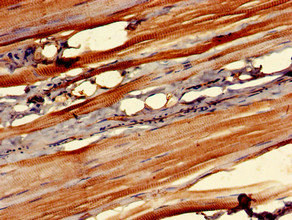
Immunohistochemistry of paraffin-embedded human skeletal muscle tissue using CSB-PA857869LA01HU at dilution of 1:100
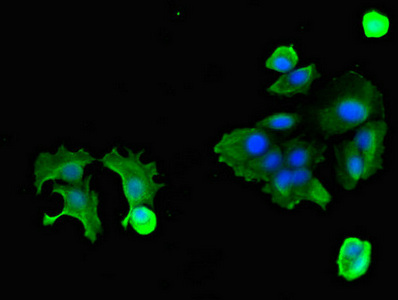
Immunofluorescent analysis of MCF-7 cells using CSB-PA857869LA01HU at dilution of 1:100 and Alexa Fluor 488-congugated AffiniPure Goat Anti-Rabbit IgG(H+L)

Associates with IL31RA to form the IL31 receptor. Binds IL31 to activate STAT3 and possibly STAT1 and STAT5. Capable of transducing OSM-specific signaling events.
Gene References into Functions
Polymorphisms of the OSMR rs2292016 locus are related to the development and outcome of DCM.PMID:29652994
Missense mutatios were found in exon 10 of the oncostatin-M specific receptor beta subunit (OSMR) gene in all of the six patients from family 1, and in exon 14 of the OSMR gene in all of the four patients from family 2.PMID:29419851
The PLAC1 expression has been demonstrated for the first time in cervical cancers. This preliminary study has further revealed a complex relationship between PLAC1 expression, cervical cancer histologic type, p53, and HPV type that requires further investigation.PMID:28375929
OSMR-beta deficiency in macrophages improved high-fat diet-induced atherogenesis and plaque vulnerabilityPMID:28258089
OSM and OSMR are highly expressed in inflammatory bowel disease intestinal mucosa compared to control mucosa. Intestinal stromal cells express abundant OSMR.PMID:28368383
OSM:OSMR interactions are able to induce EMT, increased cancer stem cell-like properties and enhanced lung colonisation in SCC cellsPMID:27351213
the RET p.S891A mutation combined with OSMR p.G513D may underlie a novel phenotype manifesting as familial medullary thyroid carcinoma and cutaneous amyloidosisPMID:26356818
this study offers new findings on the molecular genetics and disease relevance of mutations in OSMR in Familial primary localized cutaneous amyloidosis.PMID:25792357
Oncostatin M and interleukin-31: Cytokines, receptors, signal transduction and physiology.PMID:26198770
OSMRBeta in neurons is critical for neuronal survival during cerebral ischemic/reperfusion.PMID:26311783
primary localized cutaneous amyloidosis has a missense mutation in oncostatin M receptor betaPMID:25054142
The interleukin IL-31/IL-31receptor axis contributes to tumor growth in human follicular lymphoma.PMID:25283844
oncostatin M is a cytokine possessing vigorous antiviral and immunostimulatory properties which is released by APC upon interaction with CD40L present on activated CD4+ T cells.PMID:24418171
The disease severity of rheumatoid arthritis and systemic lupus erythematosus can be partially affected by the OSMR promoter polymorphisms.PMID:24219225
We conclude that an OSMR/TGM2/integrin-alpha5beta1/fibronectin pathway is of biological significance in cervical squamous cell carcinomaPMID:23765377
A unique loop structure in oncostatin M determines binding affinity toward oncostatin M receptor and leukemia inhibitory factor receptor.PMID:22829597
enhanced production by beta-defensin-2 in T cellsPMID:22137028
This study identified a new heterozygous OSMR missense mutation in primary localized cutaneous amyloidosis.PMID:22062952
An alternatively spliced variant of OSMR transcribing a soluble form of this receptor has been characterized in esophageal squamous cell carcinoma.PMID:21394648
We conclude that OSMR overexpression in cervical SCC cells provides increased sensitivity to OSM, which induces pro-malignant changes.PMID:21952923
Aberrant methylation of the OSMR gene is associated with non-invasive colorectal cancer.PMID:21508378
Two new pathogenic heterozygous missense mutations in the OSMR gene (p.Val631Leu and p.Asp647Tyr) were identified in two Dutch familial primary localized cutaneous amyloidosis families.PMID:20507362
study provides evidence for the existence of a novel pathogenic mutation in the OSMR gene in a caucasian family with familial primary cutaneous amyloidosisPMID:19466957
The identification of OSMR and IL31RA gene pathology provides an explanation of the high prevalence of primary cutaneous amyloidosis in Taiwan as well as new insight into disease pathophysiology.PMID:19690585
provides a biologic rationale for silencing of OSMR in colon cancer progression and highlight a new therapeutic target. Moreover, detection and quantification of OSMR promoter methylation in fecal DNA is a highly specific diagnostic biomarker for CRCPMID:19662090
expression and evidence for STAT3 activation in human ovarian carcinomasPMID:12061840
The expression of OSM and its receptor in ovarian tissue from fetuses and women suggests a possible role of OSM in growth initiation of human primordial follicles.PMID:15831292
sOSMR is able to bind OSM and interleukin-31 when associated to soluble gp130 or soluble interleukin-31R, respectively, and to neutralize both cytokine propertiesPMID:17028186
FPLCA has been mapped to 5p13.1-q11.2, and by candidate gene analysis, study identified missense mutations in the OSMR gene, encoding oncostatin M-specific receptor beta (OSMRbeta), in three families.PMID:18179886
murine OSMR initiates STAT5 activation directly via the receptor bound Janus kinases. Intriguingly, the murine receptor preferentially recruits JAK2, whereas the human receptor seems to have a higher affinity for JAK1.PMID:18430728
IL-6 and Oncostatin M individually affect the profile of leukocyte traffickingPMID:18641356
The renal parenchyma is capable of generating a strong acute phase response, likely mediated via OSM/OSMR.PMID:19158344
Epigenetic silencing and DNA methylation of OSMR is associated with colorectal cancers.PMID:19223499
study reporta a Japanese family with familial primary localized cutaneous amyloidosis in whom a novel OSMR mutation was observedPMID:19375894
Show
More
Hide
All
Subcellular Location
Membrane; Single-pass type I membrane protein.
Protein Families
Type I cytokine receptor family, Type 2 subfamily
Tissue Specificity
Expressed in keratinocytes (at protein level). Expressed at relatively high levels in all neural cells as well as fibroblast and epithelial cells.