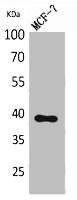
CCN family member 3 antibody; CCN3 antibody; IBP-9 antibody; IGF-binding protein 9 antibody; IGFBP-9 antibody; IGFBP9 antibody; Insulin-like growth factor-binding protein 9 antibody; Nephroblastoma overexpressed antibody; Nephroblastoma overexpressed gene protein homolog antibody; Nephroblastoma-overexpressed gene protein homolog antibody; NOV antibody; NOV_HUMAN antibody; NovH antibody; Protein NOV homolog antibody
Raised in
Rabbit
Species Reactivity
Human,Mouse
Immunogen
Synthesized peptide derived from the Internal region of Human Nov.
Immunogen Species
Homo sapiens (Human)
Conjugate
Non-conjugated
Isotype
IgG
Purification Method
The antibody was affinity-purified from rabbit antiserum by affinity-chromatography using epitope-specific immunogen.
Concentration
It differs from different batches. Please contact us to confirm it.
Buffer
Liquid in PBS containing 50% glycerol, 0.5% BSA and 0.02% sodium azide.
Tested Applications
WB, ELISA
Storage
Upon receipt, store at -20°C or -80°C. Avoid repeated freeze.
Lead Time
Basically, we can dispatch the products out in 1-3 working days after receiving your orders. Delivery time maybe differs from different purchasing way or location, please kindly consult your local distributors for specific delivery time.
Note: All of our proteins are default shipped with normal blue ice packs, if you request to ship with dry ice, please communicate with us in advance and extra fees will be charged.
Usage
For Research Use Only. Not for use in diagnostic or therapeutic procedures.
Immediate-early protein playing a role in various cellular processes including proliferation, adhesion, migration, differentiation and survival. Acts by binding to integrins or membrane receptors such as NOTCH1. Essential regulator of hematopoietic stem and progenitor cell function. Inhibits myogenic differentiation through the activation of Notch-signaling pathway. Inhibits vascular smooth muscle cells proliferation by increasing expression of cell-cycle regulators such as CDKN2B or CDKN1A independently of TGFB1 signaling. Ligand of integrins ITGAV:ITGB3 and ITGA5:ITGB1, acts directly upon endothelial cells to stimulate pro-angiogenic activities and induces angiogenesis. In endothelial cells, supports cell adhesion, induces directed cell migration (chemotaxis) and promotes cell survival. Plays also a role in cutaneous wound healing acting as integrin receptor ligand. Supports skin fibroblast adhesion through ITGA5:ITGB1 and ITGA6:ITGB1 and induces fibroblast chemotaxis through ITGAV:ITGB5. Seems to enhance bFGF-induced DNA synthesis in fibroblasts. Involved in bone regeneration as a negative regulator. Enhances the articular chondrocytic phenotype, whereas it repressed the one representing endochondral ossification. Impairs pancreatic beta-cell function, inhibits beta-cell proliferation and insulin secretion. Plays a role as negative regulator of endothelial pro-inflammatory activation reducing monocyte adhesion, its anti-inflammatory effects occur secondary to the inhibition of NF-kappaB signaling pathway. Contributes to the control and coordination of inflammatory processes in atherosclerosis. Attenuates inflammatory pain through regulation of IL1B- and TNF-induced MMP9, MMP2 and CCL2 expression. Inhibits MMP9 expression through ITGB1 engagement.
Gene References into Functions
A significant reduction of CCN3 expression was observed in lesioned skin compared to non-lesioned skin in vitiligo patients.PMID:29998862
This is the first evidence of downregulation of TGFbeta1-mediated activation of a Smad1/5/8 signalling pathway by CCN3 in human podocytes and in any cell type.PMID:29506624
NOV is a novel biomarker of the presence and severity of OSA and a potential marker of future cardiovascular and metabolic disease in OSA patients.PMID:28862983
down-regulation of Lamin B1 and up-regulation of Nephroblastoma overexpressed (NOV) are at least partially responsible for the inhibitory effect of Huaier on the proliferative and invasive capacity of SKHEP-1 cellsPMID:27503760
NOV is down-regulated in CRC tumours which is associated with disease progression.PMID:28412738
Taken together, our results suggest that palmitoylation by ZDHHC22 at C241 in the CCN3 TSP1 domain may be required for the secretion of CCN3. Aberrant palmitoylation induces intracellular accumulation of CCN3, inhibiting neuronal axon growth.PMID:29287726
CCN3 (Nov) and CCN5 (WISP2) are novel substrates of MMP14.PMID:27471094
Reduced levels of CCN1 and CCN3, as found in early-onset preeclampsia, could contribute to a shift from invasive to proliferative extravillous trophoblasts and may explain their shallow invasion properties in this disease.PMID:26744771
our findings establish CCN3 as a pivotal regulator of androgen receptor (AR) signaling and prostate cancer progression and suggest a functional intersection between EZH2 and AR signaling in castration-resistant prostate cancerPMID:27815387
The present study aimed to examine the clinical relevance of NOV along with CYR61 and CTGF in gastric cancer by analysing their transcript levels...the expression of NOV and CYR61 was increased in gastric cancer. The elevated expression of CYR61 was associated with poorer survival. NOV promoted proliferation and invasion of gastric cancer cellsPMID:27633176
Studies indicate that the CYR61 CTGF NOV matricellular proteins (CCN family of proteins) comprises the members CCN1, CCN2, CCN3, CCN4, CCN5 and CCN6 and have been identified in various types of cancer.PMID:26498181
NOV expression was highly increased in biopsies of patients with tubulointerstitial nephritis.PMID:26367310
Results revealed that NOV regulates the tumor growth of osteosarcoma cells through activation of the MAPK signaling pathway and promotes osteosarcoma cell migration in vitro.PMID:26238193
our results argue that MZF-1 regulates the CTGF and NOV genes in the hematopoietic compartment, and may be involved in their respective functions in the stroma.PMID:25899830
Overexpression of CCN3 induces M2 macrophage infiltration and contributes to angiogenesis in prostate cancer microenvironment.PMID:24721786
NOV may promote carcinogenesis via promotion of EMT and association with increased mTOR activityPMID:24719190
over-expression of NOV in pancreatic cancer cells promoted cell proliferation and migration, while knock down the expression of NOV impaired the tumorigenecity of pancreatic cancer cells in vitro and in vivoPMID:24258112
CCN3 may play an important role in cervical carcinogenesis and therefore may have potential as a biomarker for prognosis and as a therapeutic target in cervical cancer.PMID:24431313
Our findings establish a tumor-suppressive role of NOV in prostate cancerPMID:23318417
in obese humans and mice plasma NOV levels positively correlated with NOV expression in adipose tissue, and support a possible contribution of NOV to obesity-related inflammation.PMID:23785511
These results identify CCN3, a novel transcriptional target of FoxO1 in pancreatic beta-cells.PMID:23705021
Presence of both forms of CCN3 is accompanied by a balance of trophoblast proliferation and migration/invasion properties, which are triggered by different signalling pathways.PMID:23220688
CCN3 expression is higher in highly invasive PC3 cells.PMID:23536580
Data suggest that urinary CCN3/CCN2 mRNA ratio may be a useful noninvasive biomarker for evaluating patients with nondiabetic chronic kidney disease (CKD) prior to renal biopsy.PMID:23061738
Melanocytes remaining in perilesional vitiligo skin did not express CCN3.PMID:22507556
results indicate that CCN3 enhances the migration of prostate cancer cells by increasing ICAM-1 expression through a signal transduction pathway that involves alphavbeta3 integrin, ILK, Akt and NF-kappaBPMID:22345292
Provide evidence that CCN3 enhances BMP-4 expression and bone nodule formation in osteoblasts, and that the integrin receptor, ILK, p38, JNK, and AP-1 signaling pathways may be involved.PMID:21898398
CCN3 protein regulates the decrease in Jeg3 cell numbers independent of its glycosylation statusPMID:21784733
CCN3 enhances the migration of chondrosarcoma cells by increasing MMP-13 expression through the alphavbeta3/alphavbeta5 integrin receptor, FAK, PI3K, Akt, p65, and NF-kappaB signal transduction pathway.PMID:21344378
Data show reduced CCN3 levels in aRMS cells following small interfering RNA knockdown of PAX3-FKHR.PMID:21423212
CCN3 regulates the differentiation of bone resident cells to create a resorptive environment that promotes the formation of osteolytic breast cancer metastasesPMID:21514448
Recombinant expression, purification, and functional characterisation of connective tissue growth factor and nephroblastoma-overexpressed proteinPMID:21209863
NOV acts through alphavbeta5 integrin to activate ILK and Akt, which in turn activates c-Jun and AP-1, resulting in the activations of COX-2 and contributing the migration of human osteosarcoma cells.PMID:21145881
Only defined binding properties between Cx43 and CCN3 leading to an upregulation of CCN3 are needed for signaling.PMID:20336664
CYR61 and NOV are regulated by HIF-1alpha and TGF-beta3 in the trophoblast cell line JEG3, and their enhanced secretion could be implicated in appropriate placental invasion.PMID:20237132
CCN3 counter-regulates positive signals from TGF-beta and Wnt for fibrillin fibrillogenesis and profibrotic gene expression.PMID:20182440
These findings identify a new paracrine role of NOV in the development of cerebellar granule neurons.PMID:19286457
CCN3 suppresses neointimal thickening through the inhibition of vascular smooth cell migration and proliferation.PMID:20139355
The angiogenic gene CCN3/nov was specifically downregulated in the plexiform neurofibromas and malignant peripheral nerve sheath tumor.PMID:20010302
expression of this protein appears to be associated with a higher risk of developing metastases in Ewing's sarcomaPMID:11891184
association with Notch1 extracellular domain and inhibition of myoblast differentiation via Notch signaling pathwayPMID:12050162
NOVH concentration was significantly modified in malignant but not benign adrenocortical tumors; the concentration of NOVH was significantly decreased in patients suffering from astrocytomas or multiple sclerosisPMID:12519873
in endothelial cells, CCN3 supports cell adhesion, induces directed cell migration (chemotaxis), and promotes cell survivalPMID:12695522
NOVH increases cell adhesion and migration of glioblastoma cells via matrix metalloprotease 3 expression and a PDGFR-alpha dependent mechanism.PMID:14519668
evidence that adenylate cyclase as well as one or several protein kinases might be involved in the mechanoregulation of Cyr61, CTGF and Nov genesPMID:15053922
Cx43 is able to regulate cell growth via an up-regulation of NOV transcriptionPMID:15181016
CCN3 has a role in cutaneous wound healing in skin fibroblastsPMID:15611078
expression of CCN3 in Ewing's sarcoma primary tumors may be associated with a higher risk of developing lung and/or bone metastasesPMID:15824736
Data indicates that NOV is associated with carcinogenesis and the progression of renal cell carcinoma, and the NOV expression level is different in papillary-type and clear cell-type RCC.PMID:16145471
Results suggest that NOV (nephroblastoma overexpressed) is a specific cell fate regulator in the myogenic lineage, acting negatively on key myogenic genes thus controlling the transition from progenitor cells to myoblasts.PMID:16600215
Show
More
Hide
All
Subcellular Location
Secreted. Cytoplasm. Cell junction, gap junction.
Protein Families
CCN family
Tissue Specificity
Expressed in endiothelial cells (at protein level). Expressed in bone marrow, thymic cells and nephroblastoma. Increased expression in Wilms tumor of the stromal type.