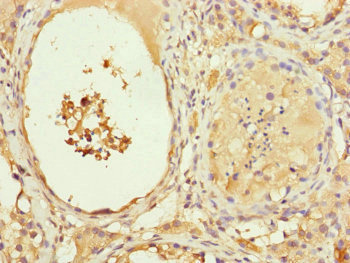
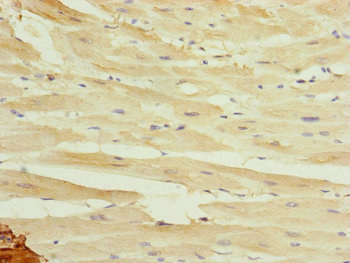
BM-023 antibody; BZF1 antibody; E3 ubiquitin protein ligase MYLIP antibody; E3 ubiquitin-protein ligase MYLIP antibody; Idol antibody; Inducible degrader of the LDL-receptor antibody; Lipoprotein receptor antibody; MIR antibody; MYLIP antibody; MYLIP_HUMAN antibody; Myosin regulatory light chain interacting protein antibody; PP5242 antibody
Raised in
Rabbit
Species Reactivity
Human
Immunogen
Recombinant Human E3 ubiquitin-protein ligase MYLIP protein (266-445AA)
Immunogen Species
Homo sapiens (Human)
Conjugate
Non-conjugated
Clonality
Polyclonal
Isotype
IgG
Purification Method
Antigen Affinity Purified
Concentration
It differs from different batches. Please contact us to confirm it.
Buffer
PBS with 0.02% sodium azide, 50% glycerol, pH7.3.
Form
Liquid
Note: We will preferentially ship the format that we have in stock, however, if you have any special requirement for the format, please remark your requirement when placing the order, we will prepare according to your demand.
Upon receipt, store at -20°C or -80°C. Avoid repeated freeze.
Lead Time
Basically, we can dispatch the products out in 1-3 working days after receiving your orders. Delivery time maybe differs from different purchasing way or location, please kindly consult your local distributors for specific delivery time.
Note: All of our proteins are default shipped with normal blue ice packs, if you request to ship with dry ice, please communicate with us in advance and extra fees will be charged.
Usage
For Research Use Only. Not for use in diagnostic or therapeutic procedures.
E3 ubiquitin-protein ligase that mediates ubiquitination and subsequent proteasomal degradation of myosin regulatory light chain (MRLC), LDLR, VLDLR and LRP8. Activity depends on E2 enzymes of the UBE2D family. Proteasomal degradation of MRLC leads to inhibit neurite outgrowth in presence of NGF by counteracting the stabilization of MRLC by saposin-like protein (CNPY2/MSAP) and reducing CNPY2-stimulated neurite outgrowth. Acts as a sterol-dependent inhibitor of cellular cholesterol uptake by mediating ubiquitination and subsequent degradation of LDLR.
Gene References into Functions
the effects caused by human inducible degrader of the low-density lipoprotein expression are LDLR- dependent given the unchanged plasma lipids in LAhB mice lacking low-density lipoprotein receptorPMID:26786161
The long noncoding RNA RP1-13D10.2 may contribute to LDL cholesterol levels in response to statins.PMID:27071970
Specifically, loss of IDOL increases LDLR distribution in the hepatic cell, and subsequently reduces serum LDL-C levels in dyslipidemic patientsPMID:26601593
Data suggest inducible expression of IDOL is subject to robust, rapid regulation by process that is sensitive to deubiquitinase inhibition in human/mouse cell lines and primary human cells; transcriptional induction of IDOL leads to degradation of LDLR.PMID:26719329
Identify USP2 as a novel regulator of lipoprotein clearance owing to its ability to control ubiquitylation-dependent degradation of the LDLR by IDOL.PMID:26666640
The study identified MARCH6 as a negative regulator of SREBP2-mediated transcription and described an unexpected E3 circuit functionally linking MARCH6 and IDOL to limit uptake of low-density lipoprotein via the LDLR pathway.PMID:26527619
IDOL N342S Variant, Atherosclerosis Progression and Cardiovascular Disorders in the Italian General Population.PMID:25927920
Several lipid-related gene polymorphisms interact with overweight/obesity to modulate blood pressure levels.PMID:23109900
study indicates that MYLIP p.N342S might be a pharmacogenetic marker for lipid-lowering therapy in patients with FH.PMID:25171759
Liver-specific expression of dominant-active IDOL is associated with hypercholesterolemia and a marked elevation in atherosclerotic lesions in transgenic mice.PMID:24935961
Results show that IDOL contributes to variation in circulating levels of LDL-C.PMID:23324548
IDOL is recruited to plasma membrane by low-density lipoprotein receptor (LDLR), promotes LDLR internalization in the absence of clathrin or caveolae, and facilitates LDLR degradation by shuttling it into the multivesicular body protein-sorting pathwayPMID:23382078
MYLIP rs3757354 SNP is associated with serum TC, HDL-C and ApoAI levels in the Bai Ku Yao and Han populations. But the association is different between the two ethnic groups.PMID:23107276
No association of the MYLIP rs9370867 genotypes with lipid profile, hemodynamic data, and coronary angiographic data was in a Brazilian population.PMID:22741812
FGF21 also enhanced expression of Canopy2 (Cnpy2)/MIR-interacting Saposin-like protein (Msap) that is known to interact with Mylip/Idol.PMID:22378787
expression levels rise with increasing age in hearts of menPMID:22261164
both the FERM and RING domains are required for promoting lysosomal degradation of the LDLR by IDOL.PMID:21734303
N342S MYLIP polymorphism is associated with high total cholesterol and increased LDL receptor degradation in humansPMID:21765216
identify the IDOL-UBE2D complex as an important determinant of LDLR activity, and provide insight into molecular mechanisms underlying the regulation of cholesterol uptakePMID:21685362
Data report that statins exert opposite effects on PCSK9 and Idol gene expression in human hepatoma-derived cell lines and primary hepatocytes isolated from hamsters and rats.PMID:21069265
MSAP interacts with this protein that enhances neurite outgrowth and increases myosin regulatory light chain in fetal and adult brain.PMID:12826659
c-MIR is the first example of an E3 ubiquitin ligase that is capable of inhibiting major histocompatibility (MHC) class II expression in antigen-presenting cells; c-MIR might potently regulate immune responses in vivo.PMID:16785530
study shows the LXR-Idol(Mylip)-LDLR axis defines a complementary pathway to sterol response element-binding proteins for sterol regulation of cholesterol uptakePMID:19520913
Novel insights into the physiology of this receptor come from studies on the ubiquitination and degradation of LDL receptor by the ubiquitin ligase Mylip/Idol that is induced in cells by the nuclear receptor, LXR.PMID:19688294