Homologue to Drosophila photoreceptor protein calphotin antibody; MDC 1 antibody; Mdc1 antibody; MDC1_HUMAN antibody; Mediation of DNA damage checkpoint 1 antibody; Mediator of DNA damage checkpoint 1 antibody; Mediator of DNA damage checkpoint protein 1 antibody; NFBD 1 antibody; NFBD1 antibody; Nuclear factor with BRCT domains 1 antibody; Nuclear Factor with BRCT Domains Protein 1 antibody
Raised in
Rabbit
Species Reactivity
Human
Immunogen
Synthetic peptide of Human MDC1
Immunogen Species
Homo sapiens (Human)
Conjugate
Non-conjugated
Isotype
IgG
Purification Method
Antigen affinity purification
Concentration
It differs from different batches. Please contact us to confirm it.
Buffer
-20°C, pH7.4 PBS, 0.05% NaN3, 40% Glycerol
Form
Liquid
Note: We will preferentially ship the format that we have in stock, however, if you have any special requirement for the format, please remark your requirement when placing the order, we will prepare according to your demand.
Upon receipt, store at -20°C or -80°C. Avoid repeated freeze.
Lead Time
Basically, we can dispatch the products out in 1-3 working days after receiving your orders. Delivery time maybe differs from different purchasing way or location, please kindly consult your local distributors for specific delivery time.
Note: All of our proteins are default shipped with normal blue ice packs, if you request to ship with dry ice, please communicate with us in advance and extra fees will be charged.
Usage
For Research Use Only. Not for use in diagnostic or therapeutic procedures.
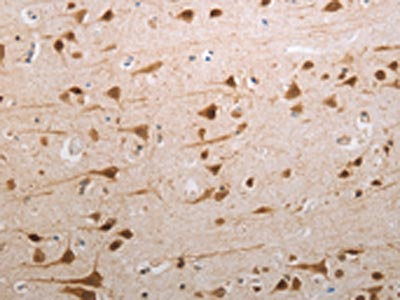
The image on the left is immunohistochemistry of paraffin-embedded Human brain tissue using CSB-PA098783(MDC1 Antibody) at dilution 1/80, on the right is treated with synthetic peptide. (Original magnification: ×200)
Required for checkpoint mediated cell cycle arrest in response to DNA damage within both the S phase and G2/M phases of the cell cycle. May serve as a scaffold for the recruitment of DNA repair and signal transduction proteins to discrete foci of DNA damage marked by 'Ser-139' phosphorylation of histone H2AX. Also required for downstream events subsequent to the recruitment of these proteins. These include phosphorylation and activation of the ATM, CHEK1 and CHEK2 kinases, and stabilization of TP53 and apoptosis. ATM and CHEK2 may also be activated independently by a parallel pathway mediated by TP53BP1.
Gene References into Functions
Our data highlight that NFBD1 participates in the regulation of proliferation and apoptosis in laryngeal squamous cell carcinomaPMID:28921460
These findings indicate that the c-Fos/miR-22/MDC1 axis plays a relevant role in DNA repair in terminally differentiated cells, which may facilitate our understanding of molecular mechanism underlying the downregulating DNA repair in differentiated cells.PMID:28637007
key component of the DNA damage response and interacts with several factors such as gamma-H2AXPMID:29026069
prognostic marker in predicting relapse-free survival in oral squamous cell carcinomaPMID:28161894
It showed a link between the status of MDC1 protein and TP53 gene, which specific mutations caused radiation-induced MDC1 down-regulation.PMID:28397142
ASF1a promotes non-homologous end joining repair by facilitating phosphorylation of MDC1 by ATM at double-strand breaks.PMID:28943310
the opposing activities of RNF4 and ataxin-3 consolidate robust MDC1-dependent signaling and repair ofDNA double-strand break.PMID:28275011
NFBD1 protein is overexpressed in NPC tissues and that silencing NFBD1 can inhibit cell growth, induce apoptosis, increase the production of intracellular ROS. NFBD1 knockdown also inhibits the tumorigenicity of NPC cells in vivo.PMID:28081741
NFBD1 knockdown improves the chemosensitivity of NPC cells by inhibiting cell growth and promoting apoptosis through the impairment of DNA damage repair, suggesting NFBD1 as a novel therapeutic target for NPC.PMID:27334757
knockdown of MCM2 or MCM6 could significantly inhibit foci forming of MDC1 in TE-1 nuclei in response to bleomycin-induced DNA damage (p < 0.001). This study indicates the direct interaction between MDC1 and MCMs in TE-1 nuclei.PMID:27908247
MDC1 recruits TNKS1 and TNKS2 to DNA lesions.PMID:26845027
MDC1 silencing enhances the radiosensitivity of human nasopharyngeal cancer CNE1 cells and results in xenograft tumor growth inhibition.PMID:26247734
we generated two HEP-2 cell lines with a stable knockdown of MDC1 or 53BP1 with short hairpin RNA (shRNA), respectively, and investigated the effect of MDC1 and 53BP1 on cell radiosensitivityPMID:25976740
During replicative senescence and stress-induced premature senescence, MDC1 is downregulated by upregulating miR-22.PMID:25627978
we have identified a novel antisense lncRNA MDC1-AS, which may participate in bladder cancer through up-regulation of its antisense tumor-suppressing gene MDC1PMID:25514464
our findings suggest that MDC1 promotes ovarian cancer metastasis through the induction of EMT.PMID:25592380
The study suggest that MDC1 as an epigenetic modifier regulates androgen receptor transcriptional activity and MDC1 may function as a tumor suppressor of prostate cancer.PMID:25934801
data suggested that the SNP rs4713354A>C of MDC1 may be a functional genetic biomarker for susceptibility to lung cancer in ChinesePMID:25198518
NFBD1/MDC1 is phosphorylated by PLK1 and controls G2/M transition through the regulation of a TOPOIIalpha-mediated decatenation checkpoint.PMID:24349352
ATM and MDC1 maintain genomic stability not only by controlling the DNA damage response, but also by regulating spindle assembly checkpoint activation, providing an important link between these two essential biological processes.PMID:24509855
The TOPBP1 phosphate-binding pocket and positively charged residues in a variant loop in BRCT5 present an extended binding surface for the negatively charged MDC1 phosphopeptide.PMID:23891287
Silencing MDC1 can enhance the radiosensitivity of esophageal squamous cell carcinoma ECA109 cells in vitro.PMID:20813677
PARP1 activation and BAL1-BBAP recruitment to DNA damage sites are independent of ATM and MDC1.PMID:23230272
proteins accumulate into foci with characteristic mean recruitment times tau(1). Mdc1 accumulates faster than 53BP1 after high LET irradiationPMID:22860035
inhibition in the activity of the core mitotic regulator CDK1 enhances MDC1-gammaH2AX colocalization in mitosis.PMID:22962268
A dual interaction between the DNA damage response protein MDC1 and the RAG1 subunit of the V(D)J recombinase.PMID:22942284
distinct dynamics of MDC1 and 53BP1 at different types of nuclear structuresPMID:22677490
It was shown that MDC1 is sumoylated after DNA damage, and sumoylation of MDC1 at Lys1840 is needed for MDC1 degradation and removal of MDC1 and 53BP1 from DNA damage sites. Sumoylated MDC1 was ubiquitinated by the SUMO-targeted E3 ubiquitin ligase RNF4.PMID:22635276
A major binding target of the Mdc1 FHA domain is a previously unidentified DNA damage and ATM-dependent phosphorylation site near the N-terminus of Mdc1 itself.PMID:22234878
expression of NFBD1 seems to be related to the oncogenic potential of cervical cancer, and suppression of its expression can inhibit cancer cell growth both in vitro and in vivoPMID:21853275
As compared to the MDC1 forkhead-associated FHA) domain, the MU2 FHA domain dimerizes using a different and more stable interface and contains a degenerate phosphothreonine-binding pocket.PMID:22273583
MDC1 is required for the recruitment of RAP80 to DNA double-strand breaks.PMID:21857162
structural insight into MDC1-CHK2 interactionPMID:22211259
This study provides the first evidence that interactions involving MDC1 can be regulated by ubiquitylationPMID:21622030
most NFBD1 regulated genes are regulated in both the absence and presence of IR, thus pointing toward a novel function for NFBD1 outside of the DNA damage responsePMID:21551225
this study reveals that human NIPBL is a novel protein recruited to DSB sites, and the recruitment is controlled by MDC1, RNF168 and HP1gamma.PMID:21784059
The specific TopBP1-MDC1 interaction was mediated by the fifth BRCT domain of TopBP1 and the Ser-Asp-Thr repeats of MDC1. TopBP1 accumulation at stalled replication forks was promoted by the H2AX/MDC1 signaling cascade.PMID:21482717
Mediator of DNA damage checkpoint protein 1 (MDC1) has a role in nodal recurrence in early-stage breast cancer patients treated with breast-conserving surgery and radiation therapyPMID:20521098
Results implicate MDC1 in the cellular apoptotic response.PMID:21148072
High NFBD1 is associated with esophageal cancer.PMID:20364298
The viral oncoprotein tax sequesters DNA damage response factors by tethering MDC1 to chromatin.PMID:20729195
NFBD1 has a pivotal role in the regulation of proper mitotic entry.PMID:20529673
MDC1 and 53BP1 expressions were observed for the first time in human esophageal carcinoma cell lines TE-1,TE-13 and Eca109 cells, at both the mRNA and protein levels.PMID:17884766
structure & peptide binding specificity of BRCT domains of MDC1 & BRCA1; crystal structures of BRCA1 & MDC1 bound to peptides show differences in the environment of conserved arginines that determine affinity for peptides with -COO(-) vs -CO-NH(2) terminiPMID:20159462
This nuclear protein with signature motifs of FHA and BRCT, and an internal 41-amino acid repeat sequence, is an early participant in DNA damage response.PMID:12475977
NFBD1 is parallel to 53BP1 in regulating Chk2 and downstream of H2AX in the recruitment of repair and signaling proteins to sites of DNA damage in tumor cellsPMID:12551934
MDC1-mediated focus formation by the MRE11 complex at sites of DNA damage is crucial for the efficient activation of the intra-S-phase checkpointPMID:12607003
MDC1 is recruited through its FHA domain to the activated CHK2 and has a critical role in CHK2-mediated DNA damage responsesPMID:12607004
role for MDC1 in mediating transduction of the DNA damage signalPMID:12607005
Show
More
Hide
All
Subcellular Location
Nucleus. Chromosome. Note=Associated with chromatin. Relocalizes to discrete nuclear foci following DNA damage, this requires 'Ser-139' phosphorylation of H2AX. Colocalizes with APTX at sites of DNA double-strand breaks.