Synthetic peptide corresponding to residues near the N terminal of Human melanocortin 3 receptor
Immunogen Species
Homo sapiens (Human)
Purification Method
Antigen Affinity Purified
Concentration
It differs from different batches. Please contact us to confirm it.
Tested Applications
ELISA,WB
Storage
Upon receipt, store at -20°C or -80°C. Avoid repeated freeze.
Lead Time
Basically, we can dispatch the products out in 1-3 working days after receiving your orders. Delivery time maybe differs from different purchasing way or location, please kindly consult your local distributors for specific delivery time.
Note: All of our proteins are default shipped with normal blue ice packs, if you request to ship with dry ice, please communicate with us in advance and extra fees will be charged.
Usage
For Research Use Only. Not for use in diagnostic or therapeutic procedures.
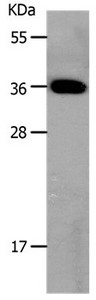
Gel: 10%SDS-PAGE Lysates (from left to right): Mouse large intestine tissue Amount of lysate: 30μg per lane Primary antibody: 1/800 dilution Secondary antibody dilution: 1/8000 Exposure time: 20 seconds
Receptor for MSH (alpha, beta and gamma) and ACTH. This receptor is mediated by G proteins which activate adenylate cyclase. Required for expression of anticipatory patterns of activity and wakefulness during periods of limited nutrient availability and for the normal regulation of circadian clock activity in the brain.
Gene References into Functions
This article reviews the MC3R polymorphisms and mutations identified in humans, and the in vitro, murine, and human cohort studies examining their putative effects. Certain human MC3R mutations are associated with greater adiposity and hyperleptinemia. [review]PMID:28363697
Structural Insights into Selective Ligand-Receptor Interactions Leading to Receptor Inactivation Utilizing Selective Melanocortin 3 Receptor Antagonists.PMID:28715181
MC3R mutations are associated with Obesity.PMID:27288827
findings support the role of MC3R genetic variants in adiposity gain during early childhood.PMID:26663875
There is no evidence of any association between MC3R variations and obesity.PMID:26782456
Replacing murine Mc3r with and double-mutant (C17A+G241A) human MC3R showed greater weight and fat mass, increased energy intake and feeding efficiency.PMID:26818770
the DPLIY motif and helix 8 was important for MC3R activation and signal transduction. The data led to a better understanding of the structure-function relationship of MC3R.PMID:26220347
novel data about the structure-function relationship of MC3R, identifying residues important for receptor function; some studied mutations exhibited biased signaling, preferentially activating one intracellular signaling pathway.PMID:25798062
propose three potential human candidate genes for voluntary physical exercise levels (MC3R, CYP24A1, and GRM8).PMID:24821406
The cytoplasmic end of transmembrane domain 3 and the intracellular loop 2 were critical for MC3R function.PMID:25228159
MC3R polymorphism is marginally associated in the development of pulmonary tuberculosis in Korean population.PMID:25064630
MC3R is a 2-exon gene that requires a 5' UTR for translation, localization, and potential interaction with MRAP2PMID:25051171
3' RACE experiments using MC3R transcript indicated the 3' UTR terminates approximately 115-160 bases after the translational stop codon.PMID:25450386
This study focused on the search for the MC3R polymorphism in the Polish population.PMID:24142065
Overall, the total prevalence of rare MC3R variants was 1 % in Belgian obese children and adolescents compared to 1.02 % in lean controls.PMID:23264184
Suggest MC3R rs6127698 polymorphism is associated with pulmonary tuberculosis in a sample Iranian population.PMID:23827504
Data suggest that specific amino acid residues (M247, R252, H254, K256, R257, A259) in 3rd intracellular loop (ICL3) of MC3R are important for ligand binding/signal transduction; studies used mutant, recombinant MC3R expressed in HEK293T cell line.PMID:23323615
while MC3R mutations are unlikely to result in an autosomal dominant form of monogenic obesity given lack of strong cosegregation in family studies, the studies provided evidence that MC3R can be one of the genes which contributes to increased adiposity [review]PMID:23280863
results suggest MC3R rs6127698 has no direct role in tuberculosis susceptibility. The possibility remains that this polymorphism is linked to an adjacent functional genetic variant, acting as a surrogate marker for disease riskPMID:23497691
we provided detailed data of these novel human MC3R mutations leading to a better understanding of structure-function relationship of MC3R and the role of MC3R mutation in obesityPMID:22884546
Interaction of the melanocortin 3 receptor (MC3R) and the growth hormone secretagogue receptor (GHSR)-1a results in a modulation of function in both receptors.PMID:22327910
The polymorphism T6K is not located in the coding region of the human MC3R and has no influence on translation initiation which makes an impact on body weight unlikely.PMID:22433616
Carriers of the MC3R 6Lys-81Ile haplotype showed higher respiratory quotient and higher glucose oxidation compared with non-carriers after standardization for fat-free mass.PMID:21983807
Extracellular cysteine residue C305, C311 and C313 are crucial for receptor expression and the transmembrane cysteine residue, C115 and 162 are important for ligand binding and signaling.PMID:22079958
in the populations studied functionally significant MC3R variants are associated with obesityPMID:21047972
The study provided overall sufficient evidence to support that there is no major effect of genetic variants of MC3R and differential weight loss.PMID:21695122
We demonstrated that the MC3R polymorphisms have a protective effect on metabolic traits.PMID:21920079
Polymorphisms in MC3R promoter and CTSZ 3'UTR are associated with tuberculosis susceptibility.PMID:21368909
A role of the MC3R gene in the pathogenesis of obesity in a small subset of patients.PMID:20539302
While MC3R is an important regulator of energy homeostasis, mutations in the MC3R gene remain controversially associated with human obesity pathogenesis.[Review]PMID:20882712
data are consistent with the involvement of rs3746619 in weight regulation among obese individualsPMID:20972733
There is not sufficient evidence to support the contribution for common melanocortin-3 receptor variants in childhood obesity. However, our results are concordant for a role of melanocortin-3 receptor variants in some dimensions of eating behavior.PMID:20144537
A novel melanocortin 3 receptor gene (MC3R) mutation associated with severe obesity.PMID:11889220
An association between an insertion polymorphism was observed with fat mass, percent body fat, and total abdominal fat.PMID:12142547
variaton in a Maori kindred with obesity and early onset type 2 diabetesPMID:12161058
functional characterization of the I183N mutated MC3R compared with that of the wild-type MC3R after transfection in HEK293 cellsPMID:15276649
MC3R mutation might be genetic factor that confers susceptibility to obesity, likely due to haploinsufficiency. We identify a residue that is critical for activation of G protein-coupled receptors.PMID:15292330
Single-nucleotide polymorphisms found in anorexia nervosa.PMID:16314751
Our results suggest that TM3 and TM6 are important for NDP-MSH binding, while D121 in TM2 and D332 in TM7 are crucial for receptor activity and signaling.and thus provide molecular determinants of hMC3R responsible for ligand binding and receptor signalsPMID:16430209
in addition to its inverse agonistic activities, Agrp exhibits agonistic properties on the endocytosis pathway of melanocortin-3 and -4 receptorsPMID:17041250
SNPs of MC3R may regulate substrate oxidation and first-phase insulin secretion.PMID:17192297
results suggest a gene-diet interaction between the MC3R C17A and G241A variants and a weight loss program for the ability to lose weight in childhood obesityPMID:17413091
Further structure-activity studies of lactam derivatives of MT-II and SHU-9119 were made at MC3R.PMID:17482720
MC3R mutations may not result in autosomal dominant forms of obesity but may contribute as a predisposing factor to childhood obesity.PMID:17639020
highly conserved N/DPxxY motif, was critical for multiple aspects of the MC3R function, including cell surface expression, ligand binding, and signaling.PMID:17964765
In the Maori kindred, the D20S32e polymorphism is significantly associated with insulin resistance but not with the metabolic syndrome.PMID:18180070
in humans, MC3R mutations may be a cause of a dominantly inherited form of obesityPMID:18231126
there is a link between MC3R and cell growth pathways that may involve the alteration of AKT signaling pathwayPMID:18291523
unlikely that MC3R gene plays a major role in tuberculosis susceptibility in African populationsPMID:18420963
acidic residues in transmembrane (TM) domains 1 and 3 are important for ligand binding whereas the acidic residues in TMs 2 and 7 are important for both ligand binding and signalingPMID:18614155