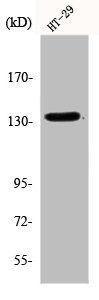
DNA ligase 1 antibody; DNA ligase I antibody; DNLI1_HUMAN antibody; LIG 1 antibody; lig1 antibody; Ligase I DNA ATP dependent antibody; MGC117397 antibody; MGC130025 antibody; Polydeoxyribonucleotide synthase [ATP] 1 antibody
Raised in
Rabbit
Species Reactivity
Human
Immunogen
Synthesized peptide derived from the N-terminal region of Human DNA Ligase I.
Immunogen Species
Homo sapiens (Human)
Conjugate
Non-conjugated
Isotype
IgG
Purification Method
The antibody was affinity-purified from rabbit antiserum by affinity-chromatography using epitope-specific immunogen.
Concentration
It differs from different batches. Please contact us to confirm it.
Buffer
Liquid in PBS containing 50% glycerol, 0.5% BSA and 0.02% sodium azide.
Form
Liquid
Note: We will preferentially ship the format that we have in stock, however, if you have any special requirement for the format, please remark your requirement when placing the order, we will prepare according to your demand.
Upon receipt, store at -20°C or -80°C. Avoid repeated freeze.
Lead Time
Basically, we can dispatch the products out in 1-3 working days after receiving your orders. Delivery time maybe differs from different purchasing way or location, please kindly consult your local distributors for specific delivery time.
Note: All of our proteins are default shipped with normal blue ice packs, if you request to ship with dry ice, please communicate with us in advance and extra fees will be charged.
Usage
For Research Use Only. Not for use in diagnostic or therapeutic procedures.
DNA ligase that seals nicks in double-stranded DNA during DNA replication, DNA recombination and DNA repair.
Gene References into Functions
single-stranded break repair by human DNA ligase III isoforms reveal biochemical differences from DNA ligasePMID:28751376
A histone H3K9-like mimic within LIG1 is methylated by G9a and GLP and avidly binds UHRF1. Interaction with methylated LIG1 promotes the recruitment of UHRF1 to DNA replication sites and is required for DNA methylation maintenance.PMID:28803780
The rs156641 polymorphism of DNA ligase 1 (LIG1) was significantly associated with lung cancer risk, whereas no association was found between rs3730931/rs439132/rs20579 polymorphisms and lung cancer.PMID:27352326
Data suggest that DNA ligase I (LigI)-deficient 46BR.1G1 cells represent a model to investigate the biological effects of sub-lethal levels of DNA insults.PMID:26151554
The LIG1 CC genotype was associated with susceptibility to non-small cell lung cancer, and the AA genotype demonstrated increased radiosensitivity compared to the AC and CC genotypes.PMID:26125914
A novel method for monitoring functional lesion-specific recruitment of repair proteins in live cells.PMID:25879709
Ppolymorphisms in LIG1 affect its expression and may therefore change its function.PMID:25189241
there is no association between LIGI polymorphisms and cervical cancer risk. However, they may be playing an important role in modulating the risk of cervical adenocarcinoma in North Indian womenPMID:24084463
DNA ligase I also interacts with replication factor C, the factor that loads the PCNA trimeric ring onto DNA.PMID:22918593
Data indicate that Ku70/Ku80 facilitates the cooperative binding of multiple XRCC4/Ligase IV (XL) and XLF molecules to DNA.PMID:23620595
Single nucleotide polymorphisms in LIG1 are associated with myelodysplastic syndromes.PMID:23339595
phosphorylation of serine 51 on hLigI plays a critical role in regulating the interaction between hLigI and RFC, which is required for efficient DNA replication and repair.PMID:22952233
Data show that association of study-wide significance (P < 8.2 x 10(-5)) was identified for single-nucleotide polymorphisms (SNP) in TP53, LIG1, and BIK.PMID:22139380
Kinetic mechanism of human DNA ligase I reveals magnesium-dependent changes in the rate-limiting step that compromise ligation efficiency.PMID:21561855
RNA silencing of human DNA ligase I expression severely reduced replication of viral DNA in cells infected with vaccinia virus ligase-deficient mutants.PMID:20006844
DNA ligase I competes with FEN1 to expand repetitive DNA sequences in vitro.PMID:11948189
stimulated by APE1 for progression through the base excision repair pathwayPMID:12200445
phosphorylation of DNA ligase I and possibly other replicative enzymes is part of the mechanism that directs the disassembly of the replication machinery at the completion of S-phase.PMID:12851383
majority of single-strand DNA interruptions produced during the repair of alkylated DNA bases are repaired by the pathway mediated by Pol beta and either Lig I or Lig IIIPMID:14627836
crystal structure of human DNA ligase I (residues 233 to 919) in complex with a nicked, 5' adenylated DNA intermediatePMID:15565146
The human checkpoint sensor and alternative clamp Rad9-Rad1-Hus1 can interact with and specifically stimulate DNA ligase IPMID:15871698
LIG1-deficiency reduces recombinational repair of DNA double-strand beaks.PMID:15907772
human DNA ligase I is stimulated by the Rad9-rad1-Hus1 checkpoint complexPMID:16731526
siRNA mediated down-regulation of DNA ligase I in human HTD114 cells led to impaired end joining that was mediated by 2-, 3- or 10-bp microhomology.PMID:18440984
The LIG1 SNP 5'UTR showed a significant association with glioma risk.PMID:19124499
drastically reduced replicative LigI activity in 46BR.1G1 cells results in the accumulation of both single-stranded and double-stranded DNA breaks.PMID:19223467
a mutant version of hLigI, which mimics the hyperphosphorylated M-phase form of hLigI, does not interact with and is not inhibited by RFC, demonstrating that inhibition of ligation is dependent upon the interaction between hLigI and RFCPMID:19223468
The DNA binding domain (DBD) within the hLigI catalytic fragment interacts with both PCNA and the heterotrimeric cell-cycle checkpoint clamp, hRad9-hRad1-hHus1 (9-1-1).PMID:19523882
Data support the notion that DNA ligase I participates in homology dependent pathways that deal with replication-associated lesions generated when replication fork encounters DNA damage.PMID:19597347
Data show that disruption of LigI and PCNA interactions influences trinucleotide repeat instability.PMID:19628465