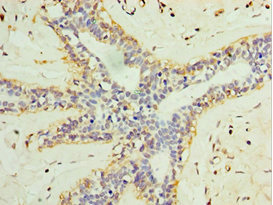
Recombinant Human Lethal(3)malignant brain tumor-like protein 1 protein (513-752AA)
Immunogen Species
Homo sapiens (Human)
Conjugate
Non-conjugated
Isotype
IgG
Purification Method
Antigen Affinity Purified
Concentration
It differs from different batches. Please contact us to confirm it.
Buffer
PBS with 0.02% sodium azide, 50% glycerol, pH7.3.
Tested Applications
ELISA, IHC
Recommended Dilution
Application
Recommended Dilution
IHC
1:20-1:200
Storage
Upon receipt, store at -20°C or -80°C. Avoid repeated freeze.
Lead Time
Basically, we can dispatch the products out in 1-3 working days after receiving your orders. Delivery time maybe differs from different purchasing way or location, please kindly consult your local distributors for specific delivery time.
Note: All of our proteins are default shipped with normal blue ice packs, if you request to ship with dry ice, please communicate with us in advance and extra fees will be charged.
Usage
For Research Use Only. Not for use in diagnostic or therapeutic procedures.
Polycomb group (PcG) protein that specifically recognizes and binds mono- and dimethyllysine residues on target proteins, therey acting as a 'reader' of a network of post-translational modifications. PcG proteins maintain the transcriptionally repressive state of genes: acts as a chromatin compaction factor by recognizing and binding mono- and dimethylated histone H1b/H1-4 at 'Lys-26' (H1bK26me1 and H1bK26me2) and histone H4 at 'Lys-20' (H4K20me1 and H4K20me2), leading to condense chromatin and repress transcription. Recognizes and binds p53/TP53 monomethylated at 'Lys-382', leading to repress p53/TP53-target genes. Also recognizes and binds RB1/RB monomethylated at 'Lys-860'. Participates in the ETV6-mediated repression. Probably plays a role in cell proliferation. Overexpression induces multinucleated cells, suggesting that it is required to accomplish normal mitosis.
Gene References into Functions
Loss of the paternally derived allele of the imprinted L3MBTL1 gene is associated with Shwachman-Diamond syndrome.PMID:27553422
The polycomb group protein L3MBTL1 represses a SMAD5-mediated hematopoietic transcriptional program in human pluripotent stem cells.PMID:25754204
Data indicate that germline genes, some of which drive oncogenesis in Drosophila melanogaster, are similarly ectopically activated in a wide range of human cancers.PMID:24243547
High expression of L3MBTL1 was associated with low grade and hormone receptor-positive tumors, as well as low risk of disease recurrence and breast cancer death.PMID:21837478
depletion of L3MBTL1 does not affect hESC self-renewal, rather it enhances differentiation toward extra-embryonic trophoblast tissuesPMID:21341991
Data suggest that the loss of L3MBTL1 contributes to the development of 20q(-) hematopoietic malignancies by inducing replicative stress, DNA damage, and genomic instability.PMID:21149733
SET8-mediated methylation of p53 at Lys-382 promotes the interaction between L3MBTL1 and p53 in cells.PMID:20870725
haploinsufficiency of L3MBTL1 contributes to some (20q-) myeloproliferative neoplasms, especially polycythemia vera, by promoting erythroid differentiationPMID:20585043
The ability of TEL to repress TEL-responsive promoters is enhanced by the presence of H-L(3)MBT, an effect dependent on the H-L(3)MBT and the TEL interacting domains, which are mapped to their respective SPM/SAM domains.PMID:12588862
represents a previously undescribed imprinted locus, a vertebrate Polycomb group gene shown to be regulated by this mechanism, and has implications for the pathogenesis of myeloid malignancies associated with 20q deletionsPMID:15123827
L3MBTL may have a role in myeloid leukemiaPMID:15334543
The MBT domain is related to protein domains that directly bind methylated histone residues and study found that L3MBTL1 MBT domains compact nucleosomal arrays dependent on mono- and dimethylation of histone H4 lysine 20 and of histone H1b lysine 26.PMID:17540172
An unexpected mode of peptide-mediated dimerization suggests a possible mechanism for chromatin compaction by L3MBTL1PMID:18026117
The structural and binding studies of the two modules provide insights into the molecular principles governing the decoding of lysine methylation states, thereby highlighting a methylation state-specific layer of histone mark readout.PMID:18042461
H4K20 monomethylation and PR-SET7 are important for L3MBTL1 functionPMID:18408754
Show
More
Hide
All
Subcellular Location
Nucleus. Note=Excluded from the nucleolus. Does not colocalizes with the PcG protein BMI1, suggesting that these two proteins do not belong to the same complex.
Tissue Specificity
Widely expressed. Expression is reduced in colorectal cancer cell line SW480 and promyelocytic leukemia cell line HL-60.