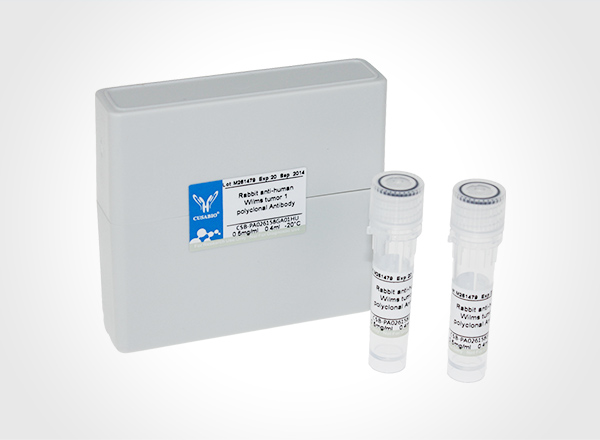
Liquid
Note: We will preferentially ship the format that we have in stock, however, if you have any special requirement for the format, please remark your requirement when placing the order, we will prepare according to your demand.
Storage
Upon receipt, store at -20°C or -80°C. Avoid repeated freeze.
Lead Time
Basically, we can dispatch the products out in 1-3 working days after receiving your orders. Delivery time maybe differs from different purchasing way or location, please kindly consult your local distributors for specific delivery time.
Note: All of our proteins are default shipped with normal blue ice packs, if you request to ship with dry ice, please communicate with us in advance and extra fees will be charged.
Usage
For Research Use Only. Not for use in diagnostic or therapeutic procedures.
Voltage-gated potassium channel that plays an important role in the rapid repolarization of fast-firing brain neurons. The channel opens in response to the voltage difference across the membrane, forming a potassium-selective channel through which potassium ions pass in accordance with their electrochemical gradient. Can form functional homotetrameric channels and heterotetrameric channels that contain variable proportions of KCNC2, and possibly other family members as well. Contributes to fire sustained trains of very brief action potentials at high frequency in pallidal neurons.
Gene References into Functions
A recurrent de novo mutation in KCNC1 (c.959G>A, p.Arg320His) has been identified recently as one of the important genetic causes of progress myoclonic epilepsy. This recurrent mutation in KCNC1 was identified in the two brothers who showed characteristic features of myoclonus epilepsy and ataxia due to potassium channel mutation (MEAK). The asymptomatic mother was suspected as being mosaic for this mutation.PMID:29428275
A nonsense variant in KCNC1 gene was identified in three family members with intellectual disability without seizures.PMID:28145425
reviews the phenotype/genotype of progressive myoclonus epilepsy and ataxia due to potassium channel mutation (MEAK)associated with KCNC1 mutations [review]PMID:27629860
KCNC1 produces a resurgent current during repolarization, ensuring enough repolarizing power to terminate each action potential. The current results from a combination of steep voltage-dependent gating kinetics and ultra-fast voltage-sensor relaxation.PMID:26673941
A recurrent KCNC1 de novo mutation, c.959G>A (p.Arg320His), is a new major cause for progressive myoclonus epilepsy. It has a dominant-negative loss-of-function effect.PMID:25401298
Findings show a decrease in Kv3.1b channel protein in schizophrenia neocortex, a deficit that is restored by antipsychotic drugsPMID:23628987
Describes localization in mouse brain of two isoforms - the longer is called b and the shorter is called a.PMID:12091563
Describes two rat isoforms of Kv3.1, alpha is the longer one and beta is the shorter onePMID:1432046
KChIP4a suppresses A-type Kv4 current via ER retention and enhancement of Kv4 closed-state inactivation.PMID:23576435
Although all KV3 subunit transcripts are significantly expressed at embryonic age in whole mouse brain extracts, only KV3.1, KV3.2 and KV3.4 subunit transgenic proteins are present.PMID:21912965
demonstrated that glycosylation was necessary for both DPP10 trafficking to the cell surface and functional interaction with Kv4 channelsPMID:22387313
Kv3.1 channels are transported into axons by binding to kinesin I.PMID:21106837