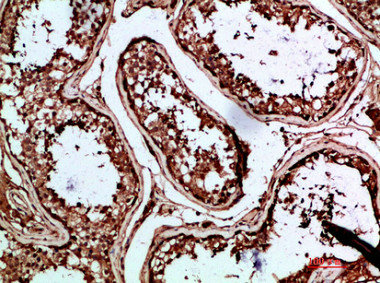
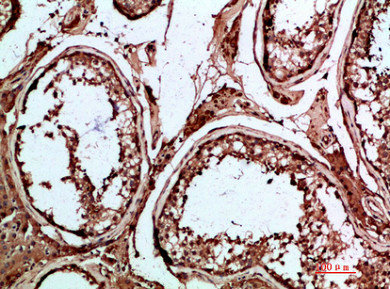
INSL 3 antibody; INSL3 antibody; INSL3_HUMAN antibody; Insulin like 3 antibody; insulin like peptide, Leydig cell-specific antibody; insulin-like 3 (Leydig cell) antibody; Insulin-like 3 A chain antibody; Ley IL antibody; Ley-I-L antibody; leydig insulin -like hormone antibody; Leydig insulin like peptide antibody; Leydig insulin-like peptide antibody; prepro-INSL3 antibody; Relaxin like factor antibody; Relaxin-like factor antibody; relaxin-like factor b antibody; RLF antibody; RLNL antibody
Raised in
Rabbit
Species Reactivity
Human
Immunogen
Synthetic peptide from Human protein at AA range: 10-50
Immunogen Species
Homo sapiens (Human)
Conjugate
Non-conjugated
Purification Method
The antibody was affinity-purified from rabbit serum by affinity-chromatography using specific immunogen.
Concentration
It differs from different batches. Please contact us to confirm it.
Buffer
Liquid in PBS containing 50% glycerol, 0.5% BSA and 0.02% sodium azide.
Tested Applications
IHC,ELISA
Storage
Upon receipt, store at -20°C or -80°C. Avoid repeated freeze.
Lead Time
Basically, we can dispatch the products out in 1-3 working days after receiving your orders. Delivery time maybe differs from different purchasing way or location, please kindly consult your local distributors for specific delivery time.
Note: All of our proteins are default shipped with normal blue ice packs, if you request to ship with dry ice, please communicate with us in advance and extra fees will be charged.
Usage
For Research Use Only. Not for use in diagnostic or therapeutic procedures.
Seems to play a role in testicular function. May be a trophic hormone with a role in testicular descent in fetal life. Is a ligand for LGR8 receptor.
Gene References into Functions
Variants of the INSL3 gene are prevalent in patients with testicular torsion instead of healthy subjects.PMID:29785651
The strong positive correlation between INSL3, and high ovarian androgens levels in all polycystic ovary syndrome women, which appeared clearly in undescended polycystic ovaries could support the proposed syndrome hypothesis between those abnormal findings.PMID:29254383
KLF6-mediated activation of the human INSL3 promoter required an intact KLF element as well as Leydig/Sertoli-enriched factors. KLF6 transcriptionally cooperates with NUR77 and SF1. our results identify KLF6 as a regulator of human INSL3 transcription.PMID:26874000
The INSL3 G178A polymorphism was not significantly associated with spermatozoa or no spermatozoa in the testes of males with a history of bilateral cryptorchidism. I The evidence suggests that mutations of INSL3 may not directly contribute to the damage of spermatogenesis in patients with bilateral cryptorchidism history.PMID:26840636
hINSL3 seems to recruit Aund spermatogonia into differentiation, potentially mediating an Fsh effect on spermatogenesis.PMID:26077926
Healthy eumenorrheic late adolescent females with sporadic anovulation display higher INSL3 blood concentration.PMID:26579638
rs6523 polymorphism and AGAG haplotype of INSL3 showed significant association with increased risk of polycystic ovary syndrome.PMID:26625974
INSL3 in girls is a unique and specific marker of theca cells surrounding antral follicles.PMID:25516081
Three common INSL3 gene polymorphisms (27G>A, 126G>A, 178G>A) unrelated to any particular phenotype of testicular maldescent (TMD) were detected both in patients and controls, indicating that INSL3 gene mutations are not a common cause of TMD.PMID:25728210
DLK1, INSL3 and COUP-TFII expression changes during normal development and is linked to different stages of Leydig Cell differentiation.PMID:24908673
low INSL3 concentration is related to the pathogenesis behind an unfavourable change in body composition and bone metabolism among Klinefelter syndrome patientsPMID:24659579
The aim of this study was to assess plasma INSL3 in patients with osteoporosis and Klinefelter's Syndrome compared to healthy males.PMID:24640568
INSL3 is as sensitive a marker as T for the evaluation of altered Leydig cell function in congenital hypogonadotropic hypogonadism/Kallmann syndrome patients.PMID:24243640
INSL3 and AMH levels are significantly correlated with each other in women with PCOS, and they are significantly increased, particularly in the presence of amenorrhea and oligomenorrhea.PMID:23928669
Findings suggest a novel and gender-specific role for INSL3 and cognate receptor RXFP2 signaling in ocular surface homeostasis.PMID:23539510
Most Prader-Willi syndrome males have normal INSL3 levels.PMID:23150680
In the meta-analysis, INSL3 rs10421916 and rs11088680 had both a 0.8-fold decreased odds ratio for gastric cancer.PMID:23028900
Cystin A11-B10 serves as an insulator between the two ports, whereas the amide functionality disturbs the signal transmission complex likely due to changes in polarity.PMID:22574850
Data suggest that insulin-like factor 3 is related to functional ovarian hyperandrogenism in women with polycystic ovary syndrome.PMID:21586896
study demonstrates that the INSL3/RXFP2 system is involved in bone metabolism by acting on the MAPK cascade and stimulating transcription of important genes of osteoblast maturation/differentiation and osteoclastogenesisPMID:22216350
Data show that synthetic parallel dimer of the B-chain of INSL3 is a potent inhibitor of the native peptide's binding to its receptor, RXFP2.PMID:20560146
The current knowledge of INSL3, its involvement in testicular descent and germ cell survival, verifies that this Leydig cell hormone is an important player in testicular physiology[review]PMID:20550598
High INSL3 is associated with testicular Leydig cell tumors.PMID:19110449
investigation of INSL3 structural requirements (i.e., intra-A-chain disulfide bonds) for binding to & activation of RXFP2PMID:20570702
INSL3 is a powerful and multifunctional promoter of tumor growth and angiogenesis in human thyroid cancer cell xenografts. INSL3 actions involve RXFP2 activation and the secretion of S100A4 and (pro-)cathepsin-LPMID:19950223
Results describe the in vitro degradation of insulin-like peptide 3 by insulin-degrading enzyme.PMID:20082125
Analogues of INSL3 with higher alpha-helicity had higher receptor binding affinity.PMID:19067106
A novel mutation in this protein is found in patients with cryptorchidism.PMID:12601553
differentially expressed in hyperplastic and neoplastic thyrocytes, and in various thyroid diseasesPMID:12684664
the only clinical consequence of alterations of the INSL3-LGR8 system seems to be failure of the testis to normally descend in the scrotum during embryonic development, without affecting the spermatogenic and endocrine components of the testis itselfPMID:12970298
Analysis of men treated with different combinations of hormones of the hypothalamus-pituitary-testis axis suggests that the production of INSL3 is related to LH in a manner similar to that of the LH-testosterone axis.PMID:15579743
Although a common polymorphism was identified in the INSL3 gene, no mutations were observed. Lack of association between genetic factors necessary for correct testicular descent and anorchia.PMID:15579790
LGR8 signal is activated by the relaxin-like factorPMID:15708846
Even testosterone and INSL3 are both dependent on lutropin, thesse two Leydig cell hormones are regulated differently.PMID:15755855
relaxin-like hormones appear to be present early during C-cell hyperplasia and potentially functional relaxin/INSL3 ligand-receptor systems are present in human medullary thyroid carcinoma tissues and cell linesPMID:15956746
Analysis of men treated with different combinations of hormones of the hypothalamus-pituitary-testis axis suggests that the production of INSL3 is related to the luteinizing hormonePMID:15956751
Strongest INSL3 expression was detected in the basal epithelial cell compartment of the prostate epithelial cells, while weaker mRNA expression and immunoreactive production were observed in secretory epithelial cells.PMID:16010410
INSL3 is not sensitive to gonadotropin stimulation in normal men, but declines markedly in response to gonadotropin deprivation.PMID:16394084
Thus, the human INSL3 promoter constitutes a novel target for the orphan nuclear receptor Nur77.PMID:16467267
Results showed a significant association of INSL3 gene mutations in men presenting one or more signs of testicular dysgenesis syndrome.PMID:16687567
INSL3 was found to adopt a characteristic relaxin/insulin-like fold in solution but is a highly dynamic molecule. The four termini of this two-chain peptide are disordered, and additional conformational exchange is evident in the molecular core.PMID:16867980
The data show that INSL3 is an independent measure of Leydig cell function (quality and number), which appears to be independent of acute control via the HPG axis.PMID:17014531
The results, in conjunction with the previous data, suggest that mutations of INSL3 and LGR8/GREAT remain rare, and that the Thr/Thr genotype of Ala60Thr polymorphism in INSL3 may constitute a susceptibility factor for the development of cryptorchidism.PMID:17028442
INSL3 blood levels may be higher in men with persistent spermatogenesis during treatment with male hormonal contraceptives.PMID:17314233
INSL3 could be considered a new circulating hormone related to LH-dependent ovarian hyperandrogenism, particularly in normal-weight polycystic ovary womenPMID:17356050
Mutations involving the insulin-like factor 3 gene may contribute to other anomalies of male genital development, such as micropenis.PMID:17437853
predicted the complete INSL3/LGR8 primary binding site, including interactions between INSL3 His-B12 and LGR8 Trp-177, INSL3 Val-B19 and LGR8 Ile-179, and INSL3 Arg-B20 with LGR8 Asp-181 and Glu-229PMID:17473281
Higher blood levels may be indicative of ovarian cancer.PMID:17549672
The common INSL3 G178A polymorphism was not statistically significantly associated with male infertility.PMID:17559848
In boys, early postnatal INSL3 is markedly higher as compared with later childhood, presumably because it is stimulated by the transient postnatal LH peakPMID:17666478
Show
More
Hide
All
Subcellular Location
Secreted.
Protein Families
Insulin family
Tissue Specificity
Expressed in prenatal and postnatal Leydig cells. Found as well in the corpus luteum, trophoblast, fetal membranes and breast.