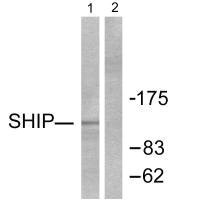
The antibody was affinity-purified from rabbit antiserum by affinity-chromatography using epitope-specific immunogen.
Concentration
It differs from different batches. Please contact us to confirm it.
Form
Rabbit IgG in phosphate buffered saline (without Mg2+ and Ca2+), pH 7.4, 150mM NaCl, 0.02% sodium azide and 50% glycerol.
Note: We will preferentially ship the format that we have in stock, however, if you have any special requirement for the format, please remark your requirement when placing the order, we will prepare according to your demand.
Upon receipt, store at -20°C or -80°C. Avoid repeated freeze.
Lead Time
Basically, we can dispatch the products out in 1-3 working days after receiving your orders. Delivery time maybe differs from different purchasing way or location, please kindly consult your local distributors for specific delivery time.
Note: All of our proteins are default shipped with normal blue ice packs, if you request to ship with dry ice, please communicate with us in advance and extra fees will be charged.
Usage
For Research Use Only. Not for use in diagnostic or therapeutic procedures.
Phosphatidylinositol (PtdIns) phosphatase that specifically hydrolyzes the 5-phosphate of phosphatidylinositol-3,4,5-trisphosphate (PtdIns(3,4,5)P3) to produce PtdIns(3,4)P2, thereby negatively regulating the PI3K (phosphoinositide 3-kinase) pathways. Able also to hydrolyzes the 5-phosphate of phosphatidylinositol-4,5-bisphosphate (PtdIns(4,5)P3) and inositol 1,3,4,5-tetrakisphosphate. Acts as a negative regulator of B-cell antigen receptor signaling. Mediates signaling from the FC-gamma-RIIB receptor (FCGR2B), playing a central role in terminating signal transduction from activating immune/hematopoietic cell receptor systems. Acts as a negative regulator of myeloid cell proliferation/survival and chemotaxis, mast cell degranulation, immune cells homeostasis, integrin alpha-IIb/beta-3 signaling in platelets and JNK signaling in B-cells. Regulates proliferation of osteoclast precursors, macrophage programming, phagocytosis and activation and is required for endotoxin tolerance. Involved in the control of cell-cell junctions, CD32a signaling in neutrophils and modulation of EGF-induced phospholipase C activity. Key regulator of neutrophil migration, by governing the formation of the leading edge and polarization required for chemotaxis. Modulates FCGR3/CD16-mediated cytotoxicity in NK cells. Mediates the activin/TGF-beta-induced apoptosis through its Smad-dependent expression.
Gene References into Functions
Overall evidence did not indicate that inositol polyphosphate-5-phosphatase (INPP5D) rs35349669 single nucleotide polymorphism play a role in the genetic predisposition to late-onset Alzheimer's disease (LOAD) in Chinese population.PMID:27750211
JARID1B directly bound to PI3K/AKT signaling inhibitor SHIP1 gene promoter and decreased SHIP1 gene expression.PMID:27584795
Study shows that SHIP1 activity is decreased in adult Crohn's disease (CD) patients either through reduced intrinsic enxymatic activity or reduced protein expression, and propose that in addition to ATG16L1, SHIP1 may contribute to the risk conferred by the 2q37 CD risk locus.PMID:28767696
results indicate that FcgammaRIIB is not uniquely able to promote membrane recruitment of SHIP, but rather modulates its function via formation of distinct signaling complexes. Membrane recruitment of SHIP via Syk-dependent mechanisms may be an important factor modulating immunoreceptor signaling.PMID:27456487
SHIP has a role in extracellular matrix accumulation via suppressing PI3K/Akt/CTGF signaling in diabetic kidney disePMID:27965087
Loss of SHIP promotes lung inflammation and mammary tumor metastasis.PMID:26683227
SHIP levels and activity are lower in intestinal tissues and peripheral blood samples from patients with Crohn's disease, resulting in induction of Il1-beta.PMID:26481854
Underexpression of SHIP1 is associated with drug resistance in acute myeloid leukemia.PMID:25971362
ectopically expressed SHIP1 accumulates in nucleolar cavities and colocalizes with the tumor suppressor protein p53.PMID:25723258
Results show that expression of SHIP1 protein is targeted by miR-155 in acute myeloid leukemia (AML) suggesting it as an onco-miR. The miR-155/SHIP1/PI3K/AKT signaling pathway could play an important role in the pathogenesis of AML.PMID:25175984
Overexpression of miR-155 in the gouty synovial fluid mononuclear cells leads to suppress SHIP-1 levels and enhance proinflammatory cytokines.PMID:24708712
SLAMF7-triggered inhibition is mediated by a mechanism involving Src kinases, CD45, and SHIP-1 that is defective in MM cellsPMID:25312647
The discovery and replication studies presented here show SHIP-1 to be a risk marker for acute ischemic stroke in the Chinese population, which appears to be a novel finding.PMID:24352714
High ship1 expression is associated with chronic lymphocytic leukemia.PMID:24914134
Tks5 is needed for breast carcinoma cell invadopodium precursor stabilization, where the phox homology (PX) domain of Tks5 interacts with PI(3,4)P2. SHIP2 arrival at the invadopodium precursor coincides with the onset of PI(3,4)P2 accumulation.PMID:24206842
Based on these observations, authors conclude that miR-155 modulates the neuroinflammatory response during Japanese encephalitis virus infection via negative regulation of SHIP1 expression.PMID:24522920
SHIP1 silencing opposes TIGIT/PVR-mediated inhibitory signaling and restores cytotoxicity of YTS cells.PMID:23154388
Mutation in the PxxP domain of SHIP affects cell migration and invasion ability of K562 cells through increased MMP-9 expression, FAK phosphorylation and NF-kappaB activation.PMID:22575191
inositol phosphatase SHIP-1 inhibits NOD2-induced NF-kappaB activation by disturbing the interaction of XIAP with RIP2PMID:22815893
SHIP1 mutant P1039S which does not reduce PI3K/AKT signaling anymore is located in a PXXP SH3 domain consensus binding motif.PMID:22820502
data suggest that miR-155 and miR-210/SHIP-1/Akt pathways could serve as clinical biomarkers for disease progression, and that miR-155 and miR-210 might serve as novel therapeutic targets in myelodysplastic syndromes.PMID:22249254
The CD2AP/SHIP1 complex and Cbl are recruited to blood dendritic cell (DC) antigen 2 (BDCA2) and Fc fragment of IgE high affinity I receptor (FcepsilonR1)gamma complex after BDCA2 cross-linking in human primary plasmacytoid DCs.PMID:22706086
The identification of SHIP1 as a nuclear inositol 5 phosphatase adds another member of the phosphoinositide and inositol modulating molecules to the emerging network of inositide signaling in the nucleus.PMID:21864674
indentification of LyGDI as a binding partner of SHIP, associating inducibly with the SHIP/Grb2/Shc complexPMID:21695085
Actin polymerization, F-actin accumulation, and Wiskott-Aldrich symptom protein phosphorylation are enhanced in SHIP-1-deficient B cells in a Bruton's tyrosine kinase (Btk)-dependent manner.PMID:21622861
Data suggest that SHIP-1 might regulate changes in the cytoskeleton.PMID:21402888
wtSHIP gene can down-regulate Akt phosphorylation and up-regulate cell cycle related proteins in K562 cells.PMID:19954644
This review summarizes how SHIP participates in normal immune physiology or the pathologies that result when SHIP is mutated. SHIP can have either inhibitory or activating roles in cell signaling.PMID:21155837
miR-155 led to down-regulation of SHIP, showing that it specifically targets the SHIP 3'untraslated regions.PMID:20041145
The novel platelet adapter Dok-3 and the structurally related Dok-1 are tyrosine phosphorylated in an Src kinase-independent manner downstream of alphaIIbbeta3 in human platelets, leading to an interaction with SHIP-1.PMID:19682241
In B cell lymphoma, elevated levels of miR-155, and consequent diminished SHIP1 expression are the result of autocrine stimulation by TNFalpha.PMID:19890474
implicated as regulator of histamine release in basophilsPMID:11692111
SHIP localization to membrane receptors and subsequent activation along with the observed inability of SHIP -/- neutrophils to exhibit enhanced apoptosis with the stimulus combination.PMID:11724799
Association of SHIP with releasability in human basophils.PMID:12217402
data demonstrate that CD16 engagement on NK cells induces membrane targeting and activation of SHIP-1, which acts as negative regulator of antibody-dependent cellular cytotoxicity functionPMID:12393695
SHIP-1 contributes to degradation of phosphatidylinositol trisphosphate (PI(3,4,5)P3) in T cells and thus influences signaling away from PI(3,4,5)P3-dependent effectors toward effectors that are exclusively driven by phosphatidylinositol 3,4-bisphosphate.PMID:12421919
SHIP expression appears to be differently altered in the early and late stages of differentiation of BCR-ABL-transformed cellsPMID:12829595
SHIP-1 and Lyn have roles in the negative regulation of M-CSF-R-induced Akt activationPMID:12882960
SHIP positively, rather than negatively, regulates in vitro membrane recruitment of pleckstrin homology domain-containing signaling proteins Bam32 and TAPP2, which therefore specify a distinct wave of phosphatidylinositol 3-kinase signaling in B cells.PMID:14688341
SHIP1 and Lyn have roles as negative regulators of integrin alpha(IIb)beta(3) adhesive and signaling functionPMID:15166241
SHIP1 and SHIP2 interact preferentially with Tec and inactivate it by de-phosphorylation of local PtdIns 3,4,5-P(3) and inhibition of Tec membrane localizationPMID:15492005
SHIP1 negatively regulates monokine-induced NK cell IFN-gamma production in vitro and in vivo and provide the first molecular explanation for an important functional distinction observed between CD56bright and CD56dim human NK subsets.PMID:15604218
SHIP has a negative regulatory role in TLR2-induced neutrophil activation and in the development of related in vivo neutrophil-dependent inflammatory processes, such as acute lung injury in transgenic mice.PMID:15944314
Heterologous activation of SHIP by non-G-protein-coupled receptor-mediated routes can impinge on PI3K-dependent signaling pathways activated by independently ligated G-protein-coupled chemokine receptors.PMID:16038794
SHIP1 is necessary for FcgammaRIIB to negatively regulate B cell activation.PMID:16406061
Upregulated in oral mucosa during chronic periodontitis compared to its level during gingival health.PMID:16428799
Study showed H2O2-induced IKK activation in leukemic cells is mediated by SHIP-1; Jurkat cells expressing SHIP-1 are more resistant to H2O2-induced apoptosis than parental cells, suggesting SHIP-1 has an important role in leukemic cell responses to ROSPMID:16619039
Our results indicate that SHIP1 is involved, in a Src kinase-dependent manner, in the early signaling events observed upon the cross-linking of CD32a in human neutrophils.PMID:16682172
SHIP phosphorylation in stimulated human basophils undergoes modest nonspecific desensitization that persists despite dissociation of the desensitizing antigen, resulting in an immunologic memory of prior stimulation.PMID:16818760
SHIP1 not only acts as a negative player in T-cell lines proliferation, but also regulates critical pathways, such as NF-kappaB (nuclear factor kappaB) activation.PMID:17371259
Specifically expressed in immune and hematopoietic cells. Expressed in bone marrow and blood cells. Levels vary considerably within this compartment. Present in at least 74% of immature CD34+ cells, whereas within the more mature population of CD33+ cells