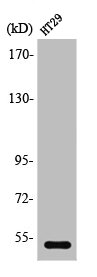
Synthesized peptide derived from the N-terminal region of Human SR-2B.
Immunogen Species
Homo sapiens (Human)
Conjugate
Non-conjugated
Isotype
IgG
Purification Method
The antibody was affinity-purified from rabbit antiserum by affinity-chromatography using epitope-specific immunogen.
Concentration
It differs from different batches. Please contact us to confirm it.
Buffer
Liquid in PBS containing 50% glycerol, 0.5% BSA and 0.02% sodium azide.
Tested Applications
WB, IF, ELISA
Storage
Upon receipt, store at -20°C or -80°C. Avoid repeated freeze.
Lead Time
Basically, we can dispatch the products out in 1-3 working days after receiving your orders. Delivery time maybe differs from different purchasing way or location, please kindly consult your local distributors for specific delivery time.
Usage
For Research Use Only. Not for use in diagnostic or therapeutic procedures.
G-protein coupled receptor for 5-hydroxytryptamine (serotonin). Also functions as a receptor for various ergot alkaloid derivatives and psychoactive substances. Ligand binding causes a conformation change that triggers signaling via guanine nucleotide-binding proteins (G proteins) and modulates the activity of down-stream effectors. Beta-arrestin family members inhibit signaling via G proteins and mediate activation of alternative signaling pathways. Signaling activates a phosphatidylinositol-calcium second messenger system that modulates the activity of phosphatidylinositol 3-kinase and down-stream signaling cascades and promotes the release of Ca(2+) ions from intracellular stores. Plays a role in the regulation of dopamine and 5-hydroxytryptamine release, 5-hydroxytryptamine uptake and in the regulation of extracellular dopamine and 5-hydroxytryptamine levels, and thereby affects neural activity. May play a role in the perception of pain. Plays a role in the regulation of behavior, including impulsive behavior. Required for normal proliferation of embryonic cardiac myocytes and normal heart development. Protects cardiomyocytes against apoptosis. Plays a role in the adaptation of pulmonary arteries to chronic hypoxia. Plays a role in vasoconstriction. Required for normal osteoblast function and proliferation, and for maintaining normal bone density. Required for normal proliferation of the interstitial cells of Cajal in the intestine.
Gene References into Functions
The biological role of 5-HT2B which may act not only as a neurotransmitter receptor.PMID:29379077
The 3.0-A resolution structure of a complex between the human 5-hydroxytryptamine 2B (5-HT2B) receptor and an antibody Fab fragment bound to the extracellular side of the receptor reveals the mechanism of selectivity in extracellular recognition of the receptor by monoclonal antibodies.PMID:28716900
MFSD2B, CCL20 and STAT1, or STARD7 and ZNF512 genes may be risk or protect factors in prognosis of ADC; HTR2B, DPP4, and TGFBRAP1 genes may be risk factors in prognosis of SQC.PMID:27301951
The HTR2B Q20* allele and testosterone predicted lower BMI independently, but an interaction between HTR2B Q20* and testosterone lead to increased insulin sensitivity among HTR2B Q20* carriers with low testosterone levels.PMID:27420381
Study describes the crystal structure of Lysergic acid diethylamide (LSD) in complex with the human serotonin receptor 5-HT2B. The complex reveals conformational rearrangements to accommodate LSD, providing a structural explanation for the conformational selectivity of LSD's key diethylamide moiety.PMID:28129538
The 5-HT2B receptor may contribute to the regulation of human glucagon and glucose homeostasis and the interplay between glucagon and insulin secretion.PMID:27437919
Authors hypothesize that HTR2B expression in the infarcted territory may render degenerating neurons susceptible to attack by activated microglia and thus aggravate the consequences of stroke.PMID:27013593
Activation of 5-HT2B receptors stimulates GSIS in beta cells by triggering downstream changes in cellular Ca(2+) flux that enhance mitochondrial metabolism.PMID:26733006
the 5-HT2B receptor limits degeneration of spinal cord mononuclear phagocytes, most likely microglia, and slows disease progression in amyotrophic lateral sclerosisPMID:26744351
Studies have found that the HTR2B Q20* connected with impulsive behavior and cognitive impulsivity.PMID:26575222
Data indicate that hydrogen bonding interactions with Ser3.36 and Thr3.37 were important for isoflurane binding with the 5HT2B receptor.PMID:24365264
results of the present study suggest that the HTR2B polymorphism is not likely to be associated with personality traits, including novelty seeking and impulsivity.PMID:23774082
a new and unanticipated role of the 5-HT2B receptor N terminus as a negative modulator, affecting both constitutive and agonist-stimulated activity.PMID:24174497
study determined the crystal structure of the 5-HT2B receptor bound to ergotamine (ERG) and compared it with the 5-HT1B/ERG structurePMID:23519215
Serotonin skews human macrophage polarization through HTR2B and HTR7.PMID:23355731
The HTR2B gene may play little or no role in the development of Tourette syndrome.PMID:22917605
Genetic variants in HTR2B and TPH1 were not associated with the risk of GDM.PMID:21836641
Study confirms expression of transgenic 5-HT2b receptors in astrocytes freshly dissociated from mouse brain, isolated by fluorescence-activated cell sorting (FACS) and investigated in cultured cells.PMID:20846463
indicates a role for HTR2B in impulsivityPMID:21179162
The 5-HT(2B) receptor plays a key regulatory role in both neuroendocrine tumor cell proliferation and the modulation of the fibroblast component of the neoplastic microenvironmentPMID:20564397
The serotonin binding site of human and murine 5-HT2B receptors: molecular modeling and site-directed mutagenesis.PMID:11859080
the excitatory effects of 5-HT in human colon are mediated by 5-HT(2B) receptors. 5-HT(2B) receptors contribute to the putative 5-HT-induced colonic smooth muscle hypersensitivity associated with irritable bowel syndrome.PMID:11877320
5-HT2B single nucleotide polymorphisms have significant association with substance-related disorders.PMID:15608559
Interactions between AT(1) and 5-HT(2B) receptors coexpressed by noncardiomyocytes are limiting key events in adrenergic agonist-induced, angiotensin-dependent cardiac hypertrophy.PMID:19023134
Ubiquitous. Detected in liver, kidney, heart, pulmonary artery, and intestine. Detected at lower levels in blood, placenta and brain, especially in cerebellum, occipital cortex and frontal cortex.