Recombinant Human Histone deacetylase 11 protein (1-347AA)
Immunogen Species
Homo sapiens (Human)
Conjugate
Non-conjugated
Isotype
IgG
Purification Method
Antigen Affinity Purified
Concentration
It differs from different batches. Please contact us to confirm it.
Buffer
PBS with 0.02% sodium azide, 50% glycerol, pH7.3.
Tested Applications
ELISA, WB, IHC
Recommended Dilution
Application
Recommended Dilution
WB
1:200-1:1000
IHC
1:20-1:200
Storage
Upon receipt, store at -20°C or -80°C. Avoid repeated freeze.
Lead Time
Basically, we can dispatch the products out in 1-3 working days after receiving your orders. Delivery time maybe differs from different purchasing way or location, please kindly consult your local distributors for specific delivery time.
Note: All of our proteins are default shipped with normal blue ice packs, if you request to ship with dry ice, please communicate with us in advance and extra fees will be charged.
Usage
For Research Use Only. Not for use in diagnostic or therapeutic procedures.
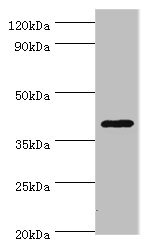
Western blot
All lanes: HDAC11 antibody at 2μg/ml + Mouse brain tissue
Secondary
Goat polyclonal to rabbit IgG at 1/10000 dilution
Predicted band size: 40, 34 kDa
Observed band size: 40 kDa
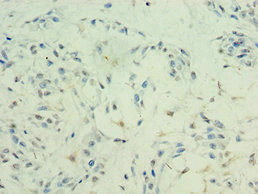
Immunohistochemistry of paraffin-embedded human breast cancer using CSB-PA010237ESR1HU at dilution of 1:100

Responsible for the deacetylation of lysine residues on the N-terminal part of the core histones (H2A, H2B, H3 and H4). Histone deacetylation gives a tag for epigenetic repression and plays an important role in transcriptional regulation, cell cycle progression and developmental events. Histone deacetylases act via the formation of large multiprotein complexes.
Gene References into Functions
The results indicated that HDAC11 was significantly expressed in human and mouse diabetic heart failure (DHF) hearts.PMID:29655790
Mycobacterium tuberculosis infection disturbs the HDAC6/HDAC11 levels to induce IL-10 expression in macrophages.PMID:29523311
HDAC11 was initially identified as a negative regulator of the well-known anti-inflammatory cytokine IL-10. Hence, antagonizing HDAC11 activity may have anti-tumor potential, whereas activating HDAC11 may be useful to treat chronic inflammation or autoimmunity.PMID:29222071
Results showed that the high levels of HDAC11 and lower levels of p53 were detected in pituitary tumor cells. A negative correlation was detected between the data of HDAC11 and p53.PMID:28782861
Our study identified a group of cell cycle-promoting genes regulated by HDAC11.PMID:28252645
High HDAC11 expression is associated with neoplasms.PMID:23024001
Data indicate a pronounced deregulation of HDAC genes HDAC9 and HDAC11 in patients with Philadelphia-negative chronic myeloproliferative neoplasms: essential thrombocythemia (ET), polycythemia vera (PV) and primary myelofibrosis (PMF).PMID:21806350
These results demonstrate for the first time that HDAC11 plays an essential role in regulating OX40L expression.PMID:21239696
HDAC11 associates with replication origins inhibits Cdt1-induced re-replication and suppresses MCM loading.PMID:20980834
We found a reduction of HDAC 11 mRNA and increased HDAC 2 levels in amyotrophic lateral sclerosis brain and spinal cord compared with controls.PMID:20467334
cloning and functional characterizationPMID:11948178
Fluorescence in situ hybridization analysis localized HDAC11 gene to chromosome 3p25, a region characterized by frequent gains and losses of chromosomal material in a number of various types of cancer.PMID:16142391
the absence of tumour-specific somatic events in WNT7A and HDAC11 suggests that these genes are unlikely to have a classical tumour suppressor gene role in sporadic malignant pancreatic endocrine tumoursPMID:17201809
HDAC11 negatively regulated expression of the gene encoding interleukin 10 in antigen-presenting cells.PMID:19011628
Cdt1 undergoes acetylation and is reversibly deacetylated by HDAC11PMID:19276081
Show
More
Hide
All
Subcellular Location
Nucleus. Note=Predominantly nuclear.
Protein Families
Histone deacetylase family
Tissue Specificity
Weakly expressed in most tissues. Strongly expressed in brain, heart, skeletal muscle, kidney and testis.