It differs from different batches. Please contact us to confirm it.
Buffer
-20°C, pH7.4 PBS, 0.05% NaN3, 40% Glycerol
Tested Applications
ELISA,IHC
Storage
Upon receipt, store at -20°C or -80°C. Avoid repeated freeze.
Lead Time
Basically, we can dispatch the products out in 1-3 working days after receiving your orders. Delivery time maybe differs from different purchasing way or location, please kindly consult your local distributors for specific delivery time.
Note: All of our proteins are default shipped with normal blue ice packs, if you request to ship with dry ice, please communicate with us in advance and extra fees will be charged.
Usage
For Research Use Only. Not for use in diagnostic or therapeutic procedures.
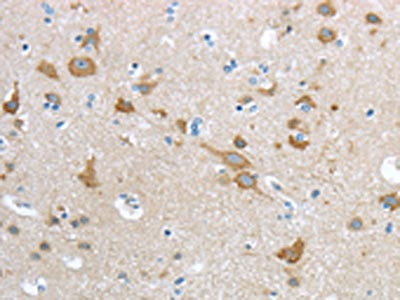
The image on the left is immunohistochemistry of paraffin-embedded Human brain tissue using CSB-PA231041(HCN4 Antibody) at dilution 1/20, on the right is treated with synthetic peptide. (Original magnification: ×200)
Hyperpolarization-activated ion channel with very slow activation and inactivation exhibiting weak selectivity for potassium over sodium ions. Contributes to the native pacemaker currents in heart (If) that regulate the rhythm of heart beat. May contribute to the native pacemaker currents in neurons (Ih). May mediate responses to sour stimuli.
Gene References into Functions
Three HCN4 mutations identified in sick sinus syndrome patients caused loss of function in vitro. Loss of function may have resulted from significantly reduced functional HCN4 channel availability and cell surface expression due to defective trafficking.PMID:30196304
These findings indicate that HCN4(G811E) may not be a monogenic factor to cause the cardiac disorders.PMID:29349559
We here report on multiple families harboring HCN4 mutations, who show significant dilation of the aorta ascendensPMID:27173043
A novel splice site HCN4 gene mutation was identified in a large family with familial bradycardia.PMID:28465117
Sick sinus syndrome (SSS) with HCN4 mutations may form a distinct SSS subgroup characterized by early clinical manifestation after adolescence and frequent association with atrial fibrillation and left ventricular noncompaction.PMID:28104484
This study has identified 4 synonymous variants in the HCN4 gene and 3 SNPs in the CYP3A4 gene. None of the variants appear to have a major effect on the reduction of HR produced by ivabradine.PMID:27439367
HCN4 channel remodeling following exercise and subsequent sinus bradycardia in athletes is controlled by miR-423-5p.PMID:28821541
Our results indicate that HCN4 channel function is modulated by cav-3. LQTS-associated mutations of cav-3 differentially influence pacemaker current properties indicating a pathophysiological role in clinical manifestations.PMID:28648120
Identified in Brugada syndrome patient HCN4 mutation results in reduced channel function in HEK293 cells.PMID:27553229
S672R mutation results in a constitutive shift of the dynamic auto-inhibitory equilibrium toward inactive states of HCN4 and broadens the free-energy well of the apo-form, enhancing the millisecond to microsecond dynamics of the holo-form at sites critical for gating cAMP binding.PMID:28174302
Our results confirm the genetic evidence for the involvement of the HCN4 mutations in the combined bradycardia-non compaction cardiomyopathy phenotype and illustrates that.PMID:26206080
Aged patients with sinus rhythm exhibited significantly higher expression levels of HCN2 and HCN4 channel mRNA and protein (P<0.05), but significantly lower expression levels of miR1 and 133, compared with those of adult patients with sinus rhythm.PMID:26005035
study establishes the role of f-channels in cardiac automaticity and indicates that arrhythmia related to HCN loss-of-function may be managed by pharmacological or genetic inhibition of GIRK4 channelsPMID:25144323
The study analyzed HCN4 intracellular region dynamics in the four states of the thermodynamic cycle arising from the coupling between cAMP binding and tetramerization equilibria.PMID:25944904
study identified a novel trafficking-defective mutation in the amino-terminus of HCN4 channel in individuals with early-onset atrial fibrillation (AF); findings support that novel loss-of-function mutations in the HCN4 channel may increase susceptibility and have a role in AF pathogenesisPMID:24607718
used NMR to probe the changes caused by the binding of cAMP and of cCMP, a partial agonist, to the apo-cAMP-binding domain of HCN4PMID:24878962
Here, we review the changes in expression and kinetics of HCN4 mutant channels and provide an overview of their effects on If during the time course of a human SAN action potential, both under resting conditions and upon adrenergic stimulation. [review]PMID:24569893
The HCN4-G1097W mutant channels displayed a loss-of-function type modulation on cardiac If channels and thus could predispose them to AV nodal dysfunction. These data provide a novel insight into the genetic basis for the AV block.PMID:24492017
Mutations in ion channel gene HCN4 may be associated with structural abnormalities of the myocardium.PMID:25145517
The symptom complex of sinus node dysfunction and noncompaction cardiomyopathy is associated with heritable HCN4 defects.PMID:25145518
The HCN4 channels generate currents with reduced amplitude, while the kinetics of activation and deactivation are not altered.PMID:23075627
data show a developmental change in HCN4-Cav3 association in human embryonic stem cell-derived cardiomyocytesPMID:23311301
Cardiomyogenic progenitors derived from the first heart field and human pluripotent stem cells express HCN4.PMID:23974038
Genetic alterations in ion channels that regulate cardiac rhythms may account for some cases of SIDS, as demonstrated by this report of 2 potentially pathogenic novel or rare variants in the HCN4 gene.PMID:23623143
Structural and functional description of the disease causing mutation in human HCN4.PMID:23103389
hHCN4 hysteresis potentially plays a crucial role in human sinoatrial node pacemaking activity.PMID:20179882
Anti-HCN4 antibodies in the brain might contribute to the pathogenesis of tic symptoms in Tourette's syndrome patients.PMID:22683190
Data show that beta(2)-adrenergic receptors beta(2)ARs form protein complexes with the HCN4 channel, as well as with other subtypes of HCN channels.PMID:22613709
Genetic analysis in 48 Sudden unexpected death in epilepsy cases identified six novel and three previously reported nonsynonymous (amino acid changing) variants in HCN1 , HCN2, HCN3 and HCN4.PMID:21615589
A novel mutation is found in HCN4 gene causing symptoms of sinus bradycardia in unrelated male Moroccan Jews.PMID:20662977
These findings suggest HCN4 as a genetic susceptibility factor for mood and anxiety disordersPMID:21529705
HCN4 channels are expressed in different patterns in brain and heart; the N terminus is important for HCN4 channel activationPMID:21372143
Higher HCN4 mRNA levels in the hypertrophic cardiomyopathy hearts suggest that up-regulation of HCN4 gene expression might be responsible for ventricular arrhythmia that leads to sudden death.PMID:20207172
In this review, we focus on genotype-phenotype correlation of HCN4 mutations and discuss the relative contribution of various ion channels to sinus node function.PMID:19796353
The HCN4 channel played a preventive role in triggering bradycardia-induced ventricular arrhythmias.PMID:19165230
HCN4 activates substantially slower than HCN2 and with a half-maximum activation voltage approximately equal 10 mV less negative, both isoforms activate more positively in myocytes suggesting cell-type specificityPMID:12194012
A heterozygous 1-bp deletion (1631delC) in exon 5 of the human HCN4 gene was detected in a patient with idiopathic sinus bradycardia and chronotropic incompetencePMID:12750403
the speed of activation of the HCN4 channel is determined by structural elements present in the S1, S1-S2 linker, and the S2 segmentPMID:12813043
co-expressed KCNE2 enhanced HCN4-generated current amplitudes, slowed the activation kinetics and shifted the voltage for half-maximal activation of currents to more negative voltagesPMID:12856183
Data suggest that the loss of function of HCN4 is associated with sinus nodal dysfunction.PMID:15123648
Native I(f) channels in atrial myocardium are heteromeric complexes composed of HCN4 and/or HCN2.PMID:15687126
Sinus bradycardia in members of a large family was associated with a mutation in the gene coding for the pacemaker HCN4 ion channel.PMID:16407510
With computer modelling, we show that in channels with relatively slow opening kinetics and fast mode-shift transitions, such as HCN2 and HCN4 channels, the mode shift effects are not readily observable, except in the tail kinetics.PMID:16777944
A missense mutation, G480R, in the ion channel pore domain caused sinus node dysfunction. Mutant HCN4 had reduced synthesis, was activated at more negative voltages, & had defective ion trafficking.PMID:17646576
Src tyrosine kinase enhances HCN4 currents by shifting their activation to more positive potentials and increasing the whole cell channel conductance as well as speeding the channel kinetics. Tyr(531) mediates most of Src's actions on HCN4 channels.PMID:17977941
HCN4 associates with Cav3 to form a HCN4 macromolecular complex. Our results also indicated that disruption of caveolae using P104L alters HCN4 function and could cause a reduction of cardiac pacemaker activity.PMID:19238754
These data reveal the pathophysiologic mechanism of hHCN4-573X-linked sinoatrial node dysfunction in humans.PMID:19570998
novel mechanism using three endogenous Src kinases to rescue a trafficking defective HCN4 mutant channel (D553N) by enhancing the tyrosine phosphorylation of the mutant channel protein.PMID:19748888
A mouse model for a loss-of-function study of HCN4, which has a strong implication for the function of the related human protein.PMID:14657344
The rat HCN1 and HCN4 were shown to mediate responses to sour stimuli, suggesting a potential new function for the related human proteins.PMID:11675786
Show
More
Hide
All
Subcellular Location
Cell membrane; Multi-pass membrane protein.
Protein Families
Potassium channel HCN family
Tissue Specificity
Highly expressed in thalamus, testis and in heart, both in ventricle and atrium. Detected at much lower levels in amygdala, substantia nigra, cerebellum and hippocampus.